
8 February 2026 The Future is the Product of the Past

Nearly 20,000 Silver Coins Discovered During Restoration of Historic Merchant House in Moscow

A sensational archaeological discovery in Moscow reveals 20,000 silver coins hidden inside the historic house of merchant Averky Kirillov, shedding new light on trade, wealth, and uncertainty during the turbulent turn of the 16th–17th centuries.

A remarkable archaeological discovery has come to light in the heart of Moscow during restoration work on a historic building along the Bersenevskaya Embankment. Thousands of silver coins were uncovered inside the residential chambers of the famous merchant Averky Kirillov, offering new insights into trade, wealth, and political uncertainty at the turn of the 16th–17th centuries.

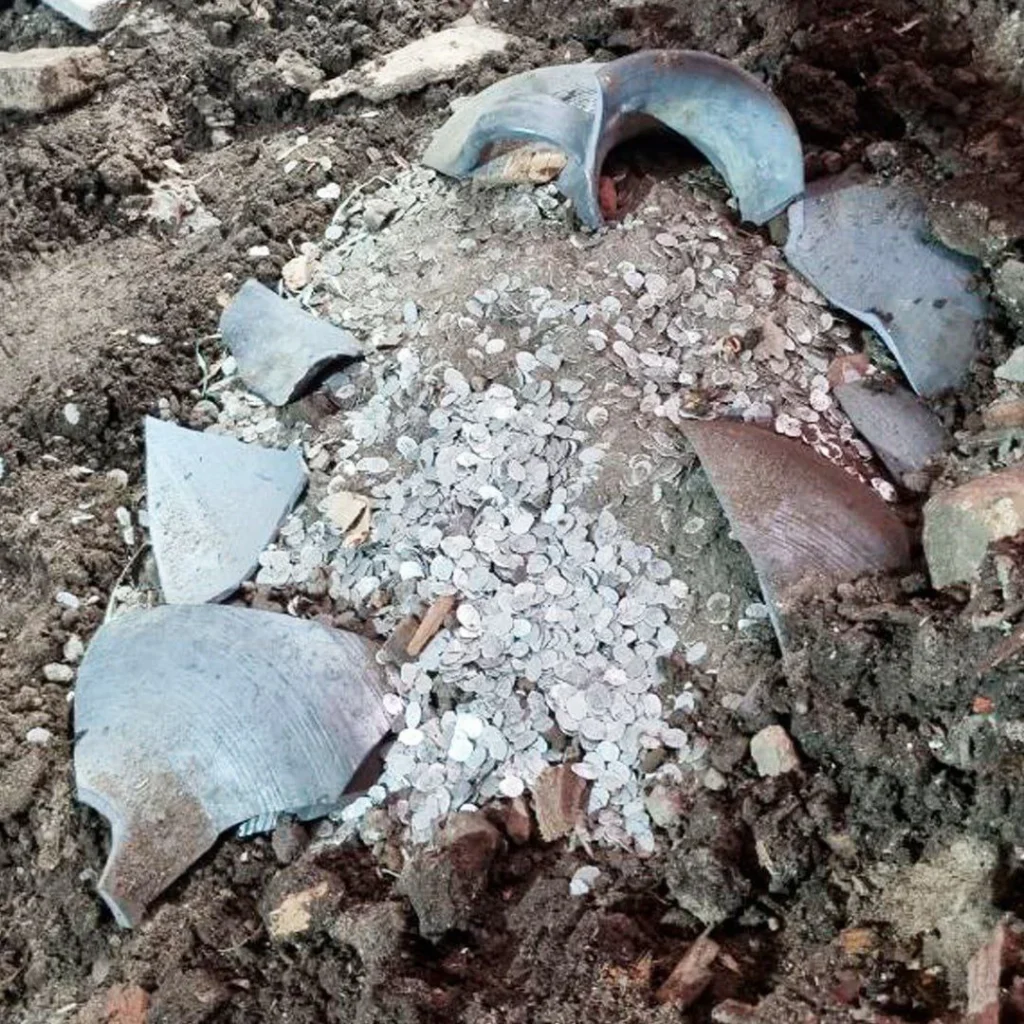
The find was announced by Russia’s Minister of Culture, Olga Lyubimova, who described the hoard as one of the most significant monetary discoveries in recent years. According to preliminary estimates, the treasure contains nearly 20,000 silver coins, carefully hidden inside a ceramic vessel and concealed on the second floor of the merchant’s residence.

Who Was Averky Kirillov?

Averky Kirillov was a prominent Moscow merchant whose stone chambers, built in the late 17th century, remain an important architectural monument today. Merchants like Kirillov played a crucial role in Russia’s economic life, acting as intermediaries between regional producers, foreign traders, and the state.

Averky Kirillov was not only a wealthy merchant but also an influential official. He owned salt mining enterprises and oversaw trade, finance, and taxation in the region. The stone chambers he commissioned reflected his status, featuring richly decorated window trims, elegant half-columns, pilasters, and cornices.


📣 Our WhatsApp channel is now LIVE! Stay up-to-date with the latest news and updates, just click here to follow us on WhatsApp and never miss a thing!!


Contemporary accounts suggest that overseas visitors were often impressed by the house’s magnificent facade, the lush courtyard with a garden, and the lavishly furnished interior, which demonstrated the prosperity and taste of one of Moscow’s most prominent merchants.

The discovery of such a vast hoard inside a private residence suggests not only personal wealth, but also the strategic importance of safeguarding assets during times of instability. Kirillov’s house, located close to the Kremlin and major trade routes along the Moscow River, would have been an ideal place to store valuables discreetly.
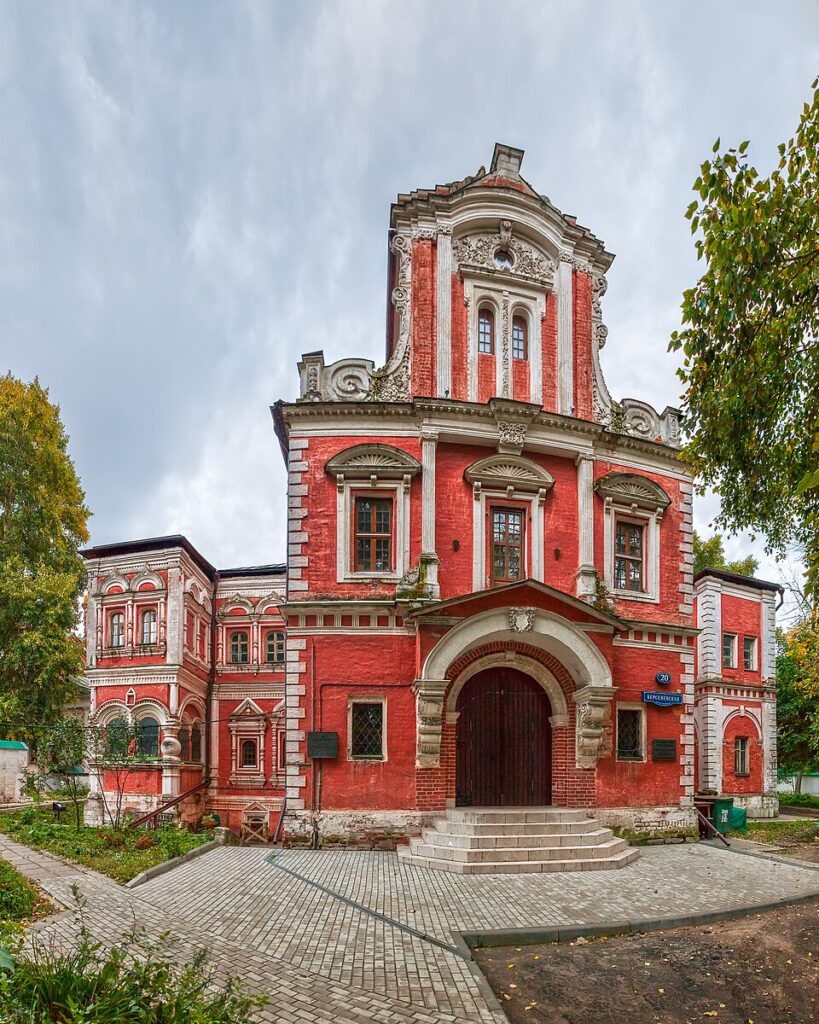
Averky Kirillov Chambers: It is believed that a wooden house stood on the site as early as the 15th–16th centuries. In 1656–1657, Duma deacon Averky Kirillov, who became the sole owner of the property, replaced it with a new two-story stone building, incorporating the foundations of the old wooden structure. Credit: Wikipedia Commons

Dating the Hoard: The Turn of the 16th–17th Centuries

Experts have preliminarily dated the coins to the late 1500s and early 1600s, a period marked by profound upheaval in Russian history. This era includes the end of the Rurik dynasty and the onset of the Time of Troubles, characterized by political chaos, economic disruption, and foreign intervention.

During such unstable times, hoarding silver coins was a common survival strategy. Silver served not only as currency but also as a reliable store of value when trust in political authority and monetary reforms was low.

Who Might the Coins Belong To?

Although the hoard was found in Kirillov’s chambers, historians caution against immediately assuming personal ownership. Several possibilities are being considered:

Personal savings of Averky Kirillov, accumulated through long-distance trade and commercial operations.

Collective merchant capital, temporarily stored for safekeeping during unrest.

Funds intended for trade or taxation, hidden and never retrieved due to sudden death, exile, or political events.

Similar hoards from this period often remained untouched for centuries, especially if their owners were unable to return during the chaos of the Time of Troubles.
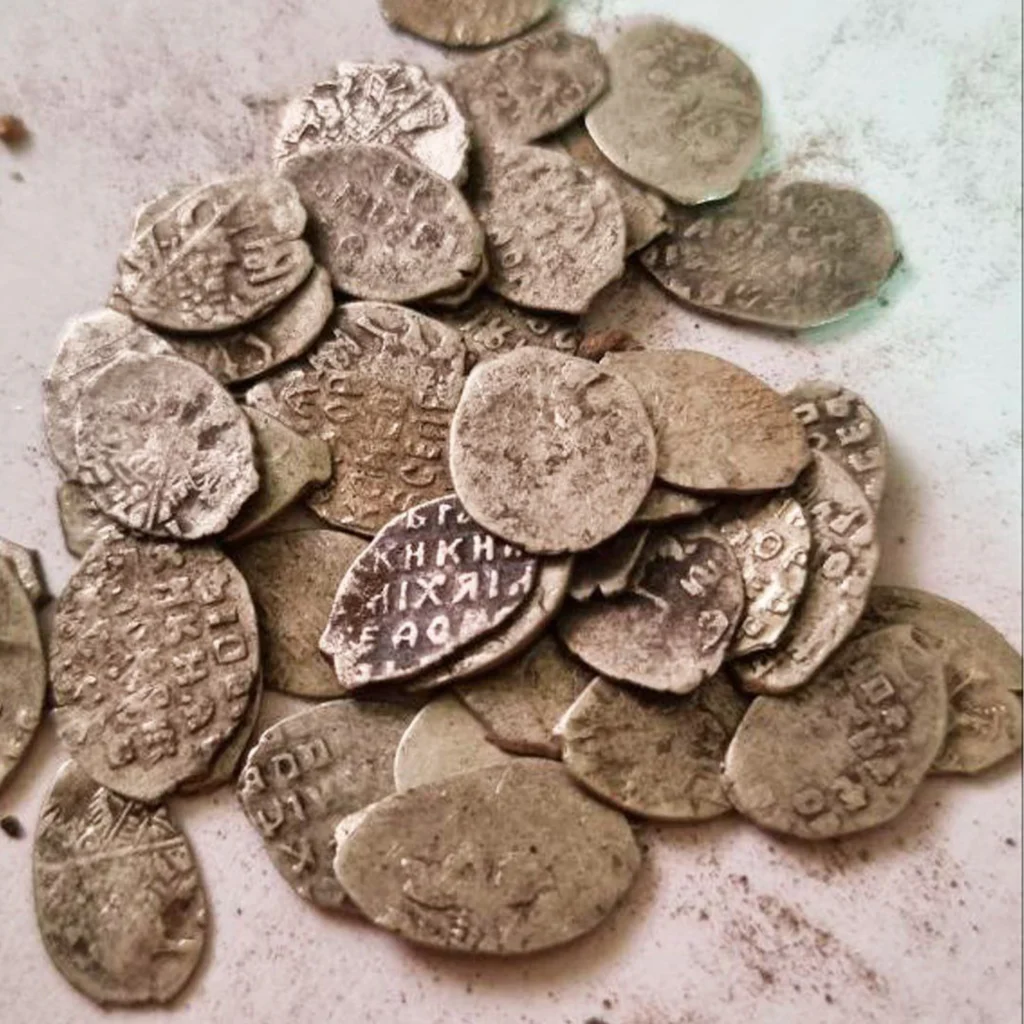
A sensational archaeological discovery in Moscow reveals 20,000 silver coins hidden inside the historic house of merchant Averky Kirillov. Credit: Olga Lyubimova Via Telegram

Numismatic Clues and Historical Parallels

While the exact inscriptions and imagery on the newly discovered coins are still under study, comparable finds provide valuable context. In 2024, specialists uncovered silver coins in the Kirillo-Belozersky Museum-Reserve bearing inscriptions such as “Grand Prince Ivan” and “Grand Prince Dmitry,” as well as images of Saint George the Victorious.

Such markings are typical of silver kopeks minted during periods of contested authority, when multiple rulers or claimants issued currency simultaneously. (A kopek is a small Russian silver coin that was used as a basic unit of currency in the 16th and 17th centuries: 100 kopeks are worth 1 ruble or 1 hryvnia.) If similar inscriptions appear on the Bersenevskaya hoard, they could help pinpoint the exact political moment when the coins were hidden.

Scientific Study and Preservation

The Ministry of Culture has confirmed that the hoard will be thoroughly studied, catalogued, and preserved for Russian science. Specialists will determine the precise number, composition, and value of the coins, using modern conservation and analytical techniques.

Beyond monetary worth, the discovery offers historians a rare snapshot of urban life, merchant behavior, and economic strategies during one of Russia’s most turbulent eras.
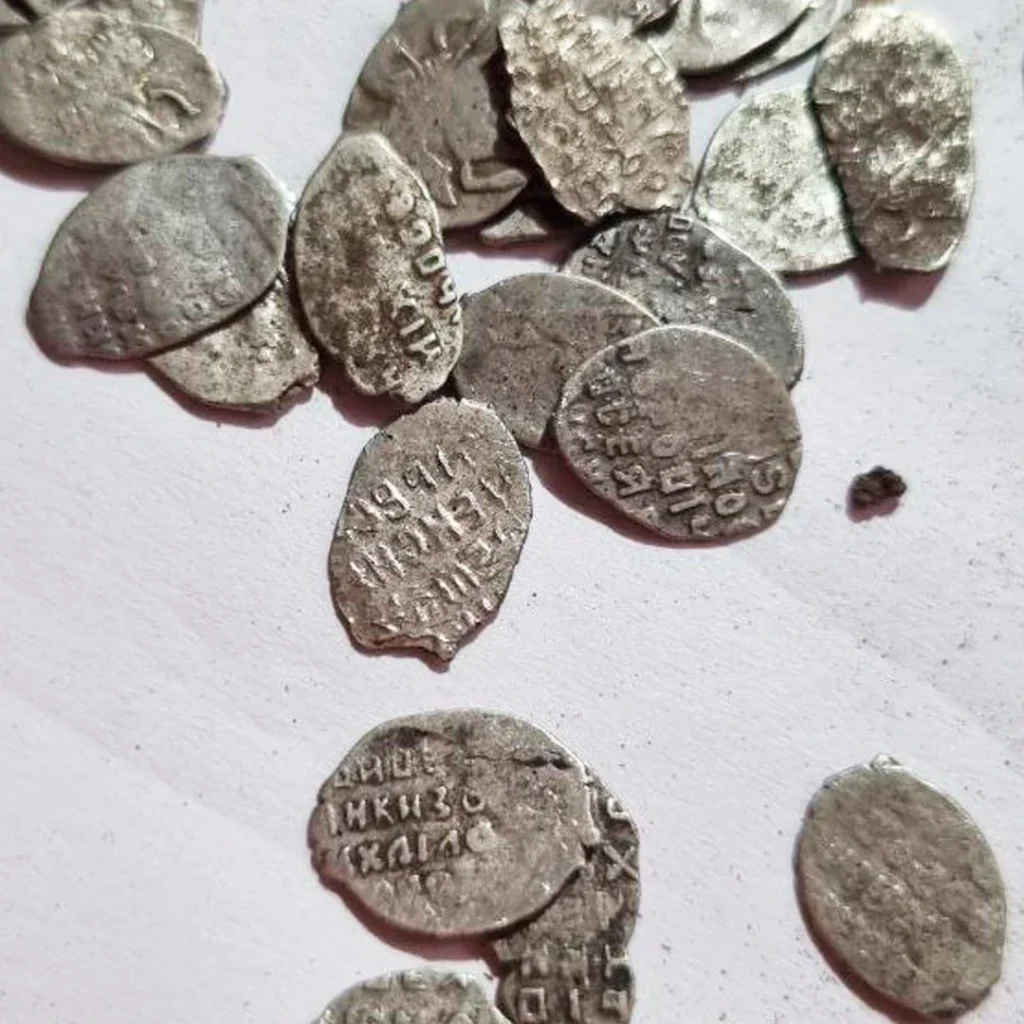
A sensational archaeological discovery in Moscow reveals 20,000 silver coins hidden inside the historic house of merchant Averky Kirillov. Credit: Olga Lyubimova Via Telegram

A Window Into the Past

This extraordinary find transforms a historic building into a tangible link with Moscow’s past. The silver coins hidden centuries ago now tell a story of caution, wealth, and uncertainty—reminding us that even in stone chambers overlooking the river, history was shaped by decisions made in times of fear and hope.

Olga Lyubimova Via Telegram

Cover Image Credit: Olga Lyubimova Via Telegram

Related Articles

A New Late Ancient Necropolis Discovered on Hvar Island

10 June 2021

10 June 2021

The protective investigation in the garden of the Radoevi Palace in the town of Hvar on the Croatian island of...

Ancient Roman 3rd-century defensive wall found in Germany

24 March 2024

24 March 2024

An exciting archaeological discovery was made during construction work in Aachen’s city center, Germany. At the corner of Pontstrasse and...

3,000-Year-Old Twisted Gold Torc Discovered in Essex, southeast England

16 July 2023

16 July 2023

A metal detectorist has discovered a 3,000-year-old part of a twisted gold torc in a field near Mistley, on the...

Archaeologists Uncovered a Unique Ancient Roman Winery with Marble Tiling and Fountains of Grape Juice

17 April 2023

17 April 2023

Archaeologists have uncovered a unique ancient Roman winery at the luxurious Villa of the Quintilii, just to the south of...

Baptismal font from the Ottonian period discovered: Oldest evidence of a quatrefoil-shaped basin north of the Alps

19 March 2024

19 March 2024

The site of a font of the medieval Ottonian dynasty, from the tenth century, has been discovered in the crypt...

Puzzling rings may be finger loops from prehistoric weapon systems

24 May 2023

24 May 2023

When many researchers looked at an astonishing group of artifacts discovered at French archaeological sites, they presumed they were ornaments...

Scientists Uncover 22,000-Year-Old Evidence of Prehistoric Transport

9 March 2025

9 March 2025

In a remarkable glimpse into the ingenuity of our early ancestors, recent research reveals that 22,000 years ago, humans may...

Cave paintings discovered in western Turkey carry the region’s past back to prehistory

18 December 2021

18 December 2021

During the archaeological survey carried out in and around the ancient city of Alinda in Aydın province in western Turkey,...

Roman boat that sank in Mediterranean 1,700 years ago is giving up its archaeological, historical, and gastronomic secrets

8 March 2022

8 March 2022

The merchant vessel, probably at anchor in the Bay of Palma while en route from south-west Spain to Italy, One...

8,500-Year-Old Mirror Unearthed at Canhasan in Central Türkiye

29 November 2025

29 November 2025

An 8,500-year-old obsidian mirror has been unearthed at Canhasan in central Türkiye, revealing new insights into early Neolithic craftsmanship and...

4,900-year-old Copper Age Fortress with a Violent Past and Odd Roman Burial Found in Spain

13 February 2025

13 February 2025

A remarkable 4,900-year-old Copper Age fortress, featuring a pentagon shape, three concentric walls, 25 bastions, and three ditches, has been...

Britain’s First Discovery of Its Kind: A 2,000-Year-Old Carnyx and Boar Standard Unearthed in Norfolk

7 January 2026

7 January 2026

A groundbreaking archaeological discovery in Norfolk has revealed one of the most complete Iron Age war trumpets ever found in...

Secrets of the Ancient Walls: 1,700-Year-Old Roman Altar Unearthed at Vuçak Castle in Kosovo

19 April 2025

19 April 2025

Excavations at Vuçak Castle in the Kosovo countryside have led to a remarkable discovery: a Roman altar dating back to...

12,000-Year-Old Rock Carvings Discovered Beneath Waters of Atatürk Dam in Türkiye

22 October 2025

22 October 2025

Archaeologists and museum officials in Adıyaman, southeastern Türkiye, have captured underwater images of rock carvings estimated to be 12,000 years...

Ancient Baekje Tombs in Korea Unearth Gold Ornaments and Pottery Treasures

31 August 2025

31 August 2025

A major archaeological discovery has been made in Jeongeup, South Korea, where the Eunsun-ri and Dogye-ri tomb clusters have yielded...

Comments
Leave a Reply

Your email address will not be published. Required fields are marked *