
6 November 2025 The Future is the Product of the Past

5,000-Year-Old Matrilineal Society Discovered in China: DNA Unveils Ancient Female-Led Clans

In a remarkable study, scientists have uncovered genetic evidence of a rare matrilineal society in Neolithic China, where women determined lineage, inheritance, and burial traditions over 5,000 years ago.

Published in Nature on July 31, 2025, the study used ancient DNA analysis to explore the burial patterns and kinship structures of individuals at the Fujia archaeological site in Shandong province, revealing that the community was organized around maternal lineage—a finding that challenges long-held assumptions about early human societies being predominantly patrilineal.

The research team, led by scholars from Peking University and the Shandong Institute of Cultural Relics and Archaeology, analyzed the remains of 60 individuals from two distinct cemeteries—Fujia_North and Fujia_South—dating from approximately 2750 to 2500 BCE. The genomic data showed that each cemetery was dominated by a single, distinct mitochondrial DNA haplogroup, suggesting that the two burial grounds corresponded to two separate maternal clans.

“This is the most compelling evidence to date for a matrilineal society in East Asia during the Neolithic period,” said Dr. Bo Sun, co-author of the study. “The entire community appears to have been structured around maternal descent, with burial practices strictly aligned to a person’s mother’s lineage.”
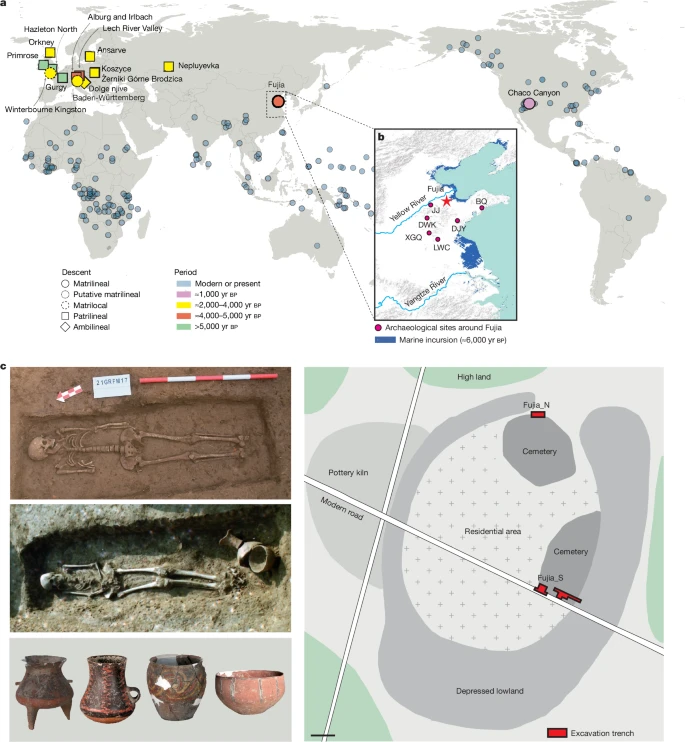
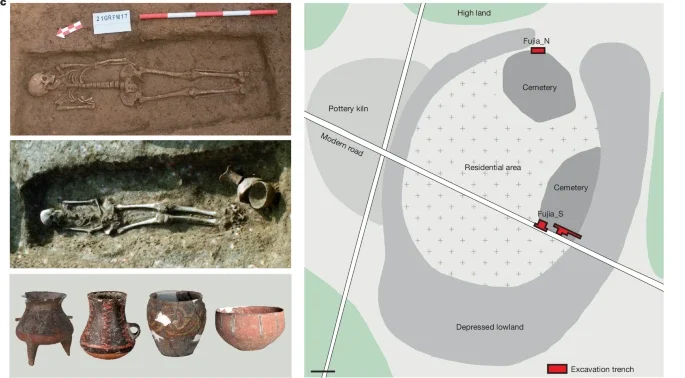
Map showing the Fujia archaeological site in eastern China and its relationship to both ancient and modern populations associated with the region. Credit: Wang et al., 2025, Nature

Genetic Evidence Reveals Strong Maternal Clans

All 14 individuals in the northern cemetery (Fujia_N) carried the mitochondrial haplogroup M8a3, while 44 of the 46 individuals in the southern cemetery (Fujia_S) carried haplogroup D5b1b. Interestingly, Y-chromosome analysis—which traces paternal lineage—showed high diversity among male individuals, indicating that men from various backgrounds had married into these maternal clans.


📣 Our WhatsApp channel is now LIVE! Stay up-to-date with the latest news and updates, just click here to follow us on WhatsApp and never miss a thing!!


This contrasting pattern—low mtDNA diversity and high Y-chromosome diversity—suggests matrilocal residence patterns, where men moved to live with their wives’ families. Such social structures are exceedingly rare in modern East Asia but are still practiced by a few ethnic groups such as the Mosuo in southwestern China.

“This is a textbook example of a matrilineal and matrilocal kinship system in prehistory,” added Dr. Yuhong Pang. “It offers us a unique view of how early agrarian communities could organize social life without patriarchal dominance.”

Stable Society with Strong Endogamy and Limited Mobility

Further analysis using radiocarbon dating and Bayesian modeling revealed that the two cemeteries were in use for over 250 years—spanning at least 10 generations. This longevity indicates remarkable social stability.

The community also practiced high endogamy, with little evidence of genetic input from outsiders. Runs of homozygosity (ROH) in the DNA showed repeated mating within a small gene pool, though not necessarily involving close relatives. The strontium isotope data confirmed that most individuals lived and died locally, pointing to low residential mobility and a geographically cohesive population.
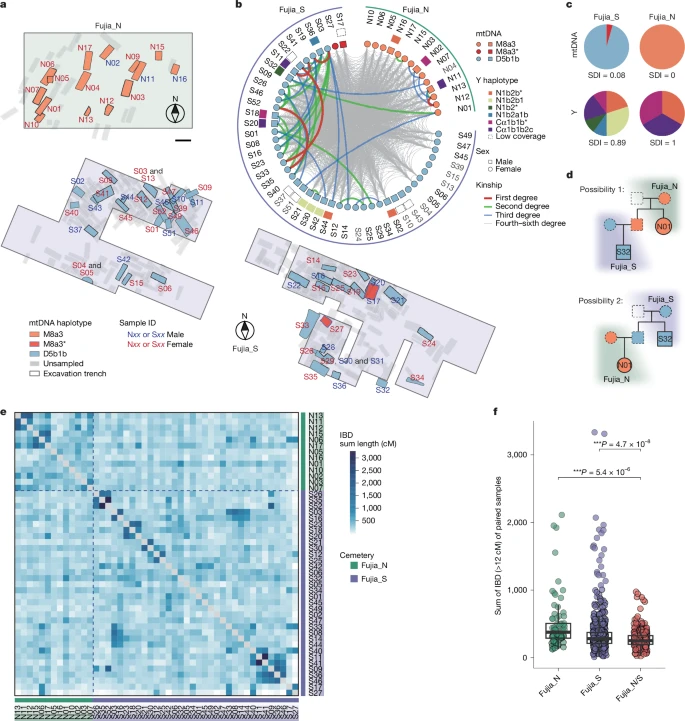
Genetic structure and kinship patterns among individuals at the Fujia site. Visualizations show burial positions, mtDNA/Y-chromosome haplotypes, and degrees of genetic relatedness between members of two distinct maternal clans. Credit: Wang et al., 2025, Nature

Millet Farming and Coastal Living in Neolithic China

The Fujia people were early millet farmers living near the Bohai Sea. Isotopic evidence from human bones and dentine suggests a diet rich in C4 plants like millet and millet-fed animals. Nitrogen values also hint at some intake of marine and freshwater resources, aligning with the site’s coastal location.

Archaeological findings such as painted pottery, residential areas, and kilns reinforce that Fujia was a well-established Neolithic settlement with communal organization and shared cultural practices.

Challenging Long-Held Assumptions About Human History

For decades, the dominant narrative in anthropology has emphasized patrilineal descent systems in early civilizations, supported by prior genomic studies from Neolithic Europe and the Near East. The Fujia discovery offers a rare counterexample, highlighting the diversity and flexibility of human social evolution.

“The idea that ancient societies must have been patriarchal is a projection of modern norms,” said Dr. Ruth Mace, a contributing anthropologist from University College London. “This research from China provides vital evidence that female-centered kinship systems were not only possible, but thriving.”
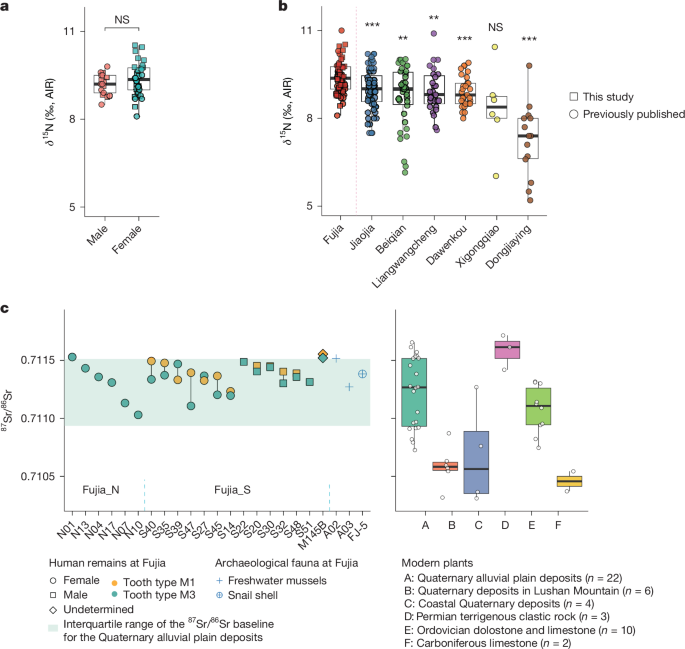
Stable isotopic analyses of the Fujia individuals.. Credit: Wang et al., 2025, Nature

Implications for Archaeology and Human Evolution

The Fujia findings help fill a significant gap in the archaeogenetic record. Until now, the only clear evidence of ancient matrilineal organization came from the Chaco Canyon elite dynasty in North America (c. 800–1300 CE). With this new evidence from East Asia, researchers can better understand the range of kinship structures that existed before the emergence of centralized states and complex hierarchies.

The study also underscores the value of combining ancient DNA, isotopic data, and traditional archaeology to reconstruct the lives of people who left no written records.

Wang, J., Yan, S., Li, Z. ve diğerleri. Antik DNA, Neolitik Çin’de iki klanlı bir anaerkil topluluğu ortaya koyuyor. Nature 643, 1304–1311 (2025). https://doi.org/10.1038/s41586-025-09103-x

Cover Image Credit: Wang et al., 2025, Nature

Related Articles

The human remains of 29 people buried as offerings in a pre-Inca temple were found at the Huaca Santa Rosa de Pucalá excavation site

23 October 2021

23 October 2021

The human remains of 29 people buried as sacrificial offerings have been discovered in a pre-Inca temple in northern Peru....

Thousand-year-old bone skate discovered in Czech Republic

20 March 2024

20 March 2024

Archaeologists from the central Moravian city of Přerov, Czech Republic have announced a unique discovery. While carrying out excavations in...

Japan’s possibly oldest stone molds for bronze casting discovered at Yoshinogari ruins

4 December 2023

4 December 2023

At the Yoshinogari Ruins in the western prefecture of Saga, relics including stone casting molds for bronze artifacts have been...

Unearthing One of the Earliest Examples of Roman Monumental Architecture: Ancient Basin Discovered in Gabii

21 October 2025

21 October 2025

Hidden beneath the soil of an ancient city just east of Rome, archaeologists from the University of Missouri have uncovered...

Prehistoric Cave Art Handprints With Missing Fingertips Point to Ritual Amputation

3 January 2024

3 January 2024

Researchers who examined prehistoric cave art in France and Spain, a new interpretation of Paleolithic cave art proposes that prehistoric...

Archaeologists uncover intact 16th-century quayside in the Belgium town of Leper

24 March 2022

24 March 2022

Excavations at Leper (Ypres), located in the West Flanders province of Belgium, have uncovered a 16th-century quayside. The find was...

Bronze Age and Roman-era settlements unearthed in Newquay

10 April 2023

10 April 2023

Archaeologists from the Cornwall Archaeological have uncovered ancient dwellings from the Bronze Age and a Roman period settlement in Newquay,...

Nearly 300-million-year-old Oldest known fossilized reptile skin found in Oklahoma cave resembles that of modern crocodiles

17 January 2024

17 January 2024

Paleontologists say they’ve identified and described the oldest fossilized reptile skin ever found. A team of paleontologists from the University...

Archaeologists have unearthed a flawless Roman blue glass bowl in the Dutch city of Nijmegen

23 January 2022

23 January 2022

Archaeologists excavating the site of a comprehensive housing and green space development in Nijmegen’s Winkelsteeg, one of the oldest cities...

Archaeologists unearth the remains of three dozen headless people at a stone age settlement in Vráble, Slovakia

25 September 2022

25 September 2022

Archaeologists have unearthed a mass grave containing the remains of about three dozen headless bodies of people at a settlement...

One of the greatest gold treasures in Danish history found in Vindelev

6 September 2021

6 September 2021

Near the town of Jelling in Denmark, one of the biggest treasures ever found dating from the sixth century has...

Around 400-year-old Bronze idols found during house construction in India

25 April 2024

25 April 2024

Three bronze idols, estimated to be about 400 years old, were unearthed during excavation for a house construction project in...

Gruesome Evidence of Prehistoric Cannibalism: Child Decapitated 850,000 Years Ago at Atapuerca

28 July 2025

28 July 2025

In a chilling archaeological discovery, researchers have uncovered direct evidence that a child was decapitated and cannibalized approximately 850,000 years...

2000-year-old anchor discovered at the bottom of the North Sea

26 September 2022

26 September 2022

A possible Iron Age anchor made from wrought iron was found at the bottom of the southern North Sea during...

Chinese Paleontologists discovered a 170-million-year-old flower

29 March 2023

29 March 2023

Chinese paleontologists discovered fossils of an ancient plant dating back approximately 170 million years. The Chinese Academy of Sciences Nanjing...