
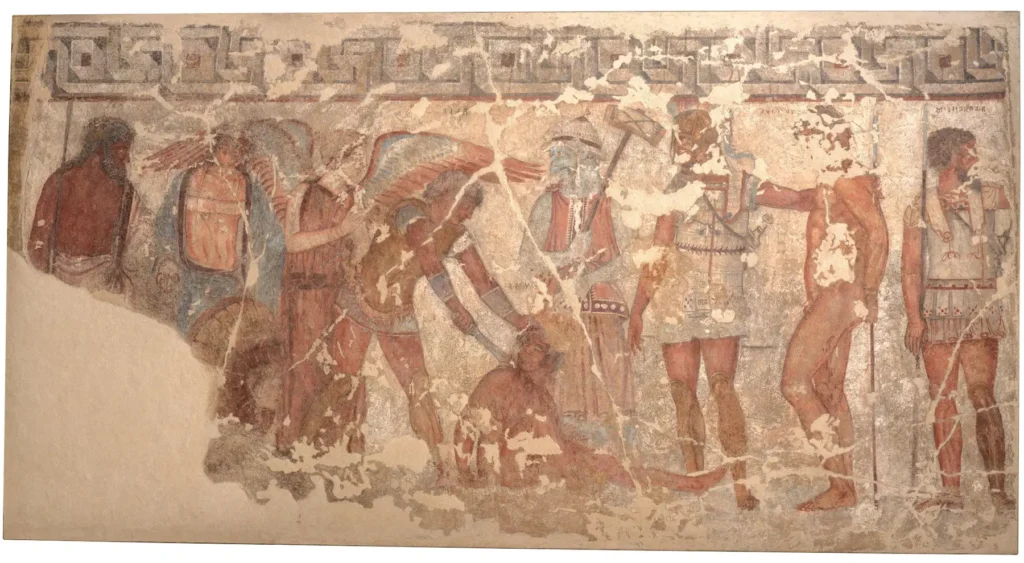
Italy has formally acquired the François Tomb of Vulci, bringing one of the most important surviving works of Etruscan painting into state ownership after more than a century of public interest in the monument.
The acquisition, announced by the Italian Ministry of Culture, secures a painted tomb cycle that holds an exceptional place in the study of ancient Italy. The frescoes preserve a rare visual narrative in which Greek myth, Etruscan political memory, and the aristocratic identity of Vulci meet on the same walls.
Under the purchase agreement signed at the Ministry of Culture in Rome, the François Tomb will become part of Italy’s national heritage and will be permanently assigned to the National Etruscan Museum of Villa Giulia. The operation is valued at €15 million.
A long-awaited return to public access
The decision closes a story that began more than 100 years ago. Italian authorities had already expressed interest in acquiring the tomb in 1921, but the painted cycle remained outside full public ownership for generations.
Culture Minister Alessandro Giuli said the state was taking ownership of one of the key masterpieces of Etruscan and ancient Mediterranean art, making it available to the public and to scientific research. The ministry said the purchase was made possible through cooperation with the heirs of the Torlonia, Sforza Cesarini, and Gaetani families, together with the Directorate General for Museums and the National Etruscan Museum of Villa Giulia.
For the public, the most immediate change will come in Rome. From June 25, the tomb cycle will be presented at Villa Giulia in a major exhibition designed to reconstruct the monument’s original setting and later collecting history.
A painted tomb from the powerful city of Vulci
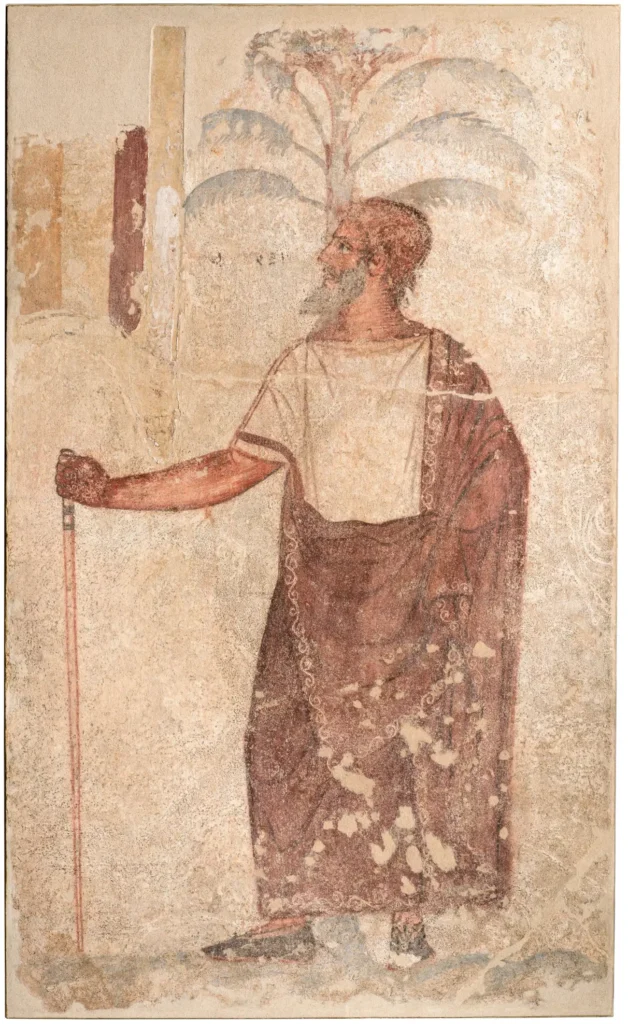
The François Tomb was discovered on May 1, 1857, by the archaeologist Alessandro François in the Ponte Rotto necropolis at Vulci, in present-day Lazio. The tomb was cut into tuff and dates to between 340 and 320 BC, when Etruscan cities were negotiating their identities in a Mediterranean world increasingly shaped by Rome.
Vulci was one of the great centers of Etruria, with wealth linked to trade, craft production, agriculture and Mediterranean networks. Like Cerveteri, Tarquinia, and Veii, it developed a funerary culture in which tombs were not only places of burial, but statements of family memory and rank.
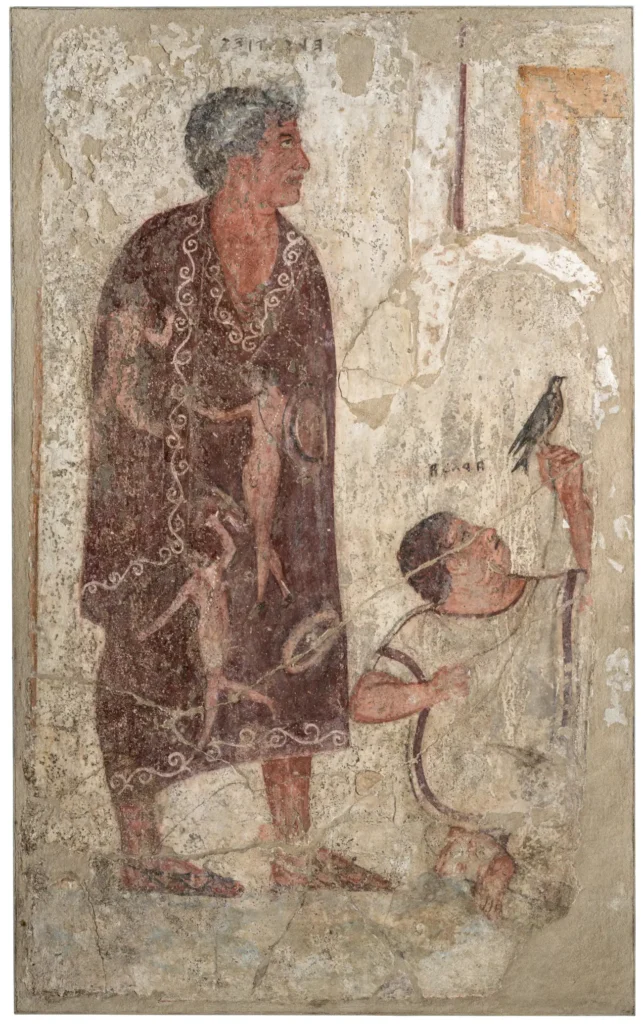
The tomb’s painted program consists of 37 panels, along with two stone markers found in the access corridor. The cycle is exceptional because it is not limited to ornament or banquet imagery. It tells stories, names figures and frames power through myth and history.
Greek myth seen through Etruscan eyes
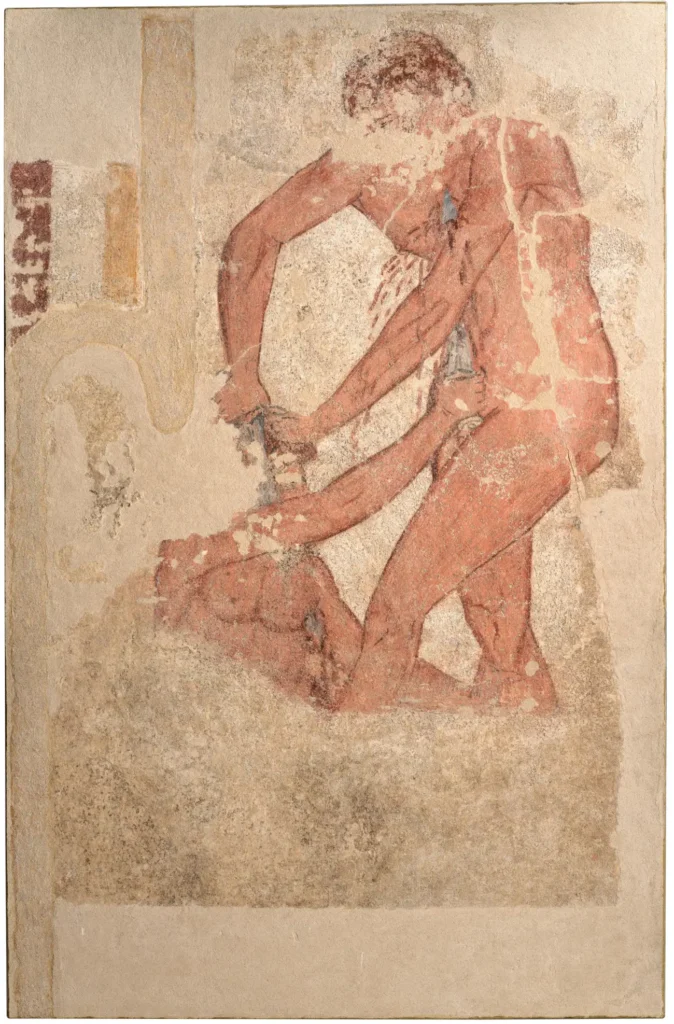
One of the most famous scenes shows the sacrifice of Trojan prisoners at the tomb of Patroclus. Achilles appears at the center of the composition, but the scene is not a simple copy of a Greek model. It is filtered through an Etruscan imagination of death and the afterlife.
The presence of Charun, the Etruscan underworld demon often shown with a hammer, gives the scene a distinct local force. He appears with Vanth, a winged female figure associated with death and transition. Together they show how Etruscan artists absorbed Greek heroic material while reshaping it according to their own religious and visual language. The myth is familiar, but the atmosphere, symbols, and funerary meaning are Etruscan.
A rare window onto early Rome
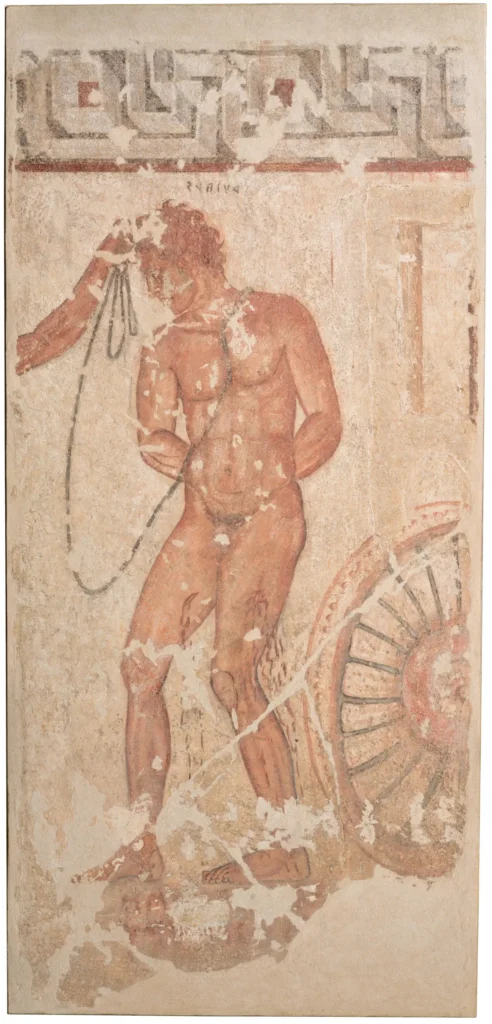
The opposite wall carries another scene with unusual historical weight. It depicts the liberation of Caelius Vibenna by his brother Aulus and by Macstarna, a figure traditionally identified with Servius Tullius, the sixth king of Rome.
This scene has made the tomb a central reference point in discussions of early Rome’s relationship with the Etruscan world. The painting suggests that Etruscan aristocratic memory preserved versions of political events and heroic figures that do not always match later Roman literary traditions.
In a field where Etruscan voices are often fragmentary, painted names and scenes carry unusual weight. The tomb is also famous for what the Ministry of Culture describes as the longest known animal frieze from antiquity. Griffins, lions, panthers, deer, wild boars, and fantastic creatures populate the decorative cycle, turning the burial space into a world of prestige, danger, and symbolic energy.
Villa Giulia prepares a major exhibition
The National Etruscan Museum of Villa Giulia is a fitting destination for the cycle. Housed in a 16th-century papal villa in Rome, the museum has been one of Italy’s central institutions for the study and display of Etruscan and pre-Roman antiquities since the late 19th century.
The upcoming exhibition will bring together loans from the Louvre, the British Museum, the Royal Museum of Art and History in Brussels, the Musée cantonal d’archéologie et d’histoire in Lausanne, the Vatican Museums, and the German Archaeological Institute in Rome. These loans will include objects, documents, historic copies, and works connected to the tomb’s burial assemblage and collecting history.
The ministry also said the display will include tactile tables and content in Italian Sign Language, part of a broader effort to make the monument accessible to a wider audience.
The acquisition restores to public view one of the most ambitious visual narratives produced by the Etruscans, a people whose role in the making of ancient Italy is still too often overshadowed by Rome.
Cover Image Credit: Italian Ministry of Culture
