
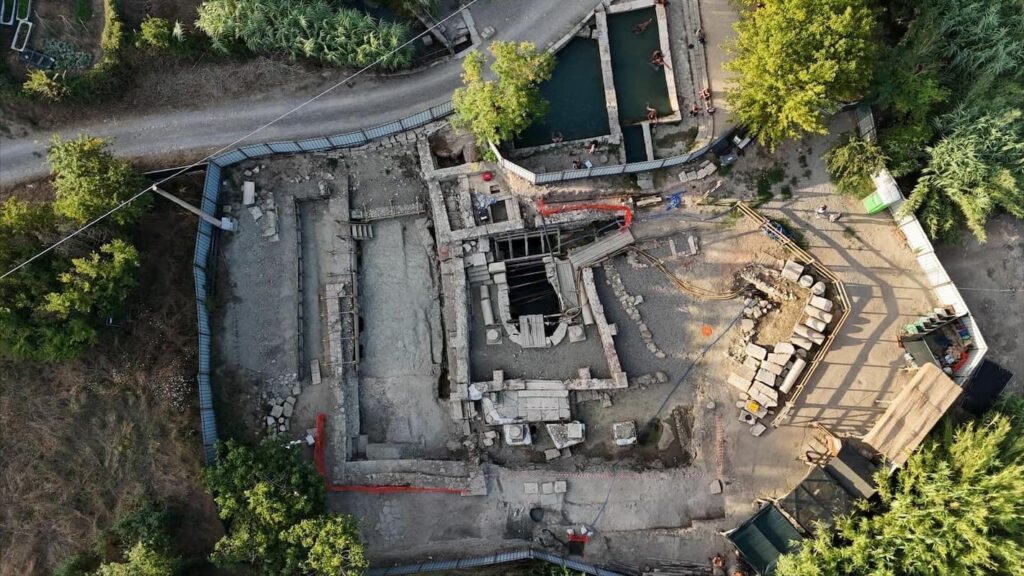
New results from the 2025 excavation season at the Bagno Grande Sanctuary in San Casciano dei Bagni are reshaping how scholars understand medicine, religion, and scientific knowledge in the ancient Mediterranean. Far from being only a thermal healing sanctuary, the site now appears to have hosted one of the most advanced medical centers of the Etruscan world—possibly functioning as an organized medical school as early as the Classical period.
Presented publicly in December, the findings confirm that the sanctuary’s origins stretch back to the late 5th century BC, at least two centuries earlier than previously believed. This revised chronology alone elevates San Casciano dei Bagni to a new position within Etruscan sacred geography, but it is the nature of the discoveries—particularly the anatomical votive material—that has generated the greatest scholarly impact.
Pushing the Sanctuary’s Origins Back in Time
Until recently, the foundation of the Bagno Grande complex had been dated to the 3rd century BC. The 2025 campaign, however, uncovered materials securely dated to the end of the 5th century BC. Among them is a fragment of a bronze ritual candelabrum, a type of object closely associated with high-status cult practices.
The find suggests the presence of an early monumental sanctuary already operating near the thermal spring or directly above it. Bronze, long recognized as a central ritual material at San Casciano, now appears to have played a continuous role from the site’s earliest phase through Late Antiquity, underscoring the sanctuary’s long-term ceremonial importance.
Ritual Closure and the End of Pagan Worship
The excavations also clarified how the sanctuary’s life came to an end. Bronze objects shaped as a lightning bolt and a branch belong to the final phase of activity, when pagan worship was forcibly terminated in the late 5th century AD following the Theodosian edicts.
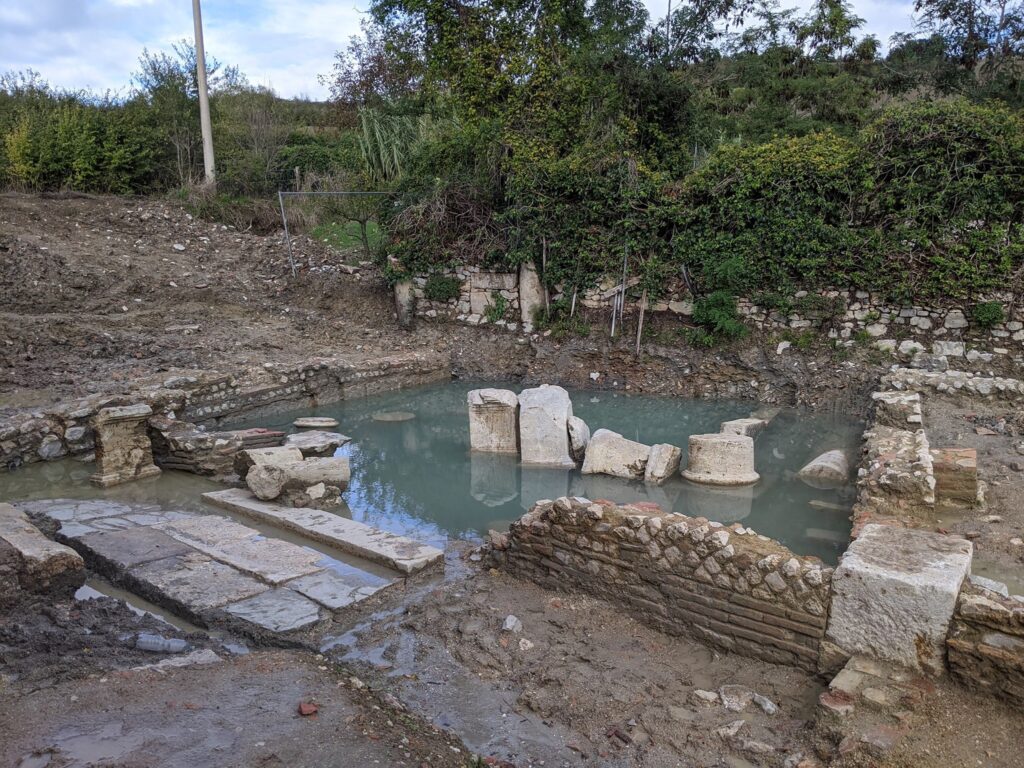
At this time, a dramatic ritual of abandonment took place. Altars were deliberately broken and rearranged into a platform constructed between the main thermal spring and a secondary spring to the south. This spatial reconfiguration suggests that multiple sacred focal points once structured the sanctuary’s ritual landscape, even in its final moments.
Architecture and Intentional Abandonment
Archaeologists confirmed the existence of a massive Etruscan enclosure wall, active from at least the 3rd century BC and likely earlier. Comparable in scale to the later Roman imperial temple, this structure shows repeated evidence of closure rituals.
In several areas, architectural terracottas were intentionally dismantled and dispersed—an act that appears less like destruction and more like a controlled ceremonial decommissioning of sacred space.
The Favissa: A Sacred Archive of the Human Body
The most transformative discoveries of 2025 came not from bronze, but from terracotta. Excavations in the southwestern sector of the sanctuary revealed the beginning of a favissa—a sacred deposit where votive offerings were ritually buried once removed from active use.
Inside this deposit, archaeologists uncovered an extraordinary range of anatomical votives: feet, legs, hands, heads, swaddled infants, and fragments of statues and architectural decorations such as antefixes. While anatomical offerings are known from other Italic sanctuaries, the quantity, diversity, and precision found here are unparalleled.
A Polyvisceral Model Unlike Any Other
The most striking object emerged from Late Antique ritual layers disturbed during 4th-century AD construction work. As Roman builders erected a massive retaining wall after structural collapses in the imperial temple, they cut through older Etruscan deposits and redeposited them outside the sanctuary in a highly ritualized process.
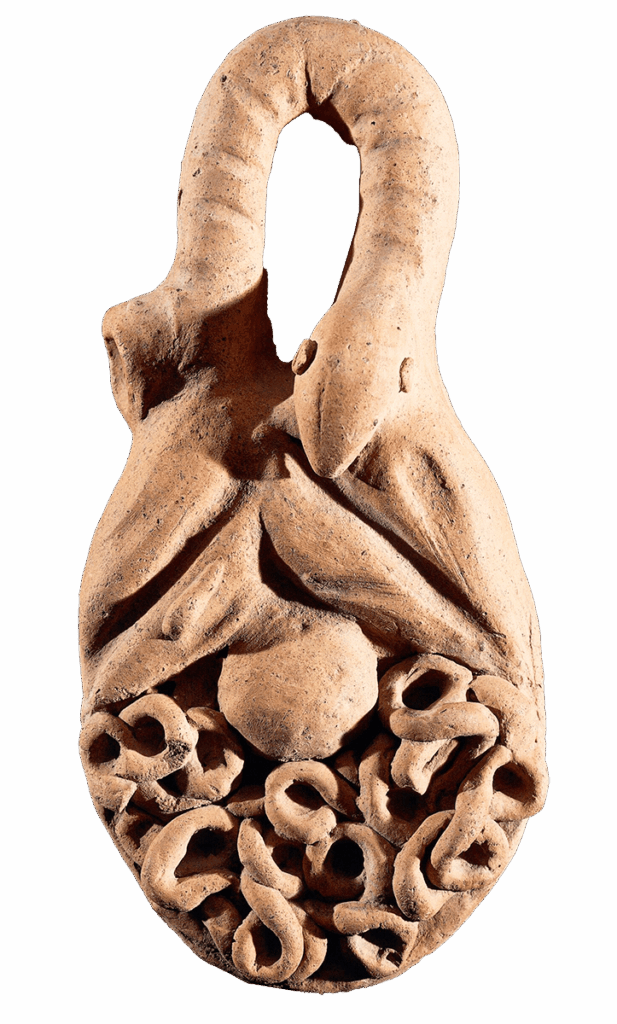
These layers contained evidence of bonfires, scattered pine nuts and astragali, painted elements, and objects with clear magical connotations. Among them was a polivisceral terracotta model depicting the internal organs of the human body with astonishing anatomical accuracy.
No comparable object is known from the ancient world. Its realism suggests systematic anatomical observation rather than symbolic representation, pointing to advanced medical knowledge grounded in practice rather than abstraction.
Evidence for an Etruscan Medical School
This discovery fundamentally changes the interpretation of the Bagno Grande. The sanctuary can no longer be understood solely as a place of therapeutic bathing. Instead, it appears to have functioned as a complex healing institution, comparable to an ancient hospital and teaching center.
Scholars now argue that a structured medical school operated here from at least the 3rd century BC, where knowledge of anatomy was actively produced, taught, and ritually expressed. The fact that anatomical accuracy diminishes in votive offerings found farther from San Casciano strongly suggests that this sanctuary served as the primary hub for medical knowledge in the region.
Artisans working at the site were clearly integrated into this system, capable of translating detailed anatomical understanding into terracotta and bronze with remarkable fidelity—an indication of shared expertise between healers and craftspeople.
A Site Still Revealing Its Secrets
The favissa excavation has only just begun, and future campaigns are expected to yield critical data on Etruscan craftsmanship, religious practice, and ancient medicine. Each new layer promises to refine our understanding of how science, ritual, and community intersected at this extraordinary sanctuary.
Parallel to the excavations, major steps are being taken to secure the site’s future. The University for Foreigners of Siena, through its CADMO Center, has acquired a historic property in San Casciano dei Bagni to serve as an international research hub. Plans are underway for a museum and archaeological park, with construction expected to begin in 2026.
As Mayor Agnese Carletti emphasized during the presentation, the goal is not only scientific discovery but also public return—bringing the bronzes and the story of this ancient medical center back to the community where they were created more than two millennia ago.
Unione dei Comuni Valdichiana Senese
Cover Image Credit: Ministero della Cultura
