16 April 2026 The Future is the Product of the Past

God Vishnumurthy Statue Found in a Well in Karnataka

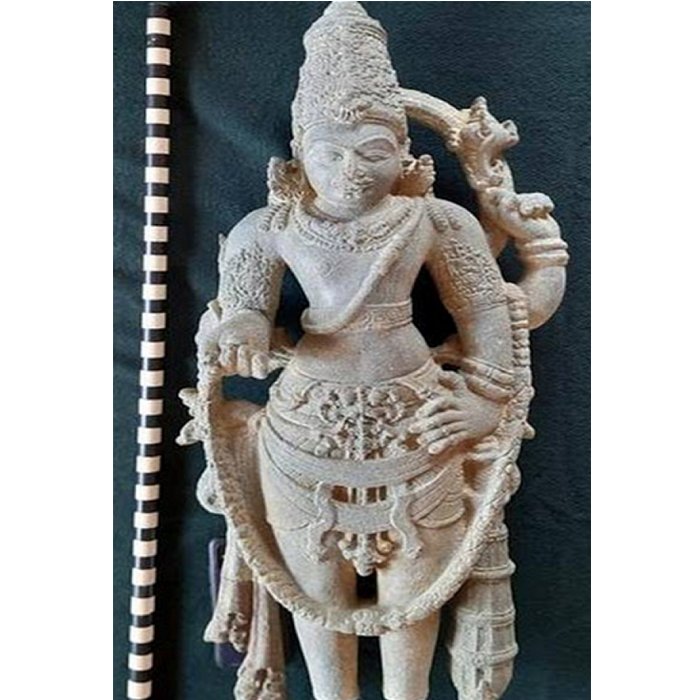
A statue of the god Vishnumurthy dumped into a well was found near a destroyed Udupi temple in the state of Karnataka, India. God Vishnumurthy is also known as Lord Vishnu and Janardhana.

The god Vishnumurthy, one of the main gods of Hinduism, is a supreme guardian being. It controls the entire universe and is the master of reality. Vishnumurthy is he who created and protected the universe. It is one of the gods in the Hindu trilogy and accompanies the other two great gods, Brahma and Shiva.

So why was the statue of such an important god found in a 20-foot deep well and the nearby temple destroyed? Archaeologists are not yet able to answer these questions.

According to T. Murugeshi, associate professor of the Department of Ancient History and Archaeology at the MSRS College of Sherva, the temple is full of architectural relics and red clay bricks, and the statue’s history can be traced back to the 12th century AD.
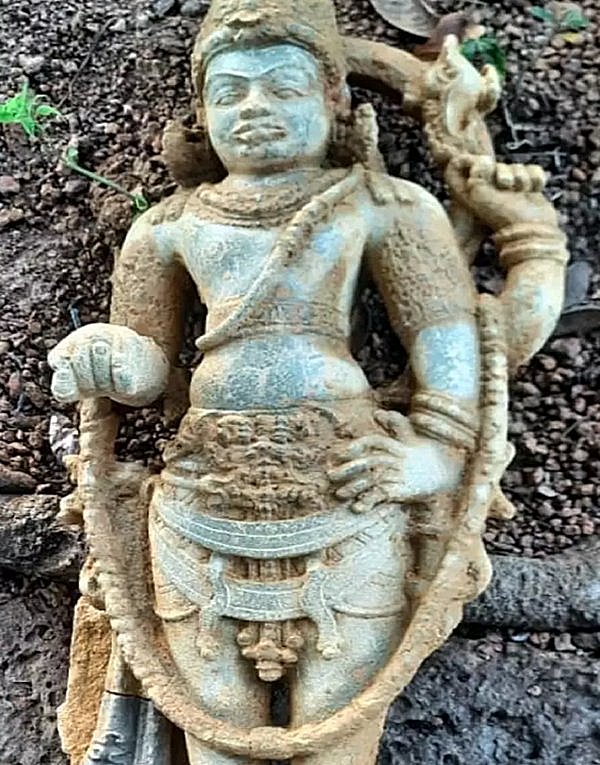
God Vishnumurthy sculpture
SOURCE

Murugeshi, “The beautiful sculpture has a Karanda Mukuta (head dress), Makara Kundala (ear rings), armlets, anklets, Kaustubhahara and very nice eye brows, nose and lips which make it a master piece of Coastal Karnataka,” he said. By The Hindu.


📣 Our WhatsApp channel is now LIVE! Stay up-to-date with the latest news and updates, just click here to follow us on WhatsApp and never miss a thing!!


“It holds a pinda in the front right hand. In the back left hand, it holds a conch and its right hand is missing but, exploration is still being continued,” he said.

“In the ruined sanctum sanctorum, part of a pair of human feet remained in the middle of the peetha, but the upper part is totally missing. The sculpture stylistically belongs to 12th century AD,” he said.

The statement said it was a pre-Madhwa sculpture and the finest specimen of the Coastal Karnataka Bhagavatha cult. However, for now, researchers do not know the reasons why the temple was ruined. They also believe that the restoration work on this sculpture (a fragment is missing) is a delicate process and will undoubtedly take time.
Related Articles

18,000-Year-Old Evidence of Human Brain Consumption Found in Poland’s Maszycka Cave

22 February 2026

22 February 2026

New scientific research has uncovered compelling evidence that prehistoric humans practiced cannibalism—including the consumption of human brains—around 18,000 years ago...

Archaeological excavations started again after 50 years in Tunceli Tozkoparan mound

28 June 2021

28 June 2021

Archaeological excavations at the Tozkoparan Mound in Turkey’s Tunceli province are anticipated to turn the city into one of eastern...

27,000-year-old Pendants made from giant sloths suggest earlier arrival of people in the Americas

16 July 2023

16 July 2023

Archaeologists discovered three pendants made from the bony material of an extinct giant sloth in a rock shelter in central...

A long-lost branch of the Nile helped in building Egypt’s pyramids – Scientists Say

1 September 2022

1 September 2022

The Giza Pyramids are one of the world’s most iconic cultural landscapes, and they have fascinated humans for thousands of...

On a 5,300-year-old skull, archaeologists find evidence of the first known ear surgery

20 February 2022

20 February 2022

Humans may have begun performing ear surgery more than 5,000 years ago, say Spanish archaeologists. Spanish researchers say the skull...

Madinat al-Zāhira: The Enigmatic Palace-City Lost for 1,000 Years, Revealed by New LiDAR Evidence in Córdoba

14 January 2026

14 January 2026

For more than a thousand years, the precise location of Madinat al-Zāhira, the enigmatic palace-city founded by Almanzor (al-Mansur Ibn...

Archaeological excavations unearthed the first great Iberian city in Contestania and the oldest one

11 May 2024

11 May 2024

Archaeologists from the University of Alicante and the University of Murcia “Damas y Héroes. In the project “Tras la Ilici...

3500-year-old grape seed remains found in western Anatolia

12 September 2023

12 September 2023

Archaeologists at the Aşağıseyit Höyük (Aşağıseyit Mound) site in western Anatolia’s Denizli have uncovered a 3,500-year-old grape seed. Aşağıseyi Höyük...

30 Graves Found in the Basilica-Planned Ancient City

4 April 2021

4 April 2021

Kibyra ancient city is situated south of Turkey, located in the town Gölhisar in the southwestern part of Burdur Province,...

Artifacts used for ancient magic rituals discovered on Darb al-Hajj route from Cairo to Mecca

11 September 2023

11 September 2023

The artifacts, found in the 1990s on the ancient Darb al-Hajj route from Cairo to Mecca, may have been in...

DNA from 20,000-year-old deer-tooth pendant reveals woman who wore it

4 May 2023

4 May 2023

A pendant made of a deer tooth that was exposed to DNA about 20,000 years ago has yielded clues about...

A Large Roman Pottery Production Center was Found in Poland

2 April 2021

2 April 2021

A large Roman pottery production center was found in Poland. The production center was discovered near the village of Wrzepia,...

Tutankhamun of Kazakhstan, “Golden Man”

1 August 2024

1 August 2024

The Golden Man, the main symbol of Kazakhstan’s independence, is a warrior’s costume from about the 5th century BC that...

A stone bathtub, which is considered to be the first example of ‘water birth’, was found in Ani Ruins

7 September 2022

7 September 2022

A stone tub was found in the large bath, whose birth was mentioned in a work by the Turkish scholar...

Denmark’s Earliest Iron Weapons: 2,800-Year-Old Gold-Decorated Spears Discovered

5 December 2025

5 December 2025

Archaeologists in Denmark have uncovered two gold-decorated iron spears—the country’s earliest iron—deposited at a Bronze Age sacred spring in Boeslunde,...