
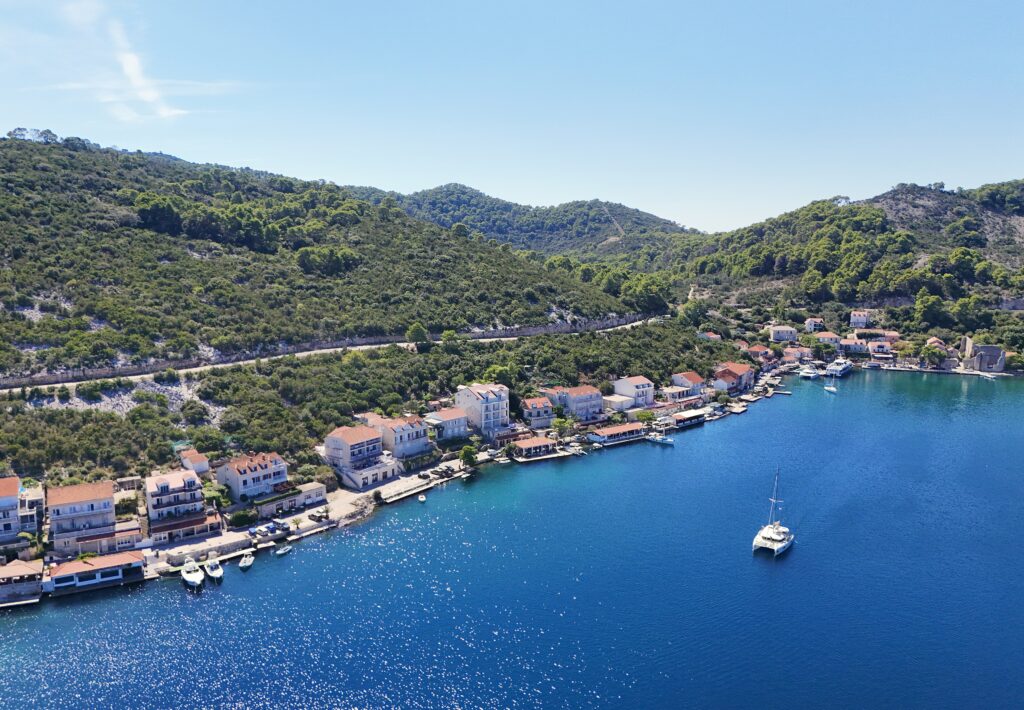
On the Croatian island of Mljet, the monumental ruins of a Late Antique palace still rise beside one of the Adriatic’s most sheltered bays. But some of the most revealing parts of the complex can no longer be seen from land.
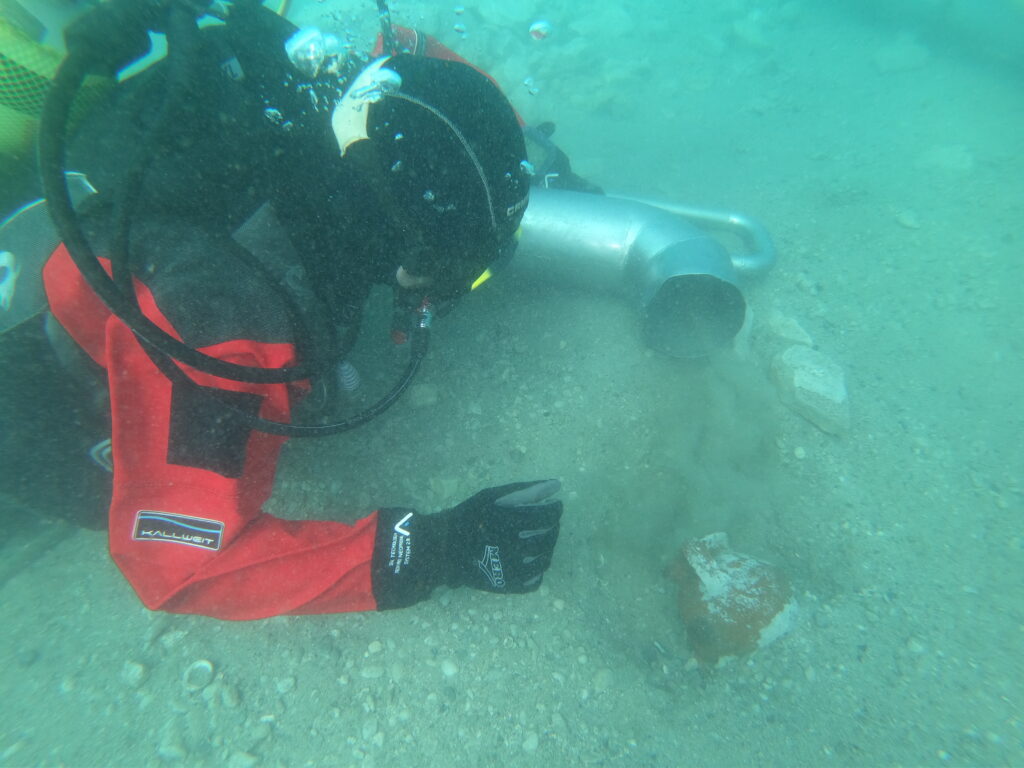
Underwater archaeologists working in Polače Bay are uncovering the infrastructure that connected the palace to the sea: a substantial quay and working waterfront, a large fishpond and traces of activity stretching across centuries. During their latest campaign, conducted in April 2026, researchers returned to the water to understand how these structures fitted together and to search for the ancient shoreline that once ran between them.
That shoreline has proved surprisingly difficult to find. Yet the search is steadily changing the picture of Polače from an imposing residence beside the sea into something much larger—a busy coastal complex tied to shipping, food production and Mediterranean trade. And evidence from another part of the bay suggests that the story of this protected harbor began thousands of years before the palace existed.
Searching for a Shoreline That Has Disappeared
Polače lies in a naturally sheltered bay on the northwestern side of Mljet, off Croatia’s southern Adriatic coast. Protected from the winds, the bay offered ships a safe anchorage along an important maritime route and created ideal conditions for a major complex to develop along its shores.
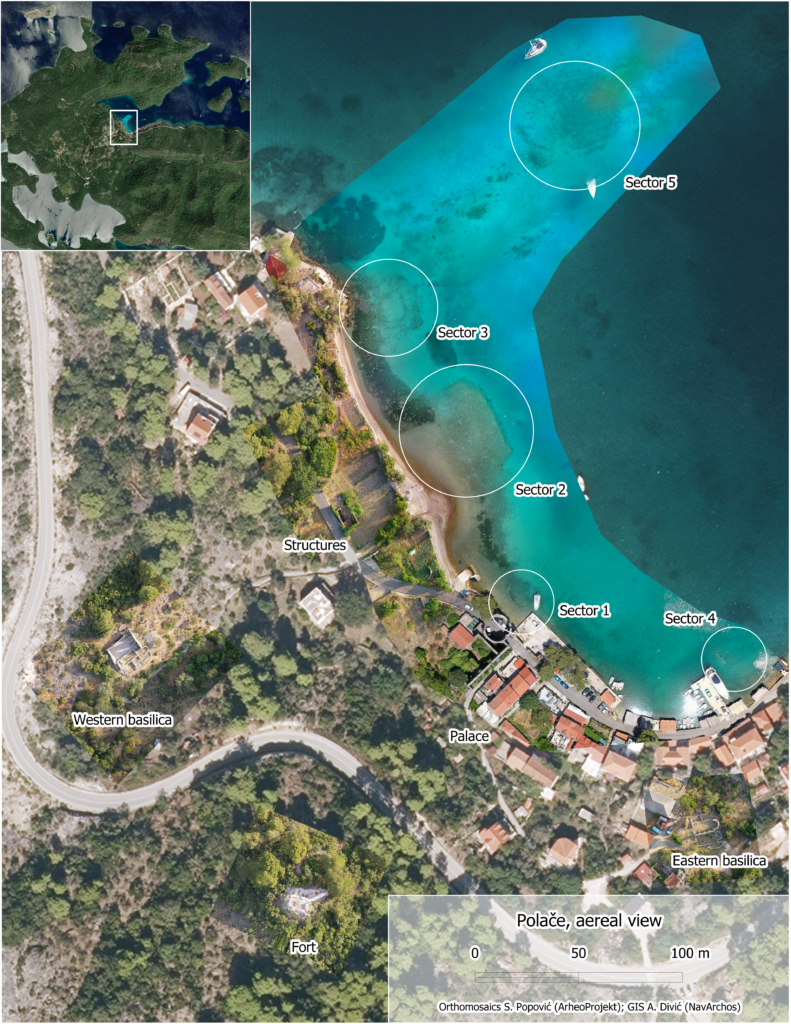
The palace stood at the heart of that complex, alongside two Early Christian basilicas dating to the fifth and sixth centuries, baths and buildings linked to its economic life. But the site did not stop at the ancient shoreline: archaeological remains also extended into the waters in front of the palace. Researchers first investigated these underwater remains in the 1970s, before systematic work resumed in 2022 and developed into annual campaigns.
From April 6 to 26 this year, a team led by underwater archaeologist Igor Miholjek of the Croatian Conservation Institute returned to Polače with German and Slovak partners. In one area, Sector 4, numerous finds again pointed to intensive use during the fourth to sixth centuries. Elsewhere, however, the archaeologists were looking not primarily for objects but for a piece of vanished geography.
They opened Sector 7 between a previously identified quay and a large structure interpreted as a fishpond. Somewhere between them should have been the Late Antique shoreline that connected these elements of the palace complex.
The team did not locate it. Excavations will therefore continue, but the evidence gathered so far allows the researchers to make a broader conclusion: the quay with its working waterfront and the fishpond both date to Late Antiquity and formed part of the palace complex.
The Palace Was Built to Face the Sea
That conclusion gives the ruins standing on Mljet a different character. The palace was not simply an elite residence with a good view of the Adriatic; its daily operation depended on the water in front of it.
Previous underwater investigations identified a large structure associated with the ancient landing area. Archaeologists found regular stone blocks and abundant Roman and Late Antique material around the quay and working waterfront, confirming activity where vessels could approach the complex. Research in the 1970s first recognized this maritime infrastructure, while renewed investigations have been mapping and testing it in much greater detail.
For the people who lived and worked at Polače, the protected bay would have been a route rather than a boundary. Boats arriving through the southern Adriatic could enter calm water close to the palace, while the waterfront provided the physical connection between maritime traffic and the buildings on land.
The archaeology reflects those connections. Pottery recovered from the bay spans several centuries, and much of the material belongs to the period when the palace complex flourished. Rather than viewing the monumental building in isolation, the underwater work increasingly allows archaeologists to reconstruct the network of spaces that supported it.
A Large Fishpond Adds Another Piece to Palace Life
One of the most unusual structures lies close to the ancient waterfront. During surveys in 2022, archaeologists documented a submerged construction where a shoal meets the coast. Its architectural form led them to identify it provisionally as a fishpond, and subsequent campaigns have investigated its construction and relationship to the palace.
The fishpond reveals another side of life at Polače. While the quay shows how people and cargo reached the complex, the fishpond points to how the palace managed food and other everyday needs. Together, they show how closely life at the palace depended on the coastal environment around it.
This is also why finding the missing shoreline matters. Connecting the quay and fishpond physically would help archaeologists reconstruct the shape of the Late Antique coast and understand how people moved through this space roughly 1,500 years ago. The sea has since transformed that landscape, leaving elements that once belonged to a coherent waterfront separated beneath the modern bay.
The palace itself has long attracted debate about who created such an elaborate residence. Archaeologist Igor Fisković argued that much of the monumental complex developed during the fifth century and explored possible links with Ravenna and the political world of fifth-century Dalmatia. Those historical interpretations remain hypotheses, but they underline the exceptional scale of Polače among Late Antique complexes on the Croatian coast.
African Lamps and a Gold Coin Reveal a Mediterranean Port
Objects recovered during earlier underwater investigations provide another way into life around the palace. They include fine and coarse pottery, North African bowls and amphorae, red-slipped vessels, decorated plates, Christian lamps and numerous bronze coins from the Constantinian period. An especially striking older find is a gold solidus of the Byzantine emperor Maurice Tiberius, who ruled from AD 582 to 602.
The lamps tell an unusually far-reaching story. Anica Kisić’s study of material recovered during the 1975 underwater campaign identified Late Antique and Early Christian examples imported from different parts of the Mediterranean. Two well-preserved lamps belong to African types associated with North African production, while other forms have parallels in Greece and Asia Minor.
These objects make the harbor easier to imagine as a lived space rather than an archaeological plan. Ships arrived carrying containers and manufactured goods; pottery was used, broken and discarded; lamps illuminated buildings around the bay. By the fifth and sixth centuries, the archaeological evidence indicates that Polače had developed into a significant ancient port, at the same time that the monumental complex beside it was flourishing.
The latest underwater work is therefore filling in the spaces between the objects and the architecture. Instead of simply knowing that imported goods reached Polače, researchers can increasingly ask where vessels approached, how the waterfront functioned and how the palace interacted with the harbor that helped sustain it.
Then the Story Suddenly Goes Back Thousands of Years
While archaeologists have been reconstructing the Late Antique landscape, another part of Polače Bay has produced evidence that does not belong to the palace at all.
During earlier work in Sector 5, on a submerged shoal, researchers recovered fragments of Neolithic pottery. The Croatian Conservation Institute says the finds make it possible to suggest that a Neolithic settlement once stood on the shoal, although archaeologists have not yet confirmed such a settlement through further excavation. The sector has, for now, been excluded from additional investigation.
That distinction matters. There is not yet a discovered Neolithic village beneath Polače Bay, but pottery from the submerged area raises the possibility that people occupied this coastal landscape thousands of years before the Late Antique palace, its quay and its fishpond appeared.
It also leaves Polače with two very different unanswered questions. Archaeologists are still searching for the missing shoreline that connected the palace’s maritime structures around 1,500 years ago, while another part of the bay may preserve evidence of human occupation from a far more distant past.
For now, the palace remains the most visible monument at Polače. The underwater archaeology is showing that it was only one chapter in the history of a bay that drew people to its protected waters long before its monumental walls rose beside the Adriatic.
Croatian Conservation Institute (HRZ)
Kisić, A. (1978). Antičke svjetiljke iz podmorja Polača na Mljetu. Vjesnik za arheologiju i historiju dalmatinsku. ( The Undersea Discovery of the Lamps from the Time of late Antique in the Bay Polače on the Island Mljet), Hrcak
