

Archaeologists in Croatia have brought 1,600-year-old Early Christian mosaics back to light nearly half a century after they were last systematically exposed, revealing elaborate geometric and plant designs alongside inscriptions that preserve the names—and unusually personal words—of the people who paid for them.
The mosaics were uncovered again at the Church and Monastery of St. Andrew in Betiga, near Barbariga on Croatia’s Istrian peninsula. Among the inscriptions is one left by a couple named Felicianus and Ingenua, who described themselves with the Latin phrase peccatores nimis: interpreted as “great sinners.”
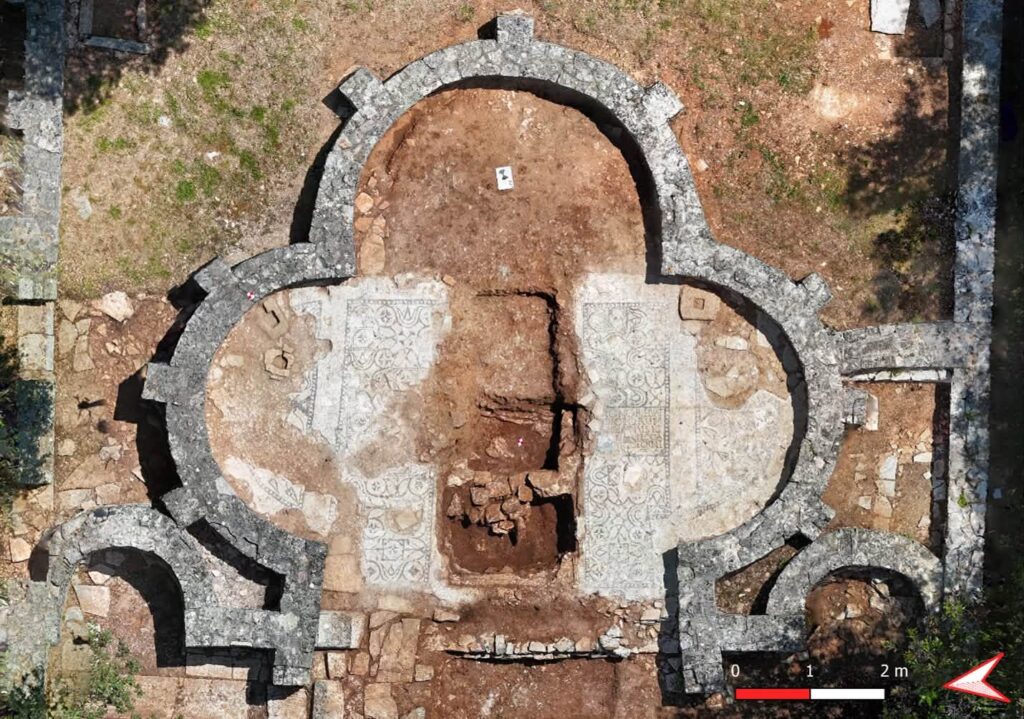
The latest work, carried out by the Archaeological Museum of Istria between May 25 and June 7, marks the first major return to the site in almost 50 years. Archaeologists re-exposed mosaics in both the early trefoil memorial chapel and the central nave of the later basilica, while documenting the entire complex using laser scanning and photogrammetry.
A 1,600-year-old message from two “great sinners”
The most striking inscription comes from the oldest part of the site, a trefoil-shaped memorial chapel constructed in the early 5th century around the grave of an unidentified local saint.
Although only part of the inscription survives, its reconstructed Latin text identifies Felicianus and Ingenua and records their role in creating the monument. The text has been reconstructed as In honore beatorum sanctorum Felicianus et Ingenua peccatores nimis fecerunt: essentially stating that Felicianus and Ingenua, “great sinners,” made the work in honor of the blessed saints.
Researchers believe the pair were probably responsible for commissioning the mosaic and may even have financed the construction of the memorial chapel itself. The wording is also significant for another reason: it suggests that the building’s original dedication may not have been to St. Andrew, as the complex later became known, but more broadly to the saints or All Saints. A later pre-Romanesque stone inscription from the 9th century provides evidence that the church was eventually dedicated to St. Andrew.
The chapel’s surviving black-and-white mosaics contain geometric designs, crosses, and stylized plant motifs. When the original memorial structure was incorporated into a larger basilica during the first half of the 5th century, the new central nave received a much more elaborate polychrome mosaic pavement.
The people who paid for the basilica floor
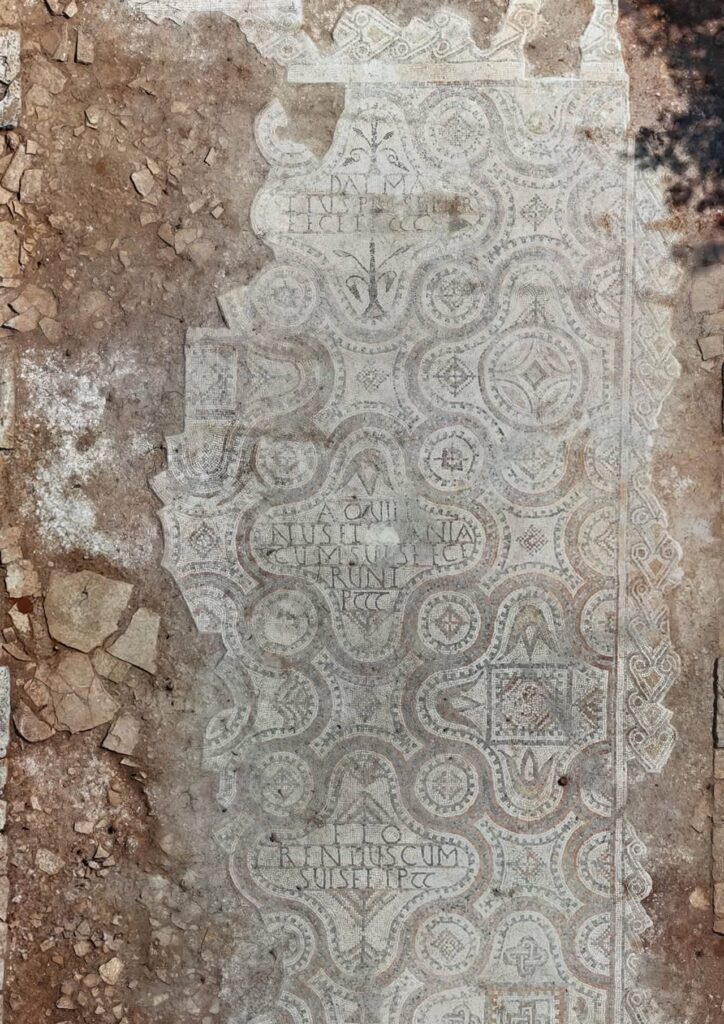
Felicianus and Ingenua were not the only people whose names became embedded in the floors of Betiga. Three additional inscriptions in the basilica record individuals who financed substantial sections of the mosaic pavement, providing a rare glimpse of the patrons who supported an Early Christian community in rural Istria.
One identifies a priest named Dalmatius, who paid for 300 Roman square feet of mosaic: roughly 26 square meters. Another records Aquilinus and Urania, who together with members of their household funded another 300 square feet, while Florentius and his family financed approximately 200 square feet.
The mosaics themselves are decorated with combinations of geometric and vegetal motifs, including ivy tendrils, lotus flowers and representations interpreted as the tree of life. Earlier research has also shown that the arrangement of Betiga’s donor inscriptions belongs to a broader Late Antique tradition visible at Christian sites around the northern Adriatic and neighboring regions.
From a saint’s grave to a major Christian complex
Betiga was far more than an isolated chapel. The surrounding area was intensively occupied during Roman and Late Antique times, with archaeological remains including Roman rural villas and other Christian structures. The St. Andrew site eventually became one of the most important Early Christian religious complexes in Istria outside the major Late Antique urban centers.
Its development began with the early 5th-century memorial chapel surrounding the unknown saint’s grave. Over the following centuries, the site expanded into a three-aisled basilica with a baptistery, mausoleum, portico, atrium and cistern, while a monastic community was probably established there during the Early Middle Ages.
The church was later remodeled in the pre-Romanesque period and equipped with new stone liturgical furnishings decorated with interlace reliefs. Ceramic finds indicate that activity in the monastery continued for centuries, probably until the complex was finally abandoned during the 13th century.
Rediscovered after nearly 50 years
Systematic excavations conducted by the Archaeological Museum of Istria between 1975 and 1979 first revealed much of the complex, including its mosaics, architectural elements, liturgical furnishings and numerous ceramic and glass fragments. The mosaics were subsequently protected, leaving them largely unseen for decades.
Their re-exposure is therefore a rediscovery rather than an entirely new archaeological find, but modern technology is allowing researchers to study and preserve the floors in ways unavailable during the original excavations. A detailed 3D model is now being produced through laser scanning and photogrammetry before conservation and restoration work proceeds.
The project also begins a new international collaboration between the Archaeological Museum of Istria and the Department of Christian Archaeology at Friedrich-Alexander-Universität Erlangen-Nürnberg. Further investigation is expected to extend into the former monastery rooms, potentially revealing more about the community that grew around an unknown saint’s grave—and about the people who ensured that their names remained beneath the church floor for more than sixteen centuries.
