
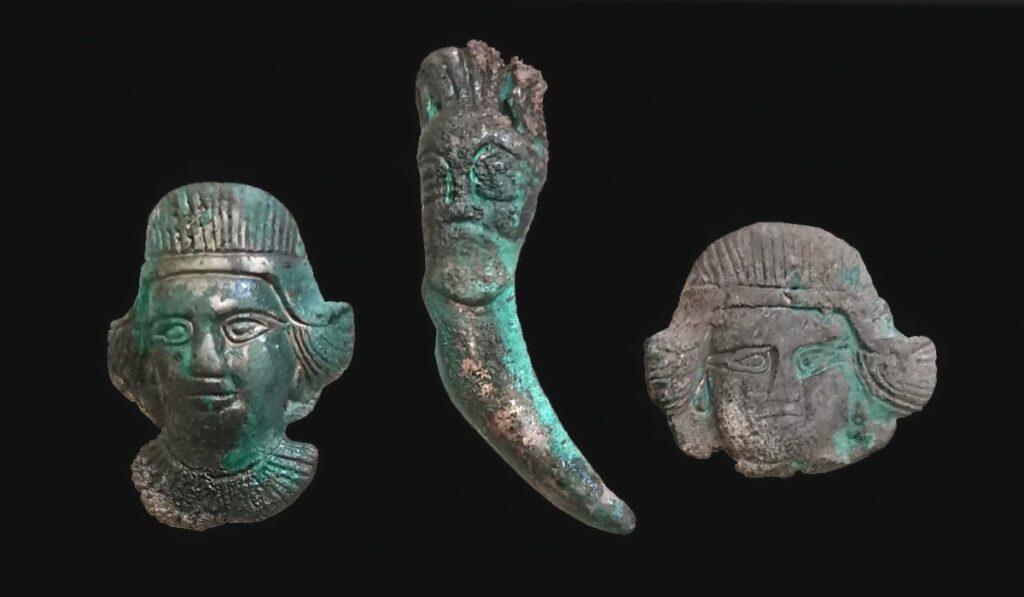
In the sweeping grasslands of the Southern Urals, archaeologists have uncovered a spectacular ritual complex that is reshaping our understanding of early nomadic culture. The discovery, made by the Institute of Archaeology of the Russian Academy of Sciences, centers on a shallow ritual pit filled with rare bronze mask pendants, openwork bronze plates, elite horse gear, and even a gold plaque featuring the head and foreleg of a tiger. The assemblage dates to the 4th–early 3rd century BC and is now considered one of the richest ritual deposits ever recorded in the region.
The find emerged during the 2025 field season at the vast necropolis “Vysokaya Mogila – Studenikin Mar” in the Orenburg region, an immense funerary complex stretching more than six kilometers across the Ural-Ilek interfluve. While surveying the inter-kurgan space around the site’s largest mound, archaeologists began noticing scattered metal fragments—iron bits, bronze psalia, and decorated plaques—at the surface of the ploughed soil. What initially appeared as random displaced artifacts soon revealed a more profound story.
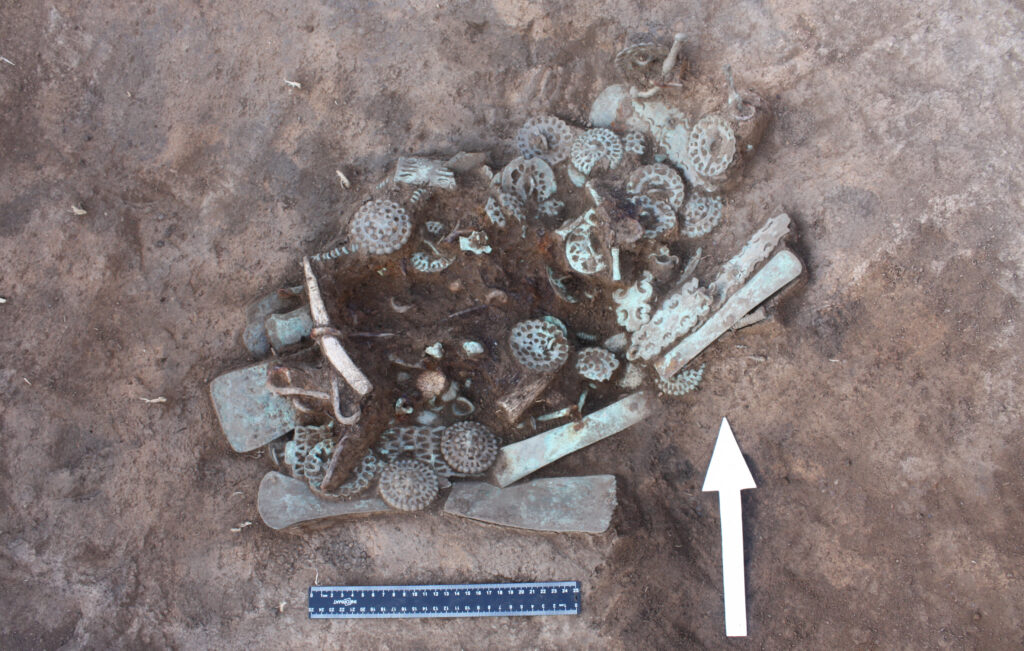
Beneath the disturbed surface layers lay a carefully arranged ritual pit. This shallow, circular feature held a dense concentration of ceremonial offerings: complete horse-bridle sets, bronze and bimetallic ornaments, carved bone pieces, and plates adorned with animal-style motifs. More than a hundred well-preserved objects were found, accompanied by over five hundred smaller decorative elements—evidence of a meticulously organized ritual deposit associated with high-status nomads.
A Collection Unlike Anything Found Before in the Southern Urals
While horse gear is a familiar component of nomadic burials, many of the items from this pit stand out for their craftsmanship and rarity. Among the most remarkable are the bronze mask pendants—small plaques shaped into stylized human faces. These anthropomorphic objects are exceptionally uncommon in the Southern Urals and appear here for the first time in a ritual context. Their expressive features and symbolic form suggest they held ceremonial or protective significance.
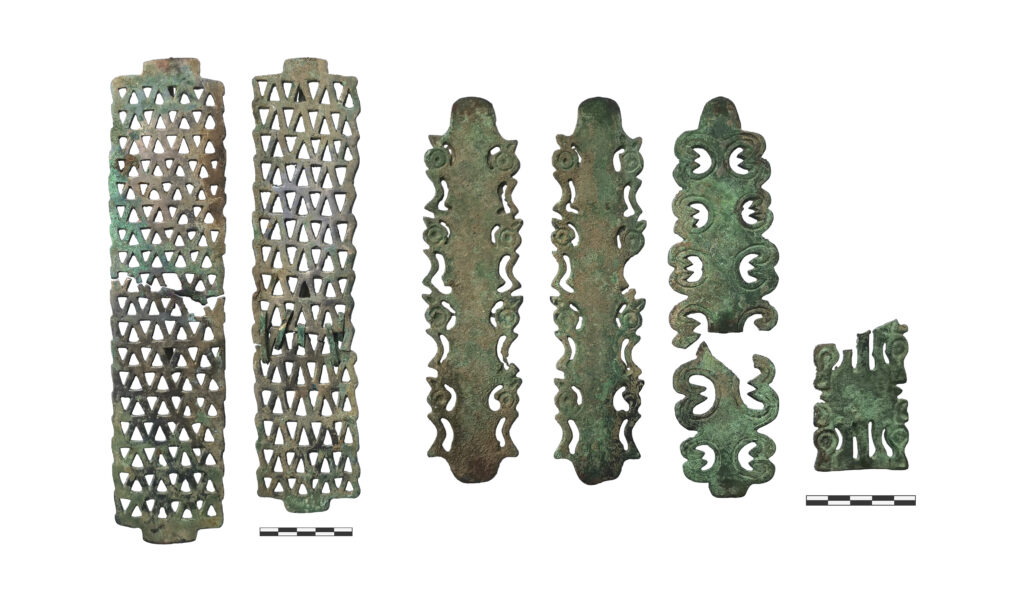
One of the most striking aspects of the assemblage is its aesthetic diversity. Bronze plates with openwork designs, flat circular plaques with raised centers, and plaques decorated with birds, swastikas, and fantastical beasts exhibit craftsmanship rarely seen in the Southern Urals. Even more exceptional are the anthropomorphic mask plaques—small bronze elements shaped like human faces—and a unique bronze pendant, all of which stand out as unprecedented discoveries in the region.
Perhaps the most captivating single object is a gold aplique depicting a tiger’s head and front leg. Such zoomorphic imagery is strongly associated with the broader traditions of steppe animal-style art. Yet tiger motifs are relatively rare in this region, marking this piece as both symbolic and potentially imported.
According to project director Sergey Sirotin, the scale and complexity of the find surpass any other ritual complex known from early nomads of the Southern Urals. He emphasizes that while some items resemble those found in rich Filippovsky-type kurgans, many have direct parallels in the North Caucasus, the Don region, and the Northern Black Sea coast. Their presence highlights the vast communication networks, cultural interactions, and shared symbolism that once linked distant steppe societies.

Elite Horse Gear and Ritual Offerings
The pit’s contents reveal the complex role of horses in nomadic ceremonial life. Archaeologists documented complete bridle sets, including iron bits, horn and metal psalia, bronze headstall elements, and numerous decorative plaques in various shapes and sizes. Many of these items match those found in elite Filippovsky culture burials—symbols of status and power among 4th-century BC nomadic aristocrats.
Beyond equipment, the ritual nature of the pit became even clearer with the discovery of a wooden bowl decorated with silver overlays crafted in animal style. The bowl, likely used during ceremonial practices, was intentionally placed alongside the horse gear. Nearby, the jaws of a boar were found—interpreted as a sacrificial offering—along with fragments of a hand-molded ceramic vessel that may have been deliberately broken during the ritual.
Together, these elements signal a complex ceremonial performance, possibly connected to post-funerary rites held near the monumental kurgans of nomadic elites. Rather than placing these items inside a burial chamber, the ancient nomads appear to have conducted rituals in open ceremonial spaces, leaving offerings to honor ancestors or maintain the spiritual authority of ruling clans.
A Window Into Nomadic Power and Cultural Networks
The necropolis itself, with its five kurgan groups and nearly 14 large burial mounds, has long been recognized as one of the most significant early nomadic sites in the Southern Urals. Excavations since 2015 have revealed that its largest mounds belong to the earliest phase of occupation and align closely with the famous Filippovka I complex. These mounds represent a period when nomadic elites consolidated influence across the steppe, controlling vast territories and establishing far-reaching cultural networks.
The diversity of objects found in the 2025 ritual pit reinforces this interpretation. Many items echo characteristic Filippovsky craftsmanship, while others show unmistakable ties to the North Caucasus, the Don region, and the Northern Black Sea. The presence of such imported or stylistically foreign artifacts indicates extensive exchange routes and symbolic connections that bound distant steppe societies together.

Expanding the Map of Nomadic Ritual Landscapes
The discovery provides compelling evidence that inter-kurgan spaces—areas long overlooked in steppe archaeology—served as active zones of ceremonial practice. The scale and richness of this ritual complex suggest that the kurgans themselves functioned not only as burial markers but also as long-term ritual centers where successive generations performed rites of remembrance and renewal.
With its unprecedented concentration of mask pendants, bronze plates, and elite horse gear, the newly uncovered ritual pit stands as one of the most significant archaeological breakthroughs in recent years—a vivid window into the ceremonial world of ancient nomadic elites and their enduring legacy across the Eurasian steppe.
Institute of Archaeology of the Russian Academy of Sciences
Cover Image Credit: Bronze strap distributors and a pendant from a 4th-century BC nomadic ritual complex. Institute of Archaeology of the Russian Academy of Sciences
