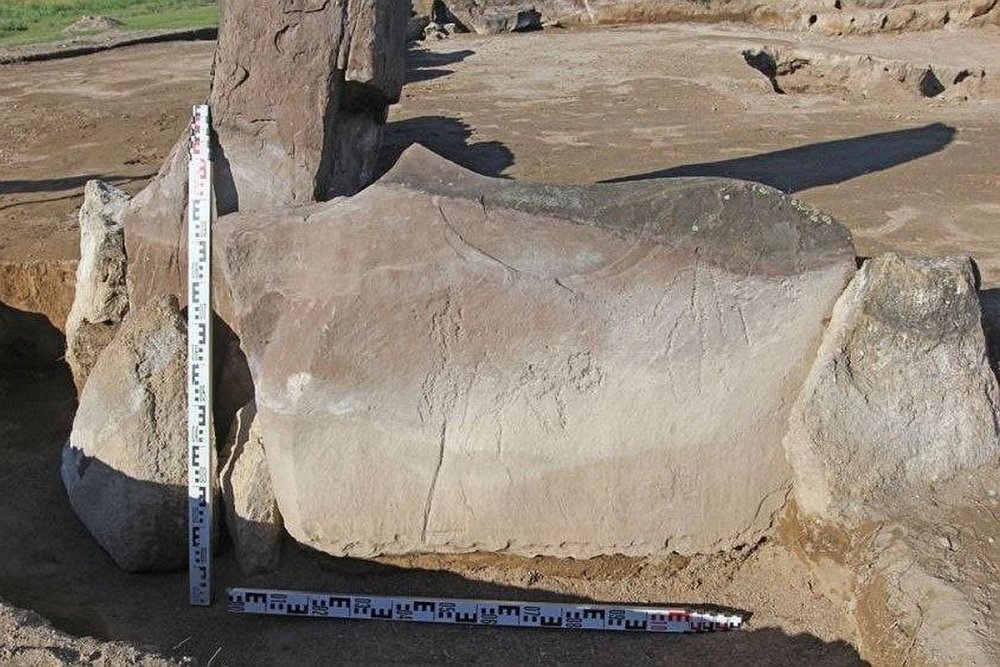
Archaeologists from the Institute for the History of Material Culture have uncovered remarkable stone slabs engraved with hunting scenes and symbolic imagery in ancient burial mounds in Khakassia. The findings provide rare chronological insight into the rock art traditions of southern Siberia and shed new light on how ancient communities reused sacred objects over thousands of years.
The discoveries were made in the Askizsky District, an area known for its rich archaeological heritage. Researchers examined two burial grounds that were used continuously for more than 3,000 years — from the Early Bronze Age (3rd millennium BCE) to the turn of the Common Era. These sites contain funerary complexes representing nearly all archaeological cultures known in Khakassia.
A Rare Opportunity to Date Rock Art
Rock carvings, or petroglyphs, are typically found on open rock faces throughout Siberia, especially in the Minusinsk Basin. However, dating such open-air engravings has always been a major challenge due to the absence of contextual archaeological materials.
This discovery is different.
Because the engraved slabs were embedded within sealed burial structures, scientists can directly associate them with specific archaeological periods based on grave goods and contextual evidence. According to researchers, this provides a rare opportunity to establish a reliable chronological framework for the region’s rock art.
📣 Our WhatsApp channel is now LIVE! Stay up-to-date with the latest news and updates, just click here to follow us on WhatsApp and never miss a thing!!
By analyzing burial inventories alongside the stylistic and thematic elements of the carvings, archaeologists were able to link the slabs to the Early Iron Age (8th century BCE to 2nd century CE). Comparative studies were also conducted between the burial mound petroglyphs and known rock engravings across the Minusinsk Basin.
Hunting Scenes and Symbolic Imagery
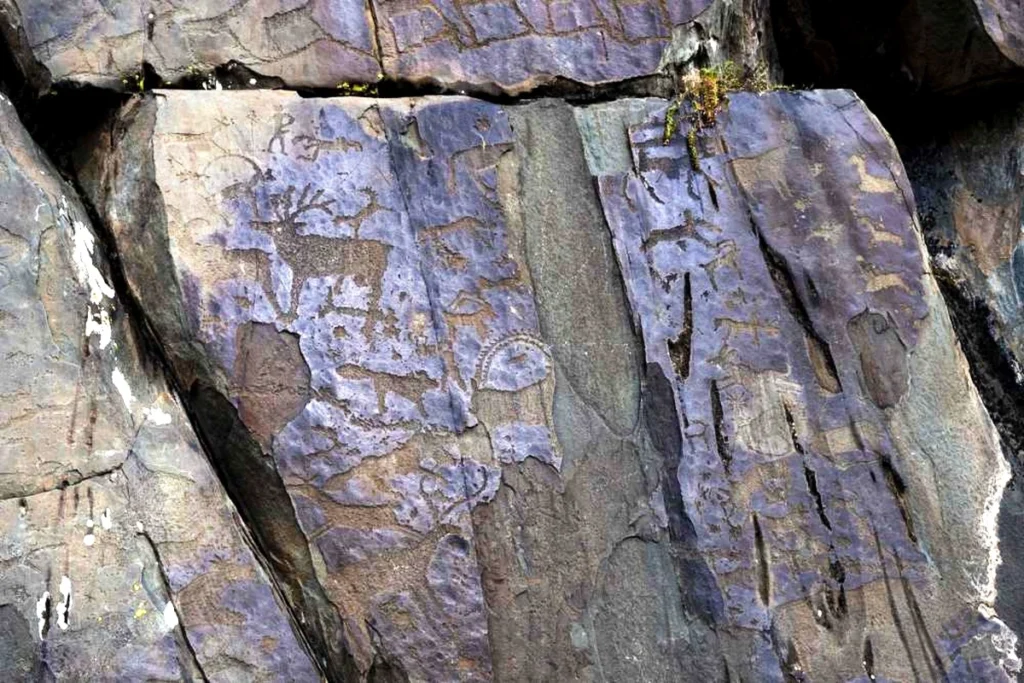
Out of ten studied slabs, six featured identifiable imagery.
Among the most striking depictions is a hunting scene typical of earlier cultural traditions: a human figure accompanied by a dog pursuing a large animal, possibly of mythological significance. These dynamic compositions reflect the importance of hunting in the worldview and economy of ancient steppe societies.
Later slabs, however, display more abstract motifs. These include spirals, labyrinth-like lines, and schematic anthropomorphic figures. Such symbolic imagery may reflect evolving spiritual beliefs or artistic conventions during the transition from the Bronze Age to the Early Iron Age.
Intriguingly, some carved details — including axes, daggers, and bows — closely resemble actual weapons recovered from the same burial contexts. These parallels between art and material culture strengthen the chronological interpretation and provide insight into daily life and warfare practices of ancient Siberian populations.
Sacred Objects Reused as Building Material
One of the most fascinating aspects of the study concerns how these stone slabs were incorporated into burial mounds.
Researchers concluded that the petroglyph-bearing stones entered the kurgans (burial mounds) through different processes. Some slabs were carefully integrated into the tomb structures, suggesting they were created specifically for funerary rituals and held symbolic or sacred meaning.
Others tell a different story.
Several slabs were found overturned, broken, or fragmented along the lines of their engravings. This indicates that later builders reused older sacred stones simply as construction material, no longer attributing ritual significance to the original carvings.
This practice highlights shifting cultural attitudes toward sacred imagery. What once may have been revered spiritual symbols eventually became ordinary building components within new burial monuments.
Khakassia: A Living Archive of Steppe History
Khakassia, located in southern Siberia near the borders of Tuva and the Altai region, is one of Eurasia’s most important archaeological landscapes. The republic lies within the Minusinsk Basin, a fertile valley surrounded by mountain ranges that has served as a crossroads of nomadic cultures for millennia.
The Askiz District in particular is renowned for its dense concentration of kurgans, rock art sites, and ancient settlements. Over centuries, the region was inhabited by multiple cultural groups, including Bronze Age pastoralists and Early Iron Age nomadic societies linked to the broader Scythian-Siberian world.
The newly studied burial grounds reflect this long cultural continuity. Their layered archaeological record allows researchers to trace artistic, technological, and ritual transformations over a vast timespan.
Establishing “Reference Standards” for Rock Art Dating
According to the research team, petroglyphs discovered within sealed burial complexes effectively serve as “reference benchmarks” for dating similar open-air carvings across southern Siberia.
Since open rock faces rarely contain datable artifacts, archaeologists can now compare stylistic elements from securely dated burial slabs with undated petroglyphs elsewhere. This breakthrough may significantly refine the chronology of Siberian rock art traditions.
The findings demonstrate that integrating burial archaeology with rock art studies offers powerful new tools for understanding ancient belief systems, artistic expression, and cultural continuity in Eurasia.
As excavations and comparative analyses continue, Khakassia’s ancient burial mounds may reveal even more about the spiritual and artistic worlds of early Siberian societies — preserving, layer by layer, the stories carved in stone thousands of years ago.
Cover Image Credit: Institute for the History of Material Culture of the Russian Academy of Sciences