
Ancient Roman and Jewish writings are drawing fresh attention because they point to one of the most debated questions in history: Did Jesus of Nazareth exist as a real person?
For most historians, the answer is not controversial. The harder question is not whether Jesus lived, but what can be known about him from sources outside the New Testament. That is why two ancient writers, the Roman historian Tacitus and the Jewish historian Flavius Josephus, remain central to the discussion. Neither wrote as a Christian. Neither was trying to defend the Gospels. Yet both preserved references that place Jesus in the world of first-century Judea and connect his death to Roman authority.
A Roman historian hostile to Christians
Tacitus, one of Rome’s most respected historians, wrote his Annals around A.D. 116. In a passage about Emperor Nero’s response to the Great Fire of Rome in A.D. 64, he described how Nero blamed a group known as Christians.
Tacitus traced their name to “Christus,” a figure he said had been executed during the reign of Emperor Tiberius by Pontius Pilate, the Roman governor of Judea.
The importance of this passage lies partly in its tone. Tacitus was not sympathetic to Christians. He treated their movement with contempt and described it as a dangerous superstition. That hostility makes the reference valuable for historians because Tacitus was not repeating Christian belief in order to support it. He was explaining the origin of a group he disliked.
His brief notice lines up with several points known from the New Testament: Jesus was associated with the beginning of the Christian movement, he was executed under Roman authority, and his death took place during the governorship of Pontius Pilate, who ruled Judea from A.D. 26 to 36.
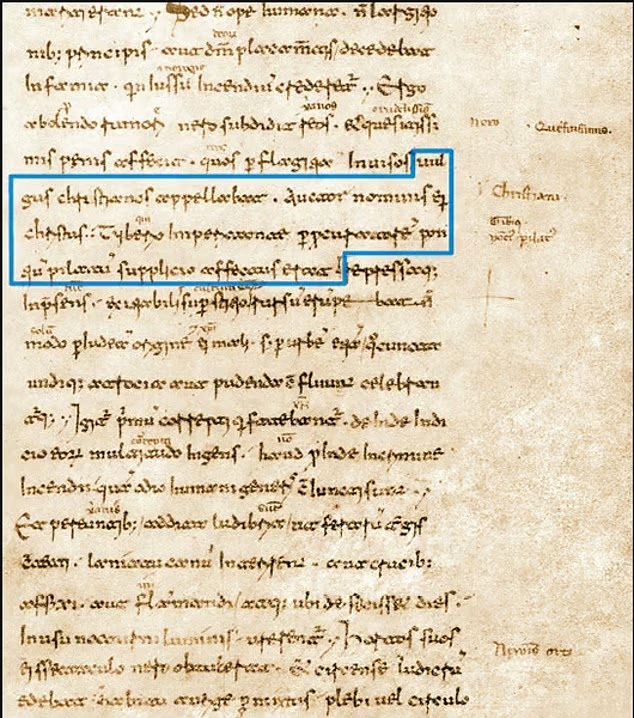
The highlighted passage contains Tacitus’ reference to Christians, stating that their founder, Christ, was executed during the reign of Emperor Tiberius by the Roman governor Pontius Pilate. Credit: Codex Mediceus 68 II, fol. 38r, the Biblioteca Medicea Laurenziana, Florence, Italy.
Josephus and the brother of Jesus
The second major source is Flavius Josephus, a Jewish priest, aristocrat, and historian born only a few years after the period in which Jesus is believed to have been crucified. Josephus lived through the First Jewish Revolt against Rome and later wrote under imperial patronage in the Flavian court.
In Jewish Antiquities, Josephus mentions the execution of James, a leader of the early Jerusalem church. To identify which James he meant, Josephus called him “the brother of Jesus who is called Christ.”
That sentence is short, almost incidental, but that is exactly why scholars often regard it as powerful. Jesus is not the subject of the passage. His name appears only because Josephus needed to identify James more clearly. Since both “James” and “Jesus” were common names in first-century Judea, the phrase “who is called Christ” helped distinguish this Jesus from others.
For many historians, this casual reference would make little sense unless Josephus and his readers understood Jesus to have been a real person known within recent Jewish history.
The debated longer passage
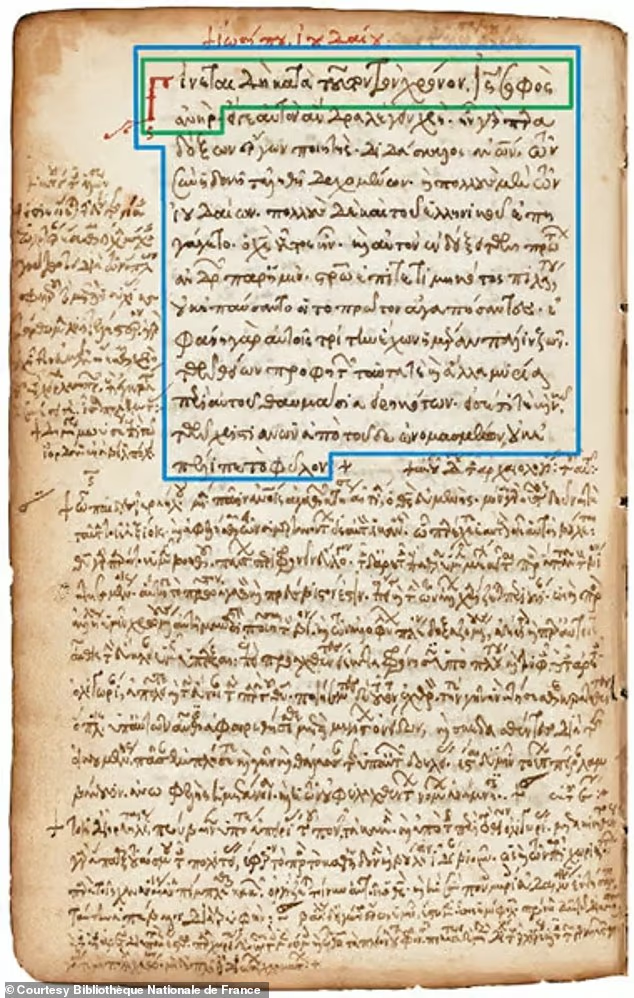
Josephus also contains a longer passage about Jesus, often called the Testimonium Flavianum. In its surviving Greek form, it describes Jesus as a wise man, a teacher, the subject of accusations by leading Jewish figures, and a person condemned to crucifixion by Pilate.
The problem is that parts of the passage sound too openly Christian to have come from Josephus himself, especially direct statements presenting Jesus as the Messiah or referring to his resurrection in confessional language. Because Josephus remained a Jewish historian writing for a Roman audience, most scholars do not accept the entire passage as it now stands.
The more common view is more cautious: Josephus likely wrote an original notice about Jesus, and later Christian scribes altered or expanded some phrases. Even after those suspected additions are removed, many scholars believe the core still points to a historical Jesus who was known as a teacher, attracted followers, and was executed under Pilate.
What these sources can and cannot prove
Tacitus and Josephus do not prove theological claims about Jesus. They do not settle debates about miracles, resurrection, or Christian doctrine. That is not what ancient documentary evidence can do.
What they do offer is something narrower but historically important. They show that Jesus was known outside Christian texts, that his name was connected to the rise of a new religious movement, and that his execution under Roman authority was remembered by non-Christian writers within roughly a century of his death.
Other ancient writers, including Lucian of Samosata, Pliny the Younger, and possibly Suetonius, also refer to early Christians or to Christ in hostile or dismissive terms. These references are generally less direct than Tacitus and Josephus, but they add to the picture of a movement that had spread from Judea to Rome and beyond by the second century.
Perhaps the most telling point is this: ancient critics of Christianity attacked Jesus in many ways. Some accused him of deception, sorcery or false teaching. Yet in the surviving ancient record, opponents do not appear to have built their case on the claim that Jesus never existed.
That silence matters. In a world where rival religious claims were often challenged aggressively, denying Jesus’ existence would have been a simple and powerful argument. Instead, Jewish, Roman, and pagan critics treated him as a real figure, even when they rejected what his followers believed about him.
For historians, that makes the evidence from Tacitus and Josephus especially significant. It does not turn faith into archaeology. It does not make the New Testament unnecessary as a source. But it does place Jesus of Nazareth firmly within the documentary world of Roman Judea, where memory, politics, and belief first began to shape one of history’s most influential movements.
Source note: This article is based on a Daily Mail report and a Biblical Archaeology Society review by biblical scholar Lawrence Mykytiuk on extra-biblical evidence for Jesus.
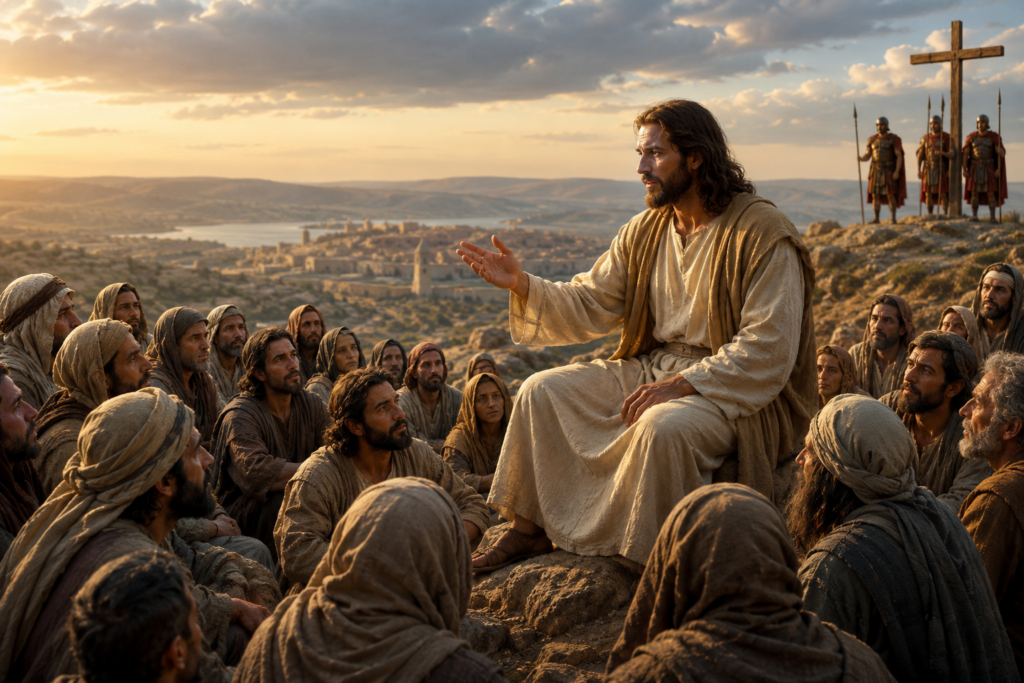
Cover Image Credit: Jesus teaching a gathered crowd in first-century Judea, with Roman soldiers in the background. This illustrative image was created with artificial intelligence for editorial use.
