
A new study published in Nature Ecology & Evolution has shed fresh light on one of prehistory’s most puzzling events: the sudden decline of Neolithic populations across Europe more than 5,000 years ago. By analyzing ancient DNA from a burial site near Paris, researchers have uncovered evidence of a dramatic population turnover, raising new questions about disease, migration, and societal change at the dawn of European civilization.
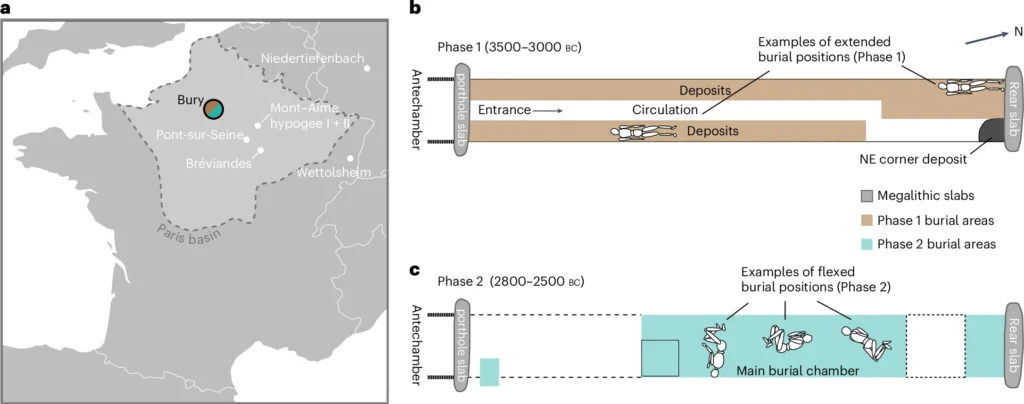
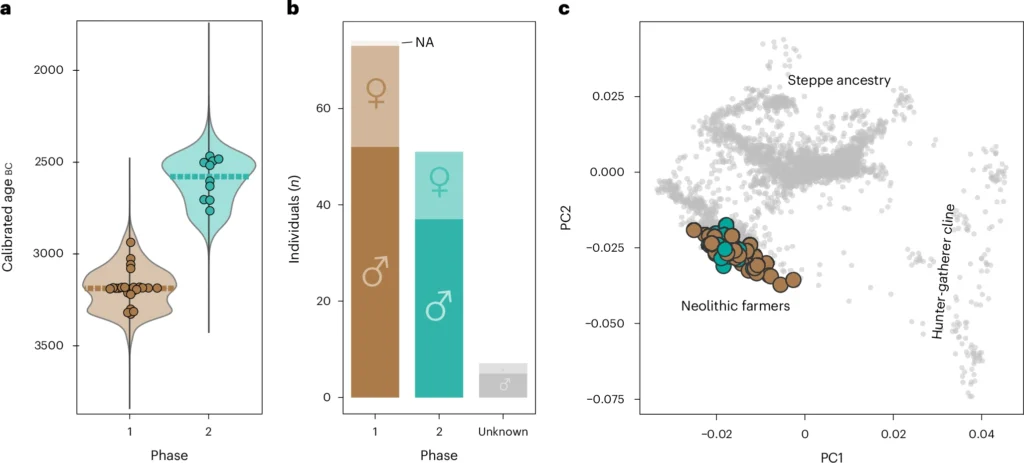
The research focuses on a large Neolithic burial complex at Bury, located roughly 50 kilometers north of Paris. Scientists sequenced 132 ancient human genomes from the site, which spans two distinct burial phases separated by a period of apparent abandonment. What they found was striking: the people buried before and after this gap were not closely related, suggesting a major population discontinuity rather than a gradual evolution of the same community.
A Sudden Break in Human Continuity
The first burial phase dates to the late fourth millennium BC, ending around 3000 BC—right when megalithic tomb-building practices across northwestern Europe began to decline. After a hiatus, the site was reused by a genetically different group during the third millennium BC.
“This wasn’t just a cultural shift,” the study indicates. “It represents a real demographic break.”
Genetic analysis revealed that individuals from the later phase were more closely related to populations from southern France and the Iberian Peninsula. This suggests that after the decline, new groups migrated northward into the Paris Basin, partially replacing earlier inhabitants.
The “Neolithic Decline” Mystery
Archaeologists have long observed a widespread drop in population and activity across Europe at the end of the Neolithic period. Megalithic tomb construction—once a hallmark of the era—abruptly ceased. Radiocarbon data also point to a reduction in burial practices and human presence in many regions between 3000 and 2600 BC.
But the causes of this “Neolithic decline” have remained elusive.
The new study strengthens the idea that this was not merely a cultural transformation but a real population collapse. Evidence from Bury aligns with broader patterns seen across Europe, including forest regrowth—an indicator that farmland was abandoned and human activity sharply decreased.
Disease, Environment, or Both?
One of the most intriguing findings involves ancient pathogens. Researchers detected DNA from several infectious diseases, including Yersinia pestis—the bacterium responsible for plague—as well as other microbes linked to serious illness.
Although the prevalence of plague at Bury was relatively low, its presence suggests that infectious diseases may have played a role in weakening populations. Combined with increased population density and close contact with domesticated animals, Neolithic communities may have been particularly vulnerable to outbreaks.
Environmental stress could have compounded the problem. Farming practices may have degraded soils and reduced agricultural productivity, making it harder for communities to sustain themselves. As land became less viable, populations may have shrunk or migrated.
A Shift in Society
The genetic evidence also reveals a fascinating transformation in social organization.
During the earlier phase, most individuals buried at Bury were closely related, forming large family networks spanning multiple generations. This suggests a tight-knit, kin-based community structure.
In contrast, the later phase shows fewer close relatives and a higher proportion of unrelated individuals. This points to a more fragmented or socially complex society, possibly reflecting new cultural practices introduced by incoming groups.
The shift hints at deeper societal changes beyond simple migration—perhaps new systems of inheritance, leadership, or social identity.
Migration Before the Bronze Age
The study also challenges previous assumptions about the timing of major migrations in Europe.
While the arrival of steppe populations during the Bronze Age is well documented, the Bury findings reveal an earlier wave of movement from Iberia into northern Europe around 2900 BC.
This migration occurred before the spread of the Bell Beaker culture, suggesting that Europe’s genetic landscape was already undergoing significant change prior to the Bronze Age transformations.
A Wider European Pattern
Importantly, the Bury site is not an isolated case. Similar gaps in burial activity and signs of population decline have been documented in Germany, Scandinavia, and other parts of Europe. Forest regrowth patterns and archaeological data all point toward a continent-wide disruption.
Researchers now believe that the Neolithic decline may have created a “demographic vacuum,” allowing new populations to expand into previously occupied areas.
Rethinking Prehistoric Europe
The findings from Bury offer a powerful reminder that prehistoric societies were far from static. Instead, they were shaped by dynamic forces—migration, disease, environmental change, and social transformation.
Rather than a smooth progression from Neolithic farmers to Bronze Age cultures, Europe’s past appears marked by episodes of collapse and renewal.
As ancient DNA technology continues to advance, scientists are uncovering increasingly detailed snapshots of these long-lost worlds. Each discovery adds another piece to the puzzle of how modern Europe came to be.
And in the case of Bury, the message is clear: thousands of years ago, entire communities vanished—and were replaced by new ones, reshaping the continent in ways we are only just beginning to understand.
Seersholm, F.V., Ramsøe, A., Cao, J. et al. Population discontinuity in the Paris Basin linked to evidence of the Neolithic decline. Nat Ecol Evol 10, 677–688 (2026). https://doi.org/10.1038/s41559-026-03027-z
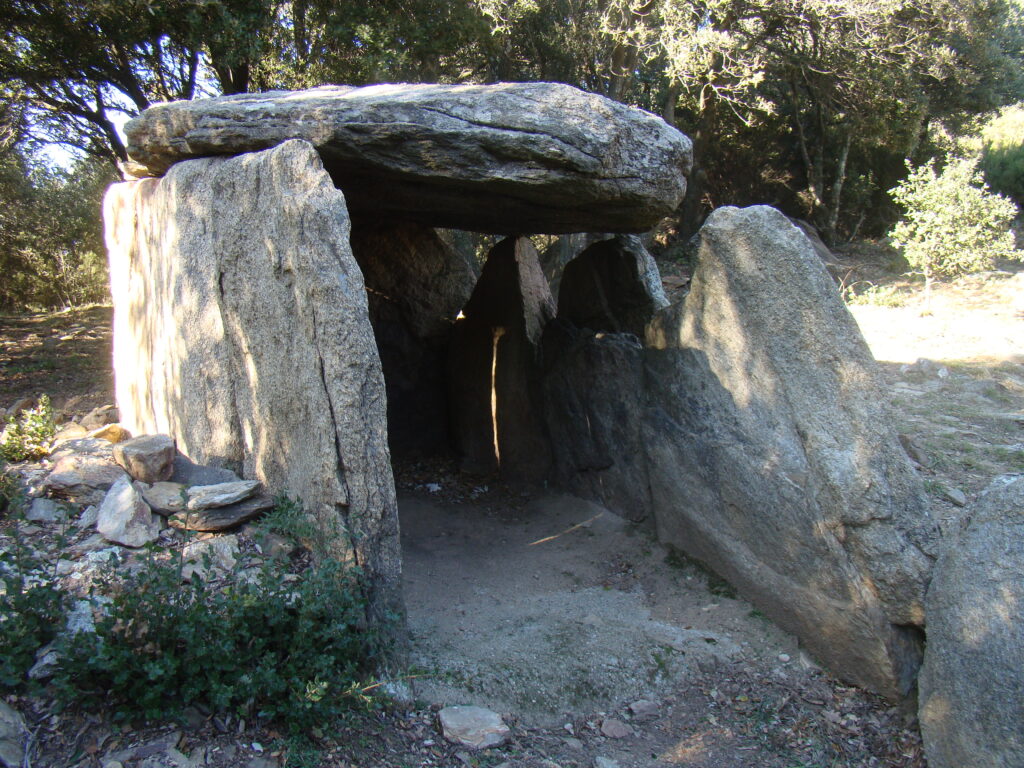
Cover Image Credit: View of the Balma de Na Cristiana dolmen from the front, slightly to the left. Public Domain
