
In 763 BCE, the sun disappeared over Assyria.
The total solar eclipse was carefully recorded by the kingdom’s scribes. To Assyrian scholars, however, it was more than a celestial event. Eclipses could signal the death of a ruler, and one royal prince may have seized the moment to challenge his nephew for the throne.
His rebellion appears to have succeeded—at least briefly. He took the name Tiglath-pileser, ruled from the sacred city of Ashur and issued land grants under the royal seal. Then he vanished from Assyria’s official history.
A new study argues that he was not alone. By re-examining damaged tablets, altered inscriptions and irregularities in ancient chronological records, Alexander Johannes Edmonds of the University of Münster and Eckart Frahm of Yale University have identified evidence for three previously unrecognized Neo-Assyrian kings.
The proposed rulers—Ashur-uballit, Tiglath-pileser and Shalmaneser—appear to have held power for less than two years each before they were defeated or deposed. Their names were subsequently omitted from the Assyrian King List, the document that has shaped modern reconstructions of Assyria’s royal succession for more than a century.
The research was published in the Journal of Cuneiform Studies.
The king list was not a neutral record
The Assyrian King List survives in several cuneiform copies. It presents the monarchy as an orderly institution in which power usually passed from father to son, creating what appears to be an uninterrupted sequence of legitimate rulers.
Historians have long treated its later sections as the backbone of Neo-Assyrian chronology, covering the period from roughly 1000 to 609 BCE. During these centuries, Assyria expanded from its northern Mesopotamian heartland into an empire that controlled much of Western Asia.
Edmonds and Frahm argue that the list was less an exhaustive register than an authorized version of royal history. Rulers who survived long enough to establish their legitimacy were preserved. Rivals who lost may have been removed.
No newly excavated tablets produced this revision. Much of the evidence had been available for decades—or, in one case, more than 125 years—but had been interpreted through the assumption that the king list was complete.
A rebel king under an eclipsed sun
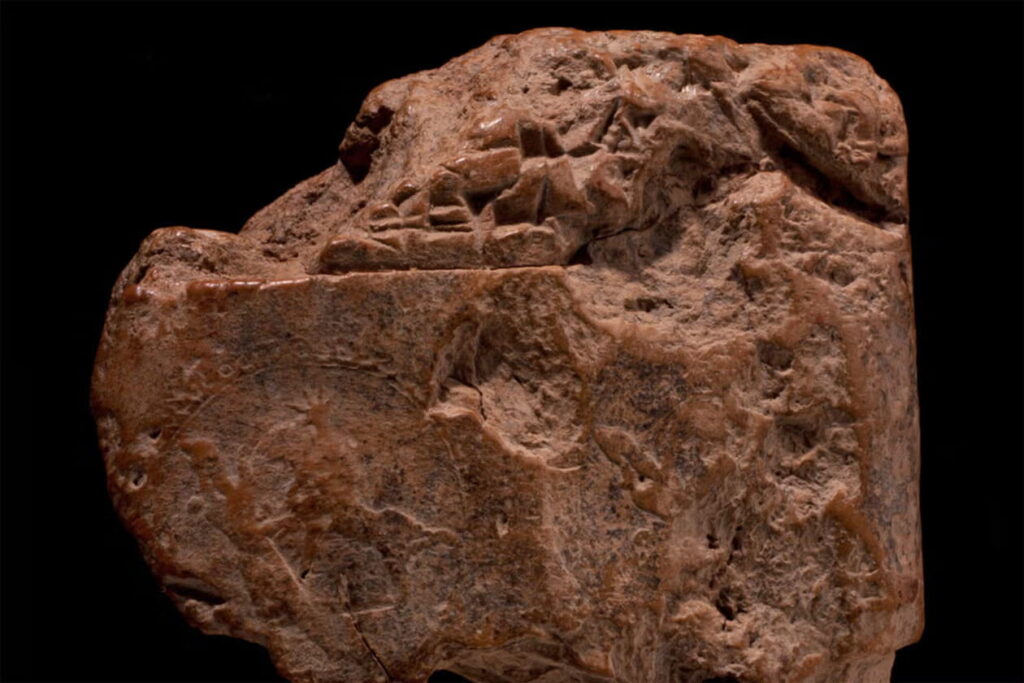
The strongest case concerns a badly damaged clay tablet known as Rm 75, found at Nineveh and now held by the British Museum.
The tablet records a royal grant dated to 762 BCE. Earlier scholars attributed it to Adad-narari III, even though that king had died in 783 BCE. The text also contained the name Tiglath-pileser, previously identified as Tiglath-pileser III, who did not take the throne until 745 BCE.
The chronology did not work.
Frahm’s rereading of the tablet’s damaged opening replaces the name Adad-narari with Tiglath-pileser. Under this interpretation, the grant was issued by a previously unknown son of Shamshi-Adad V who had adopted an established Assyrian throne name.
Impressions of the royal seal remain on the tablet. Its references to the god Ashur and to Ishtar of Ashur suggest that it was issued in the city of Ashur, Assyria’s religious center and the traditional setting for royal enthronements.
Other records place a revolt in the city during both 763 and 762 BCE. The Assyrian Eponym Chronicle also records the solar eclipse of 763 BCE, an event that would have carried dangerous political meaning for the reigning king, Ashur-dan III.
The researchers reconstruct the rebel Tiglath-pileser as Ashur-dan’s uncle. He may have used the eclipse and a period of instability to claim the throne, gaining control of Ashur while his nephew remained based at Kalhu, or Nimrud.
His rule may have lasted no more than 20 or 21 months. The evidence does not establish whether he died, was executed or continued leading rebellions elsewhere after losing Ashur.
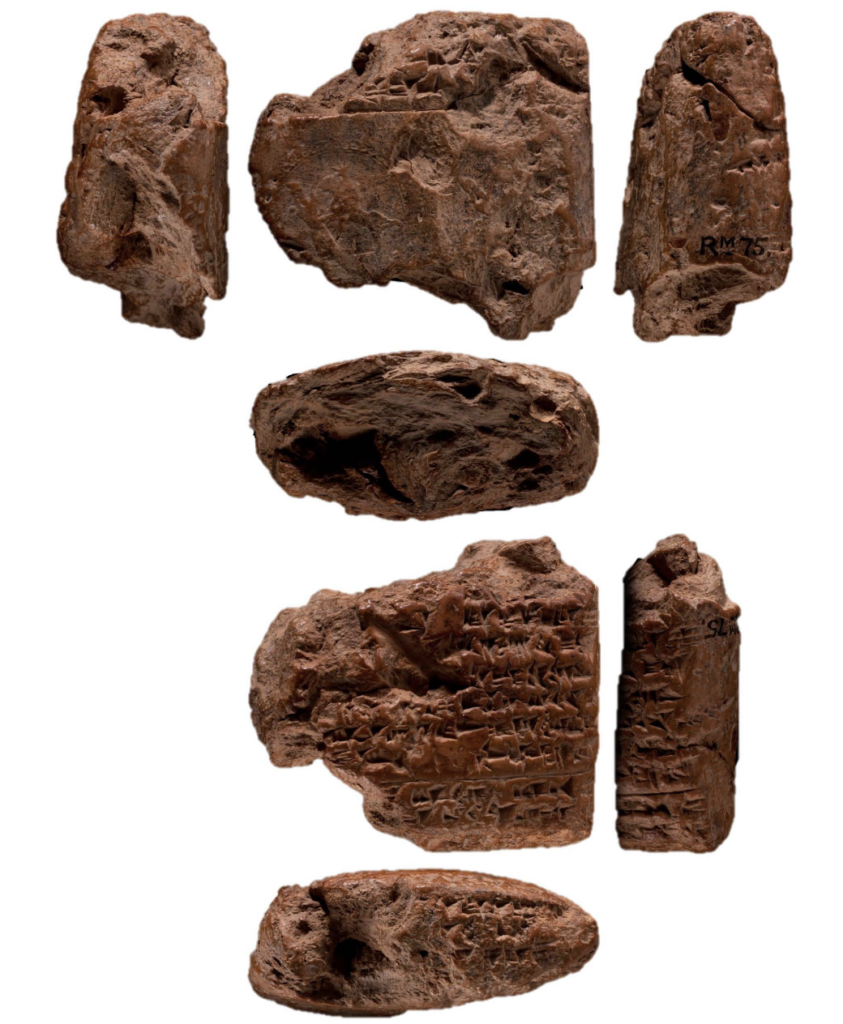
Image of the tablet Rm 75. Credit: Trustees of the British Museum, Edmonds & Frahm, 2026
A royal name carved over another
The second proposed ruler emerges from a stone monument discovered at Tell Abta in Iraq in the late 19th century.
The stela belonged to Bel-Harran-belu-usur, a senior Assyrian palace official who built a new settlement in the desert. Its inscription originally named the reigning king as Shalmaneser. At some point, that name was deliberately overwritten with Tiglath-pileser.
Previous explanations attempted to identify the erased ruler with one of the Shalmanesers already known from the official king list. Each solution required awkward gaps, unusually long careers or political circumstances that did not fit the monument.
Edmonds and Frahm instead propose that an unknown Shalmaneser succeeded Ashur-narari V in late 747 BCE. He may have ruled for approximately a year and a half before Tiglath-pileser III seized power in 745 BCE.
The new reconstruction also helps explain anomalies in the surviving eponym records and conflicting accounts of the length of Tiglath-pileser III’s reign. After the change of regime, Bel-Harran-belu-usur apparently replaced his former king’s name on the stela and retained his position under the victor.
The argument is less direct than the evidence for the rebel Tiglath-pileser, but the altered royal name, chronology and administrative records point to the same short interval of disputed rule.
The king remembered by a silver beer vessel
The earliest of the three proposed kings may have reigned around 913 to 912 BCE.
His name survives on a tablet from Ashur describing the restoration of a silver vessel used to pour beer for the god Ashur. The vessel had originally been made by King Tukulti-Ninurta I and was later repaired by someone named Ashur-uballit before being restored again by Tukulti-Ninurta II.
Neither of the previously recognized kings named Ashur-uballit fits the sequence. Ashur-uballit I lived too early, while the ruler conventionally called Ashur-uballit II lived nearly three centuries later.
The inscription refers to the vessel’s earlier benefactors as royal ancestors and instructs a future ruler to maintain it. That language makes it difficult to explain the unidentified Ashur-uballit as an ordinary private citizen.
The researchers connect him with evidence that Adad-narari II may have seized the throne. A monumental royal statue at Ashur was decapitated, stripped of its insignia and converted into a monument bearing Adad-narari’s genealogy. His own inscriptions also describe his elevation in unusually elaborate terms that may reflect the need to justify an irregular accession.
Under the proposed reconstruction, Ashur-uballit briefly succeeded Ashur-dan II before being overthrown by Adad-narari II, probably another member of the royal family.
Traces that erasure could not remove
All three cases remain historical reconstructions, and the surviving evidence is uneven. The tablet naming the rebel Tiglath-pileser offers the clearest individual case; the proposed reigns of Shalmaneser and Ashur-uballit depend on several sources being read together.
Taken as a group, however, the documents challenge the image of an Assyrian monarchy moving smoothly from one ruler to the next. The three men appear to have been members of the royal dynasty, enthroned at Ashur and supported by sections of the military, religious or administrative elite.
Their defeats did not merely end their reigns. Their successors seem to have reshaped the record: a name was carved over, chronological markers were adjusted, and inconvenient rulers disappeared from the official sequence.
The omissions do not overturn the established chronology after 911 BCE, which is supported by continuous annual records. They do suggest that earlier Assyrian dates—and the political story built around them—may be less secure than the king list once made them appear.
Assyria’s rulers sought to leave history carved in stone and pressed into clay. Three of them nearly disappeared anyway.
Edmonds, A. J., & Frahm, E. (2026). Three new kings of Assyria. Journal of Cuneiform Studies, 78, 27–59. https://doi.org/10.1086/741239
Cover Image Credit: British Museum and the Cuneiform Digital Library Initiative
