

A newly published study has brought surprising clarity to one of Anatolia’s most iconic sacred landscapes. An untranslated Late Iron Age inscription discovered nearly four decades ago near the famous İvriz rock relief has finally been deciphered—revealing not only the ancient name of the İvriz spring but also unexpected details about the 8th-century BCE ruler who commissioned it: Warpalawa, King of Tuwana.
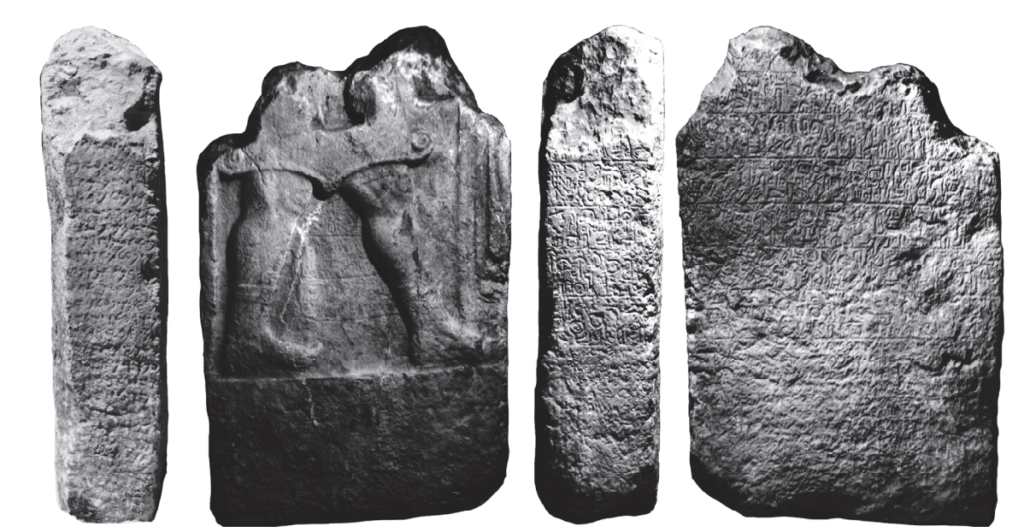
The limestone stele, referred to as İVRİZ 2, was unearthed by chance in 1986 during construction work in the modern village of Aydınkent, located near Ereğli in Konya Province, central Türkiye. Although known to scholars, its Luwian hieroglyphic text had never been fully edited or translated—until now. The newly published edition identifies the spring’s ancient name as Salusa (Sallusa in cuneiform sources), illuminating a key geographic reference long obscured in the historical record.
For a site as symbolically charged as İvriz—where the monumental relief of Tarhunza, the storm god, looms over a lush water source—this is no ordinary philological breakthrough. The discovery effectively reconnects a living natural landmark with its Bronze and Iron Age identity, giving the famous landscape a voice that had been silent for nearly three millennia.
A King Steps Forward from the Past
The stele’s Luwian inscription identifies its author as Warpalawa, one of the most prominent rulers of the Neo-Hittite world. Known in Assyrian records as Urballa of Tuhana, he was a vassal—or at times a reluctant tributary—of Tiglath-pileser III and Sargon II. Warpalawa is already well known from the masterpiece İVRİZ 1 relief, in which he stands in devotional posture before Tarhunza.
But the new stele adds fresh, vivid dimensions to his reign.
Warpalawa presents himself not simply as a pious king, but as an administrator of abundance: he boasts of increasing herds of oxen, sheep, and goats, providing agricultural prosperity for his land. He names his father, Muwaharani, and even his mother, whose name ends with “-walati”—a rare personal detail in royal Luwian inscriptions. This additional genealogical information helps clarify the Tuwanean–Nahitean dynasty and its continuity across the 8th century BCE.
More importantly, the new text shows Warpalawa performing a specific ritual and political action: erecting a stele dedicated to “Tarhunza of the River Salusa.”
This means that the stele was not simply decorative or commemorative—it served as a religious declaration tied to the sacred landscape itself.
A Bilingual Monument at the Crossroads of Cultures
Another remarkable detail: İVRİZ 2 carries two inscriptions. The Luwian hieroglyphs occupy the front, back, and right side, while a much-damaged Phoenician text appears on the left and lower sections. This bilingualism highlights İvriz as a cultural crossroads where Luwian, Aramaic-Phoenician, and Assyrian spheres intermingled.
The Phoenician sections appear to mirror or summarize the Luwian text—possibly for a linguistically diverse audience of merchants, travelers, or regional elites.
The initial examination and documentation of the stele were carried out in 1986 by Ali Dinçol, Belkıs Dinçol, Massimo Poetto, and Wolfgang Röllig, and the long-delayed edition was finally completed by Prof. Hasan Peker, allowing the multilingual monument to be fully reconstructed and its layered message revealed for the first time.
The Spring’s Ancient Name Rediscovered
Perhaps the most resonant finding is the identification of the spring’s ancient name: Salusa — The River of the God
The Luwian phrase (FLUMEN)Salusasin Tarhunzas appears clearly in the text: “This Tarhunza of the River Salusa…”
Cuneiform tablets from the Hittite Empire refer to a region called Šalluša, but until now scholars could not confirm whether this name corresponded to İvriz. The new stele settles the question: İvriz’s spring was known 2,700 years ago as Salusa.
This is more than a geographic detail—water names were sacred markers of territorial identity in Anatolian religions. The storm god’s presence at İvriz, long recognized from the main relief, now gains an explicit textual anchor in the landscape itself.
A Law Code in Stone
The inscription concludes with a striking sequence of curses and legal warnings—elements that together resemble a compact law code carved directly into stone. In this final section, the text makes unmistakably clear that both political loyalty and the sanctity of the monument were to be protected by divine authority.
Anyone who neglected the king’s commands, withheld the required allotments of land, or failed to honor the obligations tied to the spring and its cult was explicitly placed under threat. Even more severe condemnation awaited those who dared to harm the stele itself: erasing the king’s name, damaging the inscription, or interfering with the sacred dedication was framed not merely as an act of vandalism, but as a direct offense against Tarhunza.
The storm god, the inscription warns, would “trample them dreadfully,” underscoring that divine retribution would follow any assault on the physical or symbolic integrity of the monument. In this way, the stele served simultaneously as a religious declaration, a political safeguard, and a territorial boundary marker—anchoring the authority of both king and deity within the landscape.
A Sacred Landscape, Heard Anew
With the publication of İVRİZ 2, archaeologists now see İvriz not merely as a monumental relief site but as a textual landscape—a place where water, agriculture, kingship, and divine presence were woven together in the public ideology of Iron Age Tuwana.
And in this landscape, after 2,700 years, the spring once called Salusa speaks again.
Dinçol, B., Poetto, M., Dinçol, A., & Peker, H. (2025). An Anatolian Hieroglyphic Inscription on a Stele of Tarhunza from Ereğli (Konya): İVRİZ 2. Gephyra, 30, 1–12. https://doi.org/10.37095/gephyra.1776321
Cover Image Credit: İvriz Rock Monument. Governorship of Konya
