
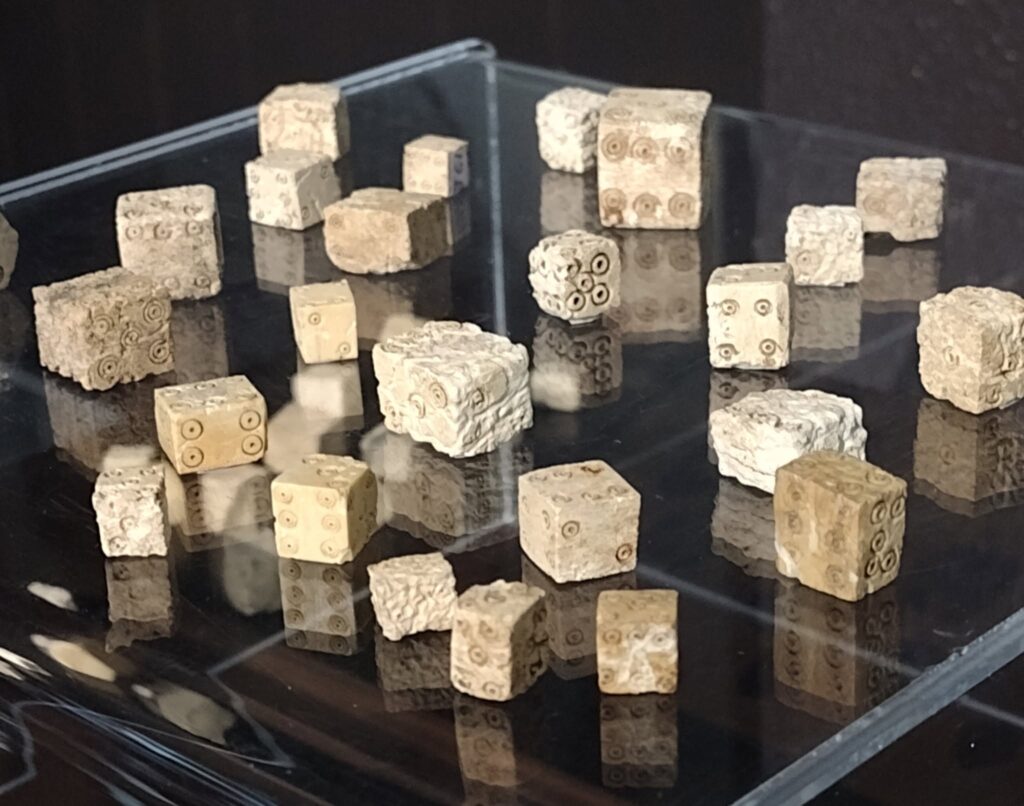
Archaeologists excavating a quiet village in northeastern France have uncovered more than 1,000 ancient bone dice, an extraordinary concentration that is raising an intriguing question: was this corner of Roman Gaul once a major center for gaming, ritual, or even something resembling an ancient “Las Vegas”?
The discoveries come from Grand, a village in the Vosges that today has only a few hundred residents. In Roman times, however, the settlement looked very different. It developed into a substantial Gallo-Roman center covering more than 70 hectares, with monumental public buildings, a vast amphitheater and an important sanctuary associated with the healing god Apollo Grannus.
Now, excavations beside the remains of the ancient basilica and its famous mosaic have revealed an unusually dense accumulation of dice whose purpose remains unresolved, adding a new puzzle to a site already known for its monumental architecture and religious importance.
More than 1,000 dice from a small Roman building
Archaeologists began excavating this part of Grand in 2022, initially to relocate and reassess structures investigated during archaeological work in the 1960s. During the 2023 and 2024 seasons, they exposed a small building measuring approximately 4.5 by 3.8 meters beside an east-west road. The structure opened toward the east and carried red-painted plaster above a yellow base.
What surrounded the building proved far more surprising. The deposits produced shoe nails, pottery fragments, animal bones, fibulae, bronze coins, eyed needles and hundreds of bone dice. By July 2026, archaeologists had already recovered more than 500 examples, while later reporting placed the total above 1,000.
Three dice came directly from the building’s foundations, suggesting that they were not simply random objects lost by passersby. Their close association with the structure has therefore become one of the strongest clues in attempts to understand whether the building served a specialized function.
Credit: Carole Raddato / Wikimedia Commons
Dice made to a recognizable Roman pattern
Craftspeople fashioned the dice from bone and marked them with small concentric circles known as ocelles. They cut these circles with a fine metal tool, and in some cases may have filled the markings with a mixture of wax and charcoal to create a stronger contrast against the pale surface.
Their numbering follows what archaeologists call the “Sevens” arrangement, in which opposite faces always add up to seven, the same basic configuration familiar on many modern dice. Dice themselves are not rare on Roman sites, and archaeologists have recovered them from houses, military camps, public buildings and amphitheaters across the empire.
What makes Grand exceptional is the scale of the concentration. More than 1,000 dice from such a restricted area are difficult to explain as accidental losses, and the excavation team has therefore considered several possible interpretations.
Workshop, gaming room or sanctuary?
One possibility is that the small structure functioned as a workshop where craftspeople manufactured dice. Another is that people used it as a dedicated gaming space. A third interpretation points toward ritual activity, since Roman dice did not belong exclusively to entertainment and could also appear in practices involving divination, chance, and appeals to the gods.
For now, archaeologists have not settled on one explanation. A nearby hydraulic installation makes the context even more complicated, because the team traced a narrow water conduit for roughly 20 meters north of the building. Iron collars found in place probably once connected wooden pipes, while a rectangular pit at the end may have contained a wooden basin.
That combination of water, a decorated building, coins, personal objects and an extraordinary number of dice suggests that the area may have served a purpose more complex than an ordinary domestic quarter. Whether that purpose involved production, gaming, ritual or some combination of them remains one of the central questions of the excavation.
Grand was anything but an ordinary Roman settlement
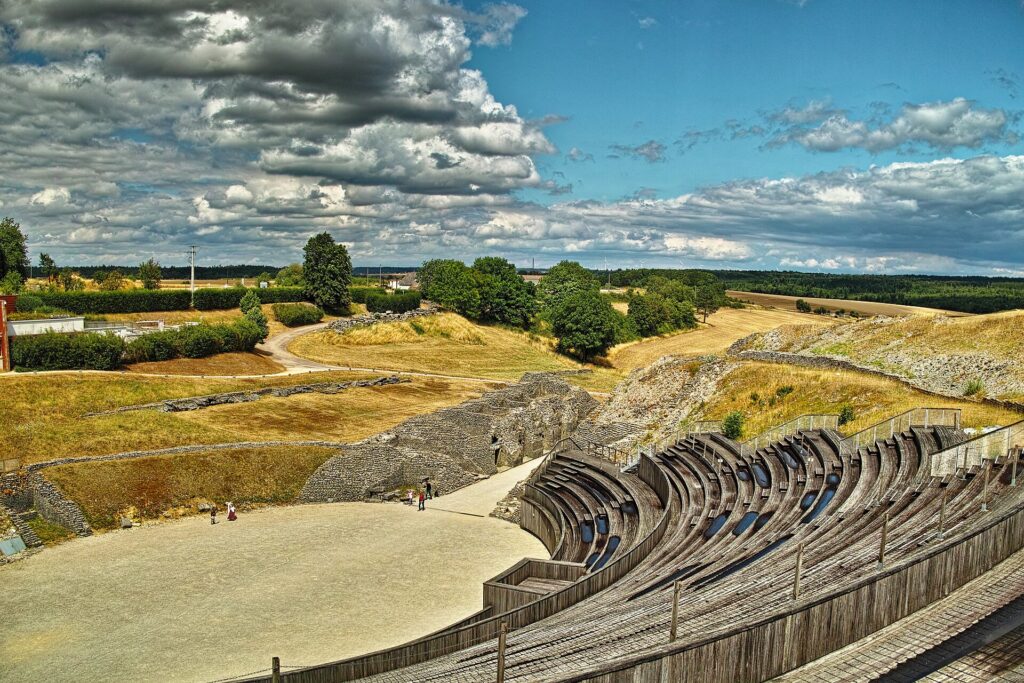
The idea of an ancient entertainment center sounds provocative, but Grand already possessed the infrastructure of an unusually important Roman town. Its amphitheater stretches about 148 meters and could accommodate more than 17,000 spectators, who would have gathered there for gladiatorial contests, animal displays, and other large public spectacles.
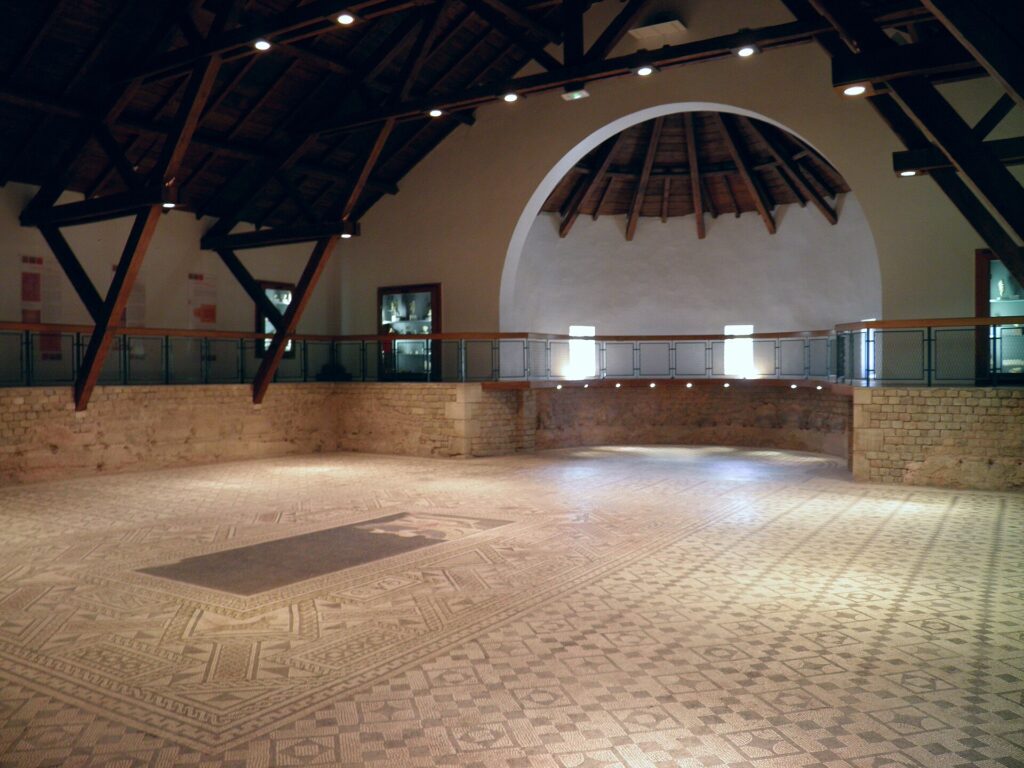
Nearby stands another of Grand’s major archaeological treasures: a monumental mosaic of more than 220 square meters, preserved inside the remains traditionally identified as a basilica. The settlement also developed around a sanctuary linked to Apollo Grannus, a healing deity whose cult attracted visitors seeking divine assistance and access to sacred or therapeutic waters.
Excavations elsewhere at Grand have reinforced the importance of water in the ancient town. Work carried out between 2010 and 2016 uncovered a broad gallery associated with a possible bath complex, decorated with marble and painted plaster, while an underground conduit may have carried water from a spring beneath the modern church toward the baths.
Together, these discoveries reveal a settlement that drew visitors for religion, spectacle and public life on a scale that seems remarkable beside the small modern village standing there today.
An ancient “Las Vegas”? Not quite yet
With a huge amphitheater, monumental public architecture and now more than 1,000 dice, the comparison with an ancient gambling destination is difficult to resist. Yet the archaeology does not show that Grand was a Roman casino town, and the dice may ultimately prove to be evidence of production rather than gambling, or of ritual practices that blurred the line between games, chance and divination.
That uncertainty is precisely what makes the discovery important. Grand has already shown that the small modern village conceals the remains of a surprisingly large and sophisticated Roman center, and the thousands of small bone objects now emerging beside its monumental buildings may reveal another side of life there, one in which chance, play and perhaps the gods were closely connected.
