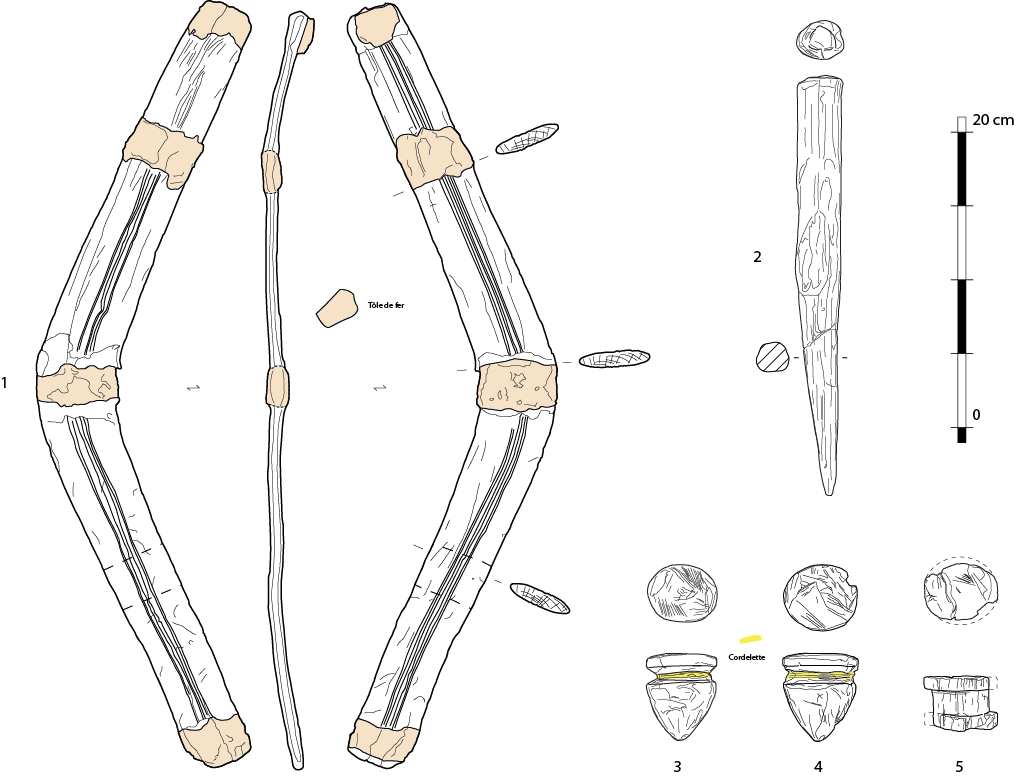
A curved wooden weapon discovered at an Iron Age settlement on the coast of Normandy is offering an unusual glimpse into hunting and ritual life in ancient Europe. Dating to around 120–80 BC, the object closely resembles what we would now call a boomerang, although archaeologists more precisely describe it as a throwing stick.
The remarkable artifact comes from Urville-Nacqueville in France’s Manche region, a prosperous coastal settlement connected to maritime trade across the English Channel. According to France’s National Institute for Preventive Archaeological Research (Inrap), the object is among the most unusual discoveries made at the site.
A Gaulish “Boomerang” Preserved in Wet Ground
Waterlogged soil protected the wooden weapon from decay for more than two millennia. Archaeological analysis dates its burial to the Late La Tène period, between approximately 120 and 80 BC.
The object has a wingspan of about 54 centimeters and was carved from a single branch of apple-family wood. Its surfaces were carefully finished and decorated with three parallel grooves, while iron strips were later attached at several points, apparently to reinforce or repair it. Traces of damage along its edges also support the interpretation that it had repeatedly been used as a projectile.
Unlike the familiar returning boomerang, however, the Urville-Nacqueville weapon was probably designed primarily for hunting rather than returning neatly to the thrower. Experimental studies suggest its shape could have produced a curved flight path and that it was particularly suited to hunting birds.
The archaeological context supports this interpretation. Animal remains found at the settlement include several species of waterbirds, while hunting may also have been an activity associated with higher social status during the Iron Age.
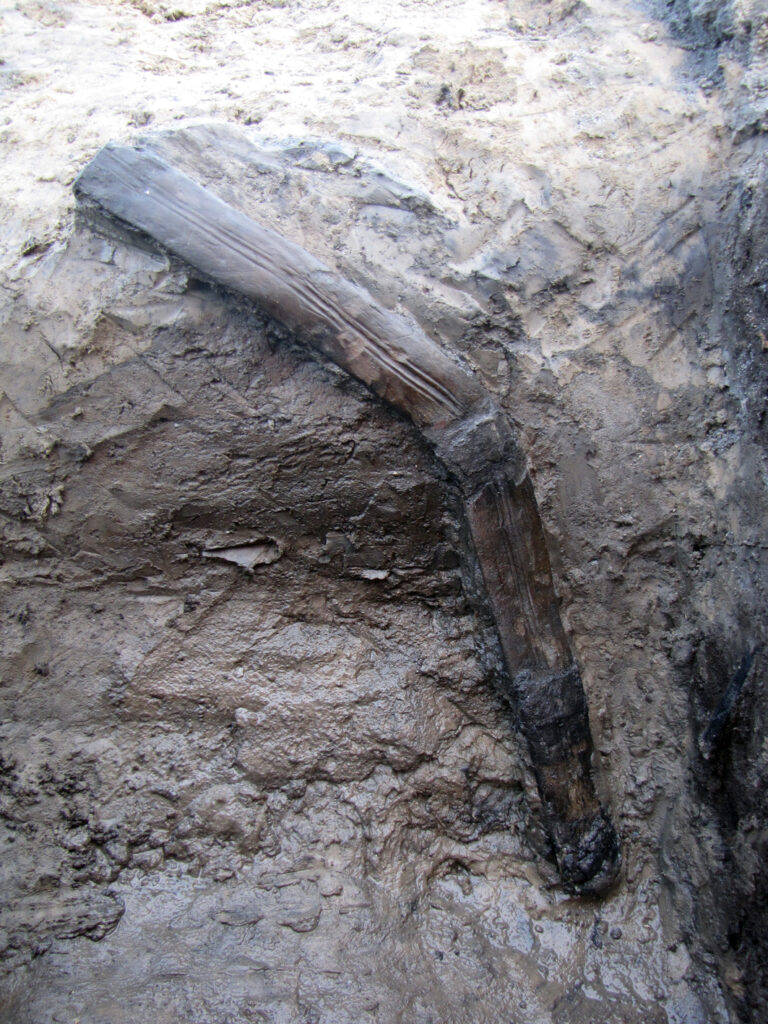
The wooden throwing stick found in situ, standing vertically against the wall of the ditch at Urville-Nacqueville. Credit: A. Lefort / Inrap / UMR 6566-CReAAH.
From Hunting Weapon to Ritual Offering?
The story of the artifact may not have ended with hunting. It was found inside a ditch where its placement appears to have been deliberate. Nearby archaeologists identified an extraordinary deposit combining an equid pelvis with a dog skull, together with pieces of whale rib, strengthening the possibility that this part of the site had a ritual function.
Ancient European throwing sticks were not unique to Gaul. Comparable Iron Age examples have been identified in the Netherlands and Germany, while much older throwing sticks are known from prehistoric Europe. Researchers have also connected such weapons with the Latin term cateia, used by ancient writers for a curved Gaulish projectile.
The Urville-Nacqueville find therefore does not prove that Gauls used the same returning boomerangs associated today with Aboriginal Australian traditions. It does show something equally intriguing: boomerang-like throwing weapons formed part of European hunting traditions thousands of years ago—and survived into the world of Iron Age Gaul.