
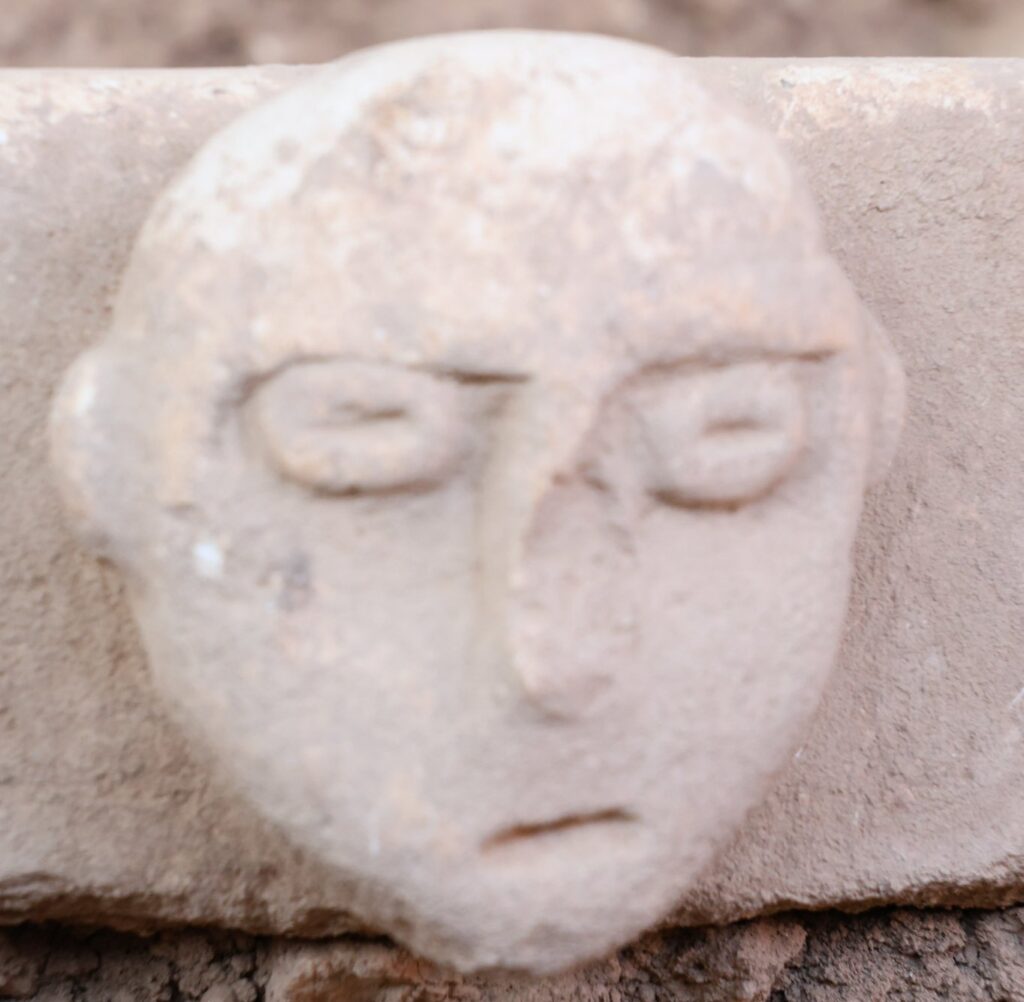
A stunning discovery at Sefertepe reveals 12,000-year-old carved human faces and a rare double-sided serpentinite bead, offering new insight into the Taş Tepeler world.
Archaeologists working in southeastern Türkiye have announced a set of discoveries that may significantly reshape our understanding of symbolic expression during the Pre-Pottery Neolithic. At a briefing held at the Karahantepe Visitor Center, Türkiye’s Minister of Culture and Tourism, Mehmet Nuri Ersoy revealed new findings from the fifth year of the Taş Tepeler project—an ambitious, multi-site research program spanning the ancient uplands of Şanlıurfa.
The new season’s results underscore that the Taş Tepeler landscape, which includes Göbeklitepe, Karahantepe, Sayburç, Sefertepe, and several lesser-known mound settlements, represents one of the earliest interconnected cultural zones in the world. Rather than a cluster of isolated ritual sites, the region now appears to be a dense constellation of communities developing complex architectural forms and experimenting with visual language more than twelve millennia ago.
Among the most striking revelations came from Sefertepe, where researchers uncovered two carved human faces on neatly dressed stone blocks—one executed in high relief, the other in low relief. Their contrasting techniques, stylistic choices, and unusual proportions immediately set them apart from previously known representations at Göbeklitepe, Karahantepe, and Sayburç. The subtle differences in cheek curvature, brow structure, and the treatment of the nose suggest that Sefertepe may have cultivated its own local sculptural idiom within the wider Taş Tepeler sphere.
Minister Ersoy also shared another unexpected find from the same area: a double-sided human motif carved into a black serpentinite bead. The tiny object, polished to a soft sheen, depicts two faces emerging from opposite sides of the stone. Its craftsmanship implies that small, portable items may have carried symbolic meanings just as complex as the monumental pillars for which the region is famous. This bead, together with the newly revealed relief faces, deepens the impression that Sefertepe was a place where ideas about identity, representation, and possibly even personhood were actively explored.
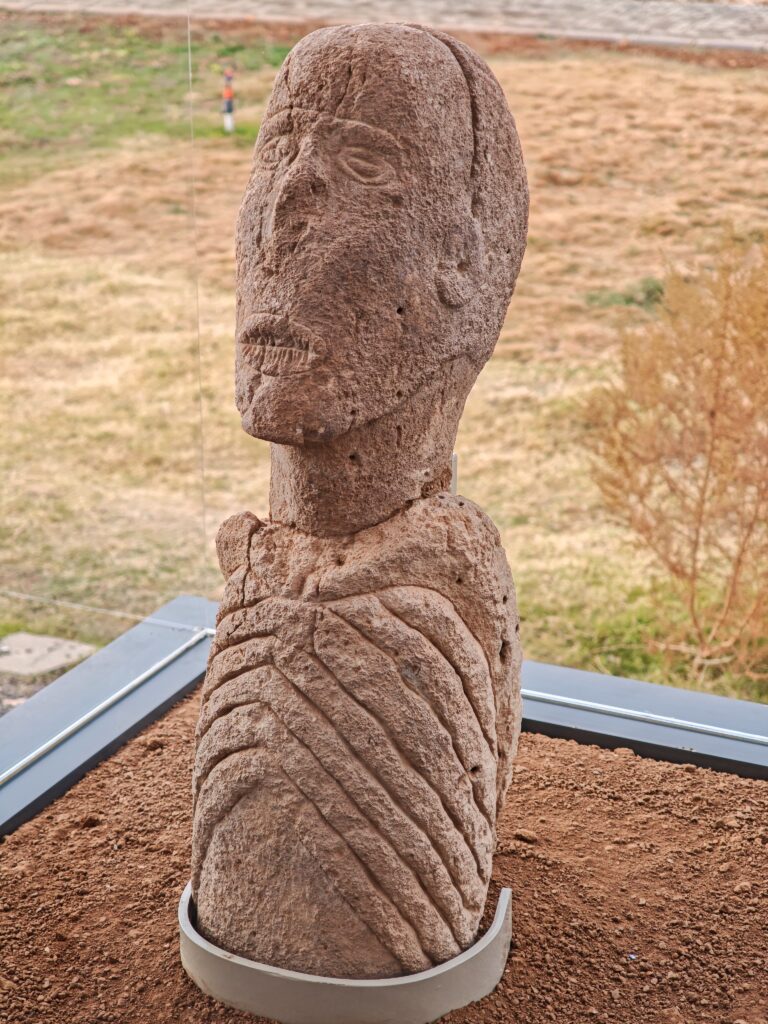
At Sayburç, excavations yielded a small but emotionally powerful sculpture whose expression evokes the inertia of death. The figure’s tightly sealed mouth—crafted as though stitched or closed deliberately—invites reflection on how prehistoric communities conceptualized the boundary between life and death. Minister Ersoy emphasized that the sculpture expands the interpretive possibilities for early funerary symbolism, complementing evidence of skull removal, secondary burials, and ritualized post-mortem practices known from other Neolithic sites.
The briefing also provided updates on conservation efforts across the region. At Göbeklitepe, restoration of the Lion-Pillar Building was completed last year, followed by successful stabilization of Structure C. At Karahantepe, work continues on the AD Structure, whose architecture remains one of the most distinctive examples of early communal design. A similar program has now begun in Sayburç, where the restoration of a domestic space will offer visitors clearer insight into the everyday environments of the region’s earliest agricultural communities.
Before addressing the press, Minister Ersoy toured a new exhibition at the Karahantepe Visitor Center with project director Prof. Dr. Necmi Karul. The display brings together previously unseen artifacts from recent excavation seasons, illustrating the evolving symbolic vocabulary of early Neolithic societies. From monumental pillars to finely carved beads, the exhibition demonstrates how representation operated on multiple scales—from intimate, handheld objects to imposing architectural elements carved with animals, humans, and geometric symbols.
Taken together, the Sefertepe reliefs, the serpentinite bead, and the Sayburç sculpture reinforce the view that the Taş Tepeler region functioned as a dynamic laboratory of symbolic experimentation between 10,000 and 12,000 years ago. The discoveries highlight not only shared traditions but also meaningful variations between individual sites, suggesting that each community contributed its own innovations to a larger cultural network.
As scientific work accelerates, southeastern Türkiye is emerging as one of the most revealing prehistoric landscapes on Earth. With the newest faces from Sefertepe joining the expanding corpus of early Neolithic imagery, the story of humanity’s first artists—and the beliefs carved into stone at the dawn of communal life—continues to grow richer and more intricate with each season of discovery.
