
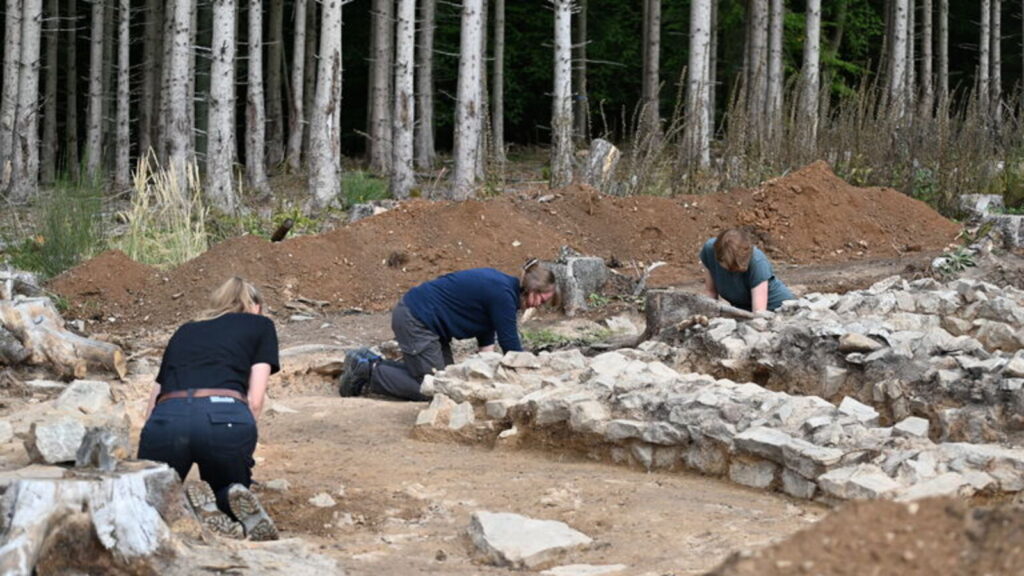
Just a few centimeters beneath the forest floor of the eastern Taunus, archaeologists are uncovering a remarkably preserved Roman settlement that once stood on the edge of the empire. The latest excavations have revealed a temple dedicated to Mars, new votive stones, a small bronze figure of Victoria and fragments of another statue that may have represented the Roman god of war himself.
The discoveries come from the vicus, or civilian settlement, attached to the Roman fort of Kapersburg in modern-day Hesse. Since 2024, hessenARCHÄOLOGIE and the Institute of Archaeological Sciences at Goethe University Frankfurt have been investigating an area that received far less archaeological attention than the nearby fort.
What is emerging beneath the trees is beginning to change the picture of life around Kapersburg — and may even offer evidence that activity continued there after Rome abandoned its frontier.
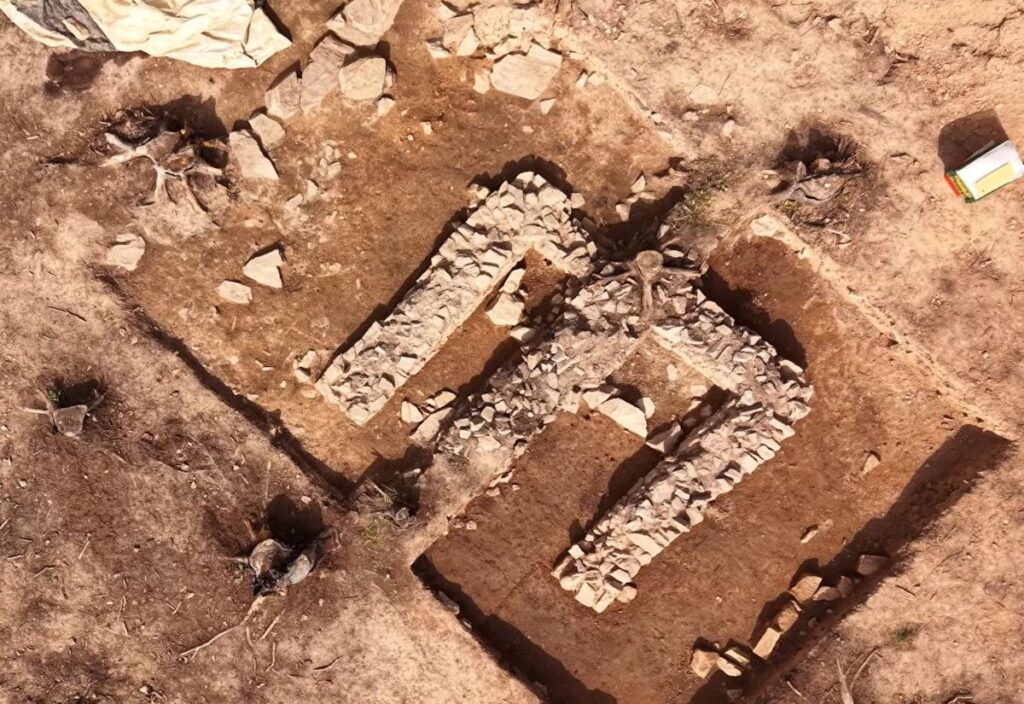
A Roman village preserved beneath the forest
Kapersburg formed part of the Upper German-Raetian Limes, the extensive frontier system that marked the limits of Roman-controlled territory north of the Alps. For roughly 150 years, the fort housed an auxiliary unit known as the Numerus Nidensium, whose name links its soldiers with ancient Nida, in what is now Frankfurt-Heddernheim.
The fort itself has been studied since the late 19th century, including excavations conducted by Louis Jacobi and the Imperial Limes Commission. The settlement outside its walls, however, remained comparatively poorly understood.
That has changed with the recent excavation campaigns.
Because the archaeological site lies beneath woodland rather than cultivated fields, centuries of ploughing never disturbed many of its upper layers. According to Dr. Kai Mückenberger, Hesse’s Limes coordinator and district archaeologist, preservation at the site is exceptional.
The team is encountering intact archaeological deposits only centimeters below the present forest surface. Roads, terraces, buildings and occupation layers that would normally have been damaged or completely removed elsewhere have survived beneath the trees.
A temple dedicated to Mars
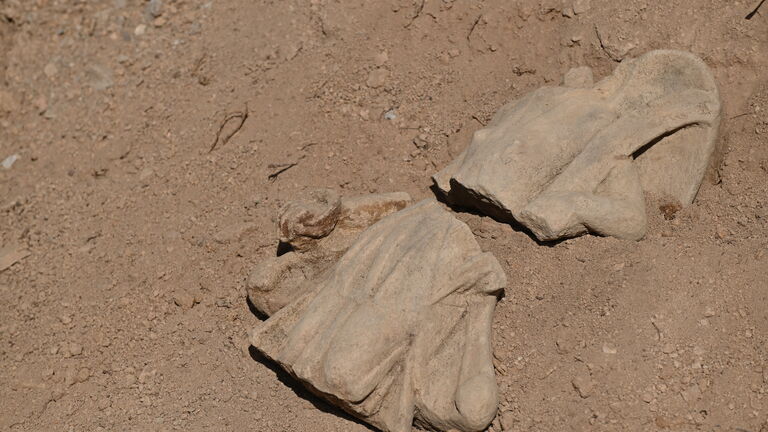
Among the most important discoveries, archaeologists identified the remains of a Roman temple within the civilian settlement. The sanctuary once honored Mars, and the excavation also produced two additional votive stones, a statuette of Victoria — the Roman personification of victory — and fragments from another statue.
Researchers suspect the larger statue may have represented Mars himself, although further study will be needed to confirm the identification. The new finds build on an earlier discovery from Kapersburg, where archaeologists recovered another votive stone dedicated to Mars during a previous excavation campaign.
That inscription is now displayed at the Wehrturm Museum in Rosbach vor der Höhe. Prof. Dr. Markus Scholz of Goethe University Frankfurt is studying the newly discovered inscriptions with the excavation team, helping researchers reconstruct religious practices among soldiers and civilians living along Rome’s northern frontier.
Evidence from after Rome abandoned the frontier
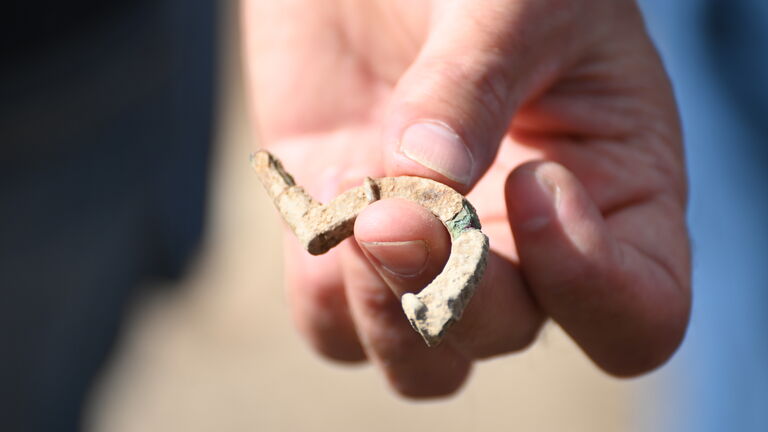
The area around the temple also produced evidence that may extend the history of Kapersburg beyond the Roman withdrawal. Archaeologists recovered a Late Antique brooch together with fragments of handmade pottery, finds that hessenARCHÄOLOGIE says could provide the first archaeological evidence for activity at the site after the Roman military abandoned the Limes region in the third century CE.
Roman control of the frontier weakened dramatically during the period traditionally associated with the so-called “Limesfall” in the mid-third century, and Kapersburg subsequently ceased to function as a Roman military installation. The newly discovered objects suggest, however, that people may have continued to use the settlement after the soldiers left.
Researchers cautiously associate the post-Roman material with Alemannic groups living in the Wetterau region. Further excavation will be needed to determine whether the finds represent brief activity at the abandoned site or a more sustained occupation.
If additional evidence emerges, Kapersburg could offer archaeologists an unusually well-preserved setting for examining the transition between Roman frontier life and the communities that followed it.
Workshops, houses and streets emerge beneath the trees
The excavation is also revealing how the Roman vicus developed while the fort was still occupied. Archaeologists have identified extensive evidence of craft production, including an area interpreted as a smithy, while later levelling deposits show that the Romans reorganized this part of the settlement and eventually replaced the workshop with residential buildings.
Traces of Roman roads and artificial terraces are helping the team reconstruct the size and internal organization of the settlement with increasing precision. Together, these features show that the vicus was not simply an appendage to the military fort but a complex settlement with its own changing layout and economic life.
More than 125 years after archaeologists first investigated the fort — and two decades after the Roman Limes became a UNESCO World Heritage Site — the woodland surrounding Kapersburg is still preserving substantial parts of that history almost directly beneath the feet of modern visitors.
For Mückenberger and his team, the Roman village has clearly not yet revealed all of its secrets. Further excavations with students from Goethe University Frankfurt are planned if research can continue next year.
