
According to a report by Hessenschau, archaeologists in Hesse have uncovered the first known Celtic “princely grave” in the Taunus, a discovery near Bad Camberg that is already being described as one of the most important Iron Age finds ever made in the region.
The grave came to light not through a planned search for a Celtic burial, but during archaeological work linked to a photovoltaic construction project near the A3 motorway in Limburg-Weilburg. What first appeared as strange lines and circles in geomagnetic survey images soon revealed the outline of something far more significant: a monumental burial complex belonging to a high-status Celtic individual from the early Iron Age.
A suspicious pattern beside the motorway
Before the excavation began, there was little to suggest that an elite Celtic grave lay beneath the unused ground near Bad Camberg. District archaeologist Kai Mückenberger ordered a geomagnetic survey as part of the checks connected to the planned solar park.
The survey images showed two thin, parallel lines running across the landscape and ending in a circular structure. Inside that circle was a sharply defined rectangular anomaly. To an archaeologist familiar with Iron Age elite burials, the pattern was hard to ignore. It resembled the processional routes and burial mounds known from major Celtic sites such as Glauberg in Hesse.
At first, Mückenberger reportedly treated the idea almost as a joke. The pattern looked too perfect. But when excavation work began, the soil quickly changed the mood. The bucket of an excavator brought up metal remains, including fragments of an iron spearhead. That was the first clear sign that the team had reached a burial chamber.
Gold jewelry survived where the body did not
The wooden walls of the grave chamber had long since decomposed. No human remains survived either. Yet the grave goods remained, and they were exceptional.
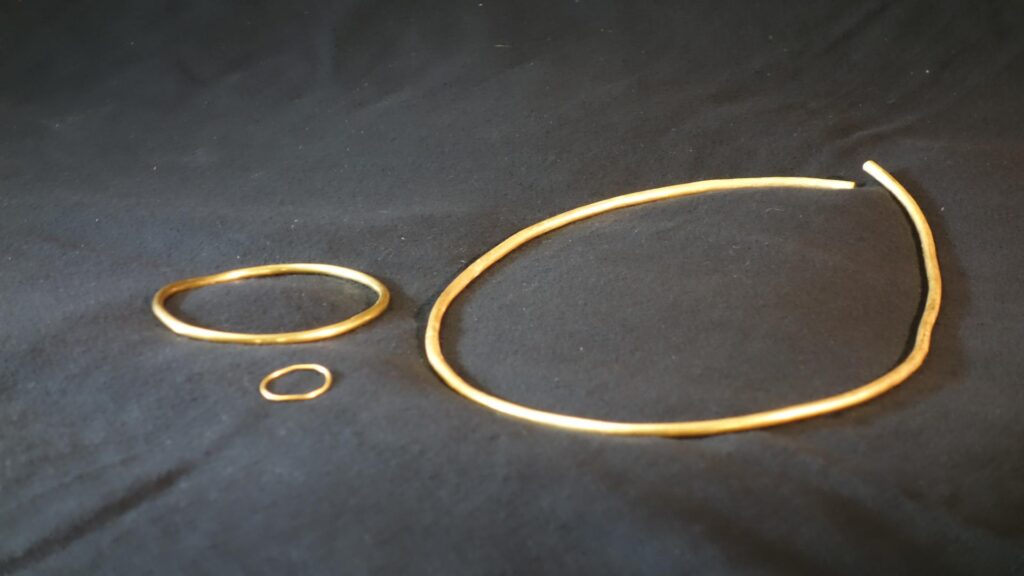
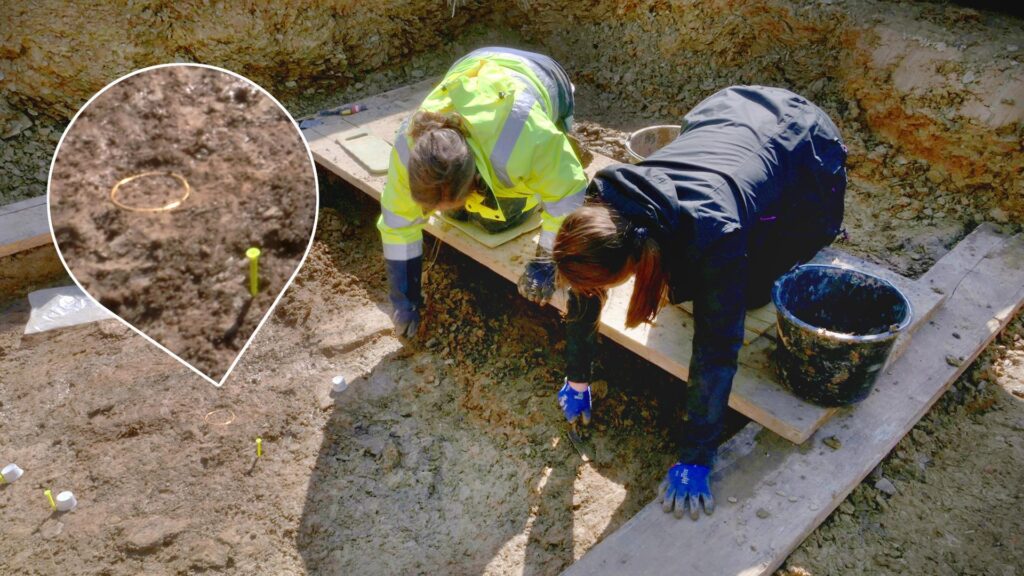
Among the most striking finds is a set of three solid gold rings. The buried person appears to have worn them at the neck, on the arm, and on a finger during the funeral. Despite more than two millennia underground, the gold ornaments survived in remarkable condition.
The gold is important not only because of its material value. In early Iron Age Europe, such objects were visible markers of rank, identity, and social power. Combined with the other grave goods from Bad Camberg, they point to a person who stood far above the ordinary population of the region.
A rare Celtic wagon burial in Hesse
The most spectacular part of the discovery may be the remains of a two-wheeled wagon placed inside the grave. Archaeologists and conservators are now studying the vehicle components at the State Office for Monument Preservation in Wiesbaden.
The finds include iron fittings from two wooden wheels. These metal bands once formed the running surfaces of the wheels. The wheels may have stood up to 1.20 meters high and were probably removed from the wagon before being placed upright against the wall of the burial chamber.
Other components suggest that the vehicle was richly decorated. Large round hubcaps and sleeve-like axle fittings made of non-ferrous metal, possibly bronze, may once have shone with a reddish-gold color. In one fitting, traces of the original wooden axle still survive.
Only a small number of Celtic wagon burials are known from Hesse. The Bad Camberg example is especially significant because of the quality and combination of its preserved objects.
An Etruscan jug points to long-distance connections
The grave also contained an Etruscan bronze jug, identified inside one of the soil blocks through X-ray imaging. This is a crucial detail.
Imported Mediterranean vessels in elite Celtic graves are often interpreted as signs of long-distance exchange, diplomatic contact or participation in high-status drinking rituals. The presence of an Etruscan vessel in the Bad Camberg grave suggests that the person buried there belonged to a social world connected far beyond the Taunus.
This pattern fits what archaeologists already know from other elite Celtic sites in Central Europe. During the early Iron Age, powerful communities north of the Alps maintained contact with the Mediterranean world. Luxury goods, metal vessels, and drinking equipment became part of the language of status among Celtic elites.
Nearly 100 finds under laboratory study
The Bad Camberg grave has produced close to 100 finds so far. Because many objects are extremely fragile, archaeologists did not expose them fully in the field. Instead, they lifted them in blocks of soil and transferred them to the conservation workshop in Wiesbaden.
There, restorers are examining the blocks using X-ray and other imaging methods before removing the soil. This approach allows specialists to document the precise position of objects and detect fragile materials before they are touched.
Smaller finds include bronze beads, possible glass or amber ornaments, rings that may have belonged to a belt, a small sickle-shaped knife used in everyday life, and pottery fragments, including pieces from a so-called lentil flask.
Each object adds a small clue. Together, they may eventually help researchers understand who this person was, how they were buried, and what kind of community built the grave.
Man, woman, warrior or ruler?
The identity of the deceased remains uncertain. Graves with similar equipment have often been associated with men, especially when weapons and wagons are present. The spearhead from Bad Camberg and the possible interpretation of the wagon as a war vehicle may support that reading.
Still, archaeologists are being careful. Without surviving bones, no biological sex can be confirmed. A female elite burial remains possible, especially because richly furnished graves of women are well known from the Celtic Iron Age.
The German term “Fürstengrab,” often translated as “princely grave,” does not necessarily mean that the person was a prince in the modern sense. It is an archaeological category used for exceptionally rich elite burials. In Bad Camberg, the gold rings, wagon, imported jug and weapon remains all point to a person of unusual status.
The first Celtic princely grave known from the Taunus
The burial is thought to date to the first half of the 5th century BC, at the beginning of the early Iron Age. Its grave goods place it close in time to other famous elite Celtic discoveries in Hesse, especially Glauberg, where richly furnished graves and the famous life-size Celtic warrior statue transformed understanding of Iron Age power in the region.
The Taunus already had an important Celtic record. The Heidetränk Oppidum near Oberursel later became one of the largest late Celtic centers in what is now Hesse, covering around 130 hectares. Other sites such as Altkönig, Dünsberg and the salt-production area of Bad Nauheim show that Celtic communities in Hesse controlled resources, trade routes and fortified settlements across different periods of the Iron Age.
Bad Camberg now adds a new and earlier piece to that picture. If the interpretation holds, the grave provides the first direct evidence of a Celtic elite burial of this rank in the Taunus itself.
For archaeologists, that is the real weight of the discovery. It does not merely add another rich grave to the European Iron Age record. It confirms that the Taunus was home to a high-ranking Celtic individual whose community had the wealth, ritual knowledge, and external contacts needed to create one of the region’s most remarkable burials.
Cover Image Credit: Gold ornaments for the neck, arm, and finger are among the unusual finds from Celtic graves of this period. © Thomas Kurella, hr
