
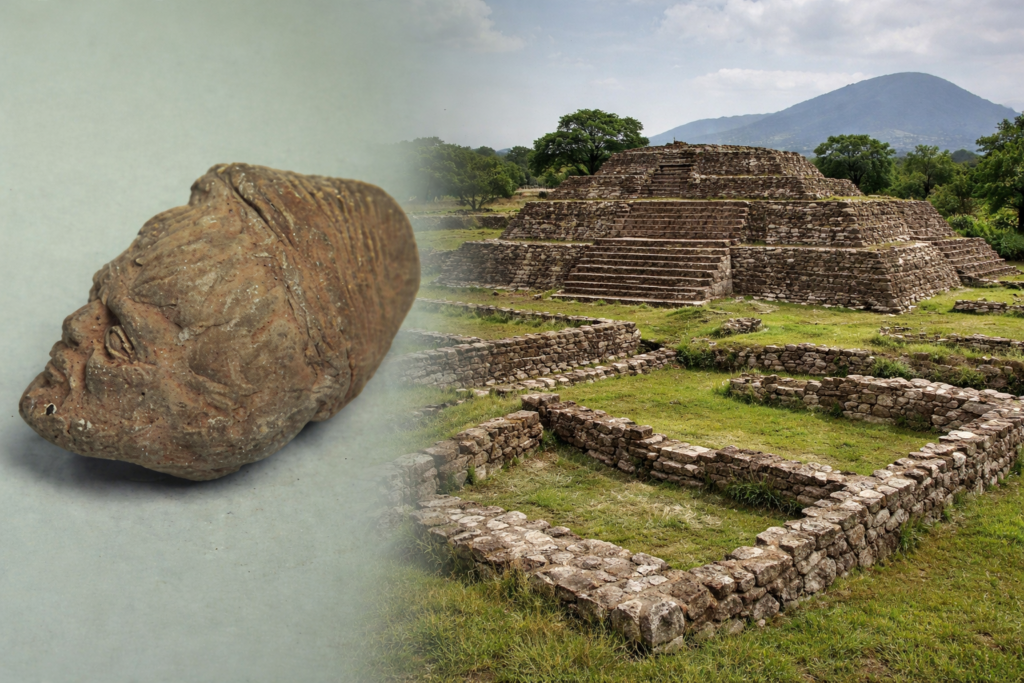
In the heart of central Mexico, beneath layers of earth untouched for centuries, archaeologists uncovered a discovery that still unsettles historians today. Known as the Tecaxic-Calixtlahuaca Head, this small terracotta artifact—found in a pre-Hispanic burial—has sparked one of the most intriguing debates in archaeology: Did ancient civilizations from Europe reach the Americas long before Columbus?
A Discovery That Defied Expectations
The story begins in 1933, when Mexican archaeologist José García Payón led excavations at the ancient site of Tecaxic-Calixtlahuaca, located roughly 65 kilometers from modern-day Mexico City.
Within a carefully sealed burial beneath three intact floor layers of a pyramidal structure, Payón’s team uncovered a rich funerary offering. The grave contained pottery fragments, gold ornaments, bone artifacts, and pieces of rock crystal—typical materials of pre-Columbian Mesoamerica.
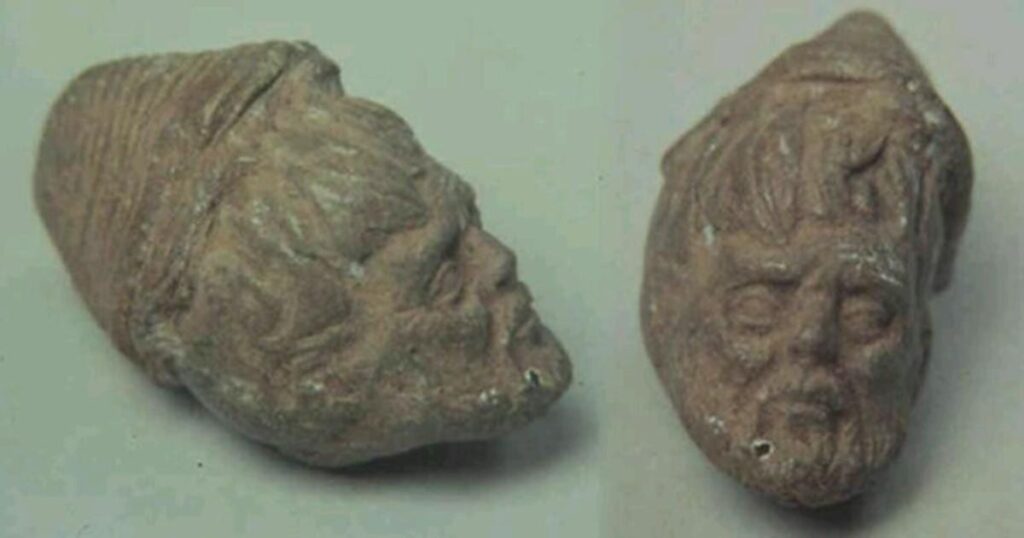
But among these objects was something entirely unexpected: a small terracotta head of a bearded man, with distinctly European features.
At first glance, the artifact appeared out of place. Its facial structure, beard style, and artistic execution did not resemble known indigenous Mesoamerican traditions. Instead, it looked strikingly familiar to something from the ancient Mediterranean world.
A Roman Face in the New World?
Decades later, the mystery deepened.
In 1961, Austrian anthropologist Robert Heine-Geldern examined the artifact and suggested it could date back as far as 200 BCE. Later, in the 1990s, German archaeologist Bernard Andreae—former director of the German Archaeological Institute in Rome—made a bold declaration.
According to Andreae, the head was “without any doubt Roman.”
His stylistic analysis pointed to the Severan period (193–235 CE), noting that the hairstyle and beard matched the fashion of Roman emperors from that era. If true, this would place the artifact’s origin in the Roman Empire—over a millennium before the burial in which it was found.
Scientific testing added another layer of intrigue. Thermoluminescence dating conducted in Germany suggested the object was indeed ancient, with a possible age range between the 9th century BCE and the 13th century CE. Crucially, this supported the idea that the artifact existed before Spanish contact with the Americas.
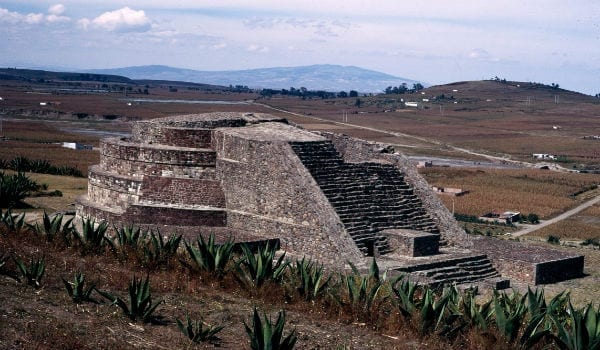
The artifact was discovered at the Tecaxic-Calixtlahuaca site alongside ceramic fragments, gold objects, bone, and rock crystal, sealed beneath three intact layers within a pyramidal structure.
A Timeline That Doesn’t Add Up
The burial itself was dated between 1476 and 1510 CE—just years before Hernán Cortés arrived in Mexico in 1519.
This creates a perplexing timeline. If the head is genuinely Roman and predates the burial, how did it end up in a sealed pre-Hispanic grave?
The find challenges the long-standing narrative tied to Christopher Columbus, whose 1492 voyage is traditionally seen as the first contact between Europe and the Americas. While Norse expeditions to North America are now widely accepted, evidence of Mediterranean civilizations reaching Mesoamerica remains controversial.
Theories Behind the Enigma
Over the decades, researchers have proposed several explanations—each as fascinating as it is contentious.
- An Archaeological Hoax
One of the simplest explanations is also the most controversial: the artifact may have been planted.
Some researchers have suggested that a member of the excavation team placed the Roman head in the burial as a prank. According to later accounts, Payón was not always present during the dig and did not maintain exhaustive field notes—leaving room for doubt.
However, this theory relies heavily on hearsay. No direct evidence has ever confirmed deliberate tampering, and key witnesses are no longer alive to clarify the claim.
- Early European Contact
Another possibility is that the head arrived in the Americas during the earliest phases of European exploration—perhaps even before the Spanish conquest of Mexico.
While the burial predates sustained contact, it overlaps with the earliest decades of transatlantic exploration. Could a stray European object have traveled inland and been incorporated into indigenous burial practices?
Some scholars consider this plausible, though unlikely.
- A Drifting Shipwreck from the Old World
Perhaps the most intriguing hypothesis involves ancient transoceanic drift.
Researchers like Romeo Hristov have suggested that a Roman, Phoenician, or Berber ship could have been carried across the Atlantic by currents. If wreckage reached the shores of the Americas, objects like the terracotta head might have been collected and eventually traded inland.
Importantly, this scenario does not require sustained contact or exploration—only a single accidental crossing.
Still, critics argue that such an event, while theoretically possible, lacks supporting archaeological evidence.
- Trans-Pacific or Asian Routes
A less discussed but equally intriguing idea proposes that the artifact may have reached the Americas via Asia. Ancient trade networks and migration routes across Eurasia could, in theory, have transported objects over vast distances before eventually crossing into the New World.
However, this theory remains speculative and difficult to prove.
A Mystery Still Unresolved
What makes the Tecaxic-Calixtlahuaca head so compelling is not just its unusual appearance, but the context in which it was found: a sealed, undisturbed burial.
Despite decades of study, no single explanation has achieved consensus. Each theory raises new questions, highlighting the complexity of interpreting archaeological evidence.
As archaeologist David Grove has pointed out, even if the head did arrive via a shipwreck, it would not necessarily prove intentional contact between civilizations.
And yet, the artifact remains an outlier—an object that does not fit neatly into established historical narratives.
Rewriting History—or Expanding It?
The Tecaxic-Calixtlahuaca head serves as a reminder that history is not always as settled as it seems. While extraordinary claims require extraordinary evidence, anomalies like this challenge researchers to remain open to new possibilities.
Was it a hoax? A lost relic of early exploration? Or evidence of a forgotten chapter in human history?
For now, the answer remains elusive.
Buried beneath layers of time, the Roman head continues to watch silently—its origins uncertain, its journey unknown, and its mystery very much alive.
Hristov R, Genovés S. MESOAMERICAN EVIDENCE OF PRE-COLUMBIAN TRANSOCEANIC CONTACTS. Ancient Mesoamerica. 1999;10(2):207-213. doi:10.1017/S0956536199102013
Cover Image Credit: AI-generated composite image representing the mysterious Roman terracotta head discovered at Tecaxic-Calixtlahuaca, juxtaposed with the ancient Mesoamerican pyramid where it was found.
