
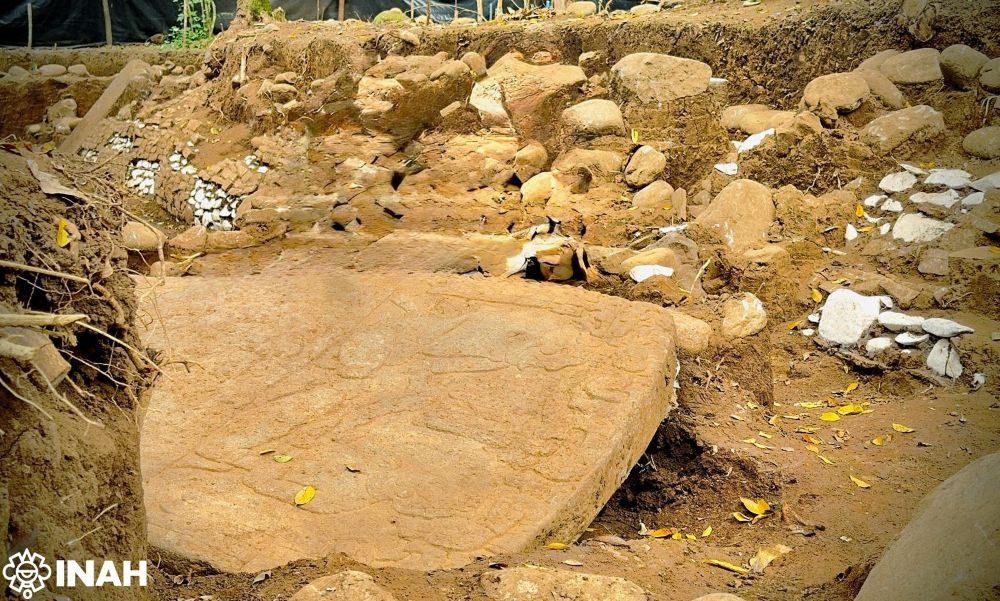
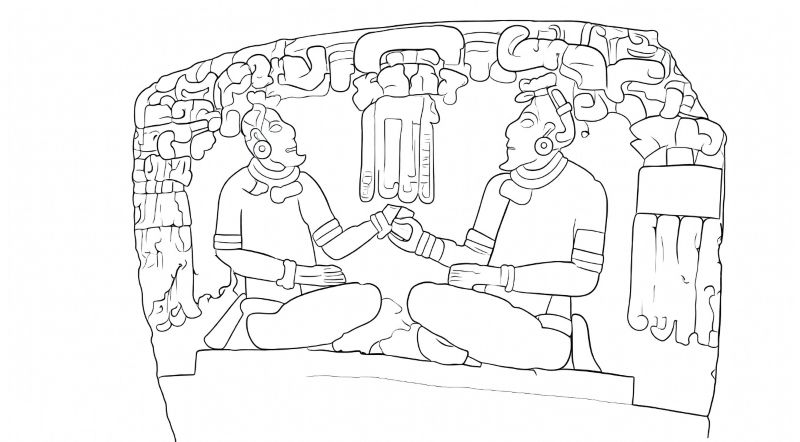
Archaeologists in Veracruz have uncovered a pre-Hispanic monolith that appears to record a rare ritual scene: two seated elite figures, richly dressed, receiving a flowing substance in a vessel from a divine being shown above them.
The carved stone monument was found by Mexico’s National Institute of Anthropology and History (INAH) during a rescue excavation at the San Lucas residential development in Coatepec, Veracruz. The discovery is associated with a civic-ceremonial platform that may date to the Early Classic period, between A.D. 200 and 600, roughly 1,400 years ago.
INAH describes both the platform and the sculpture as having characteristics not previously recorded in the region.
A Ritual Scene Carved on Stone
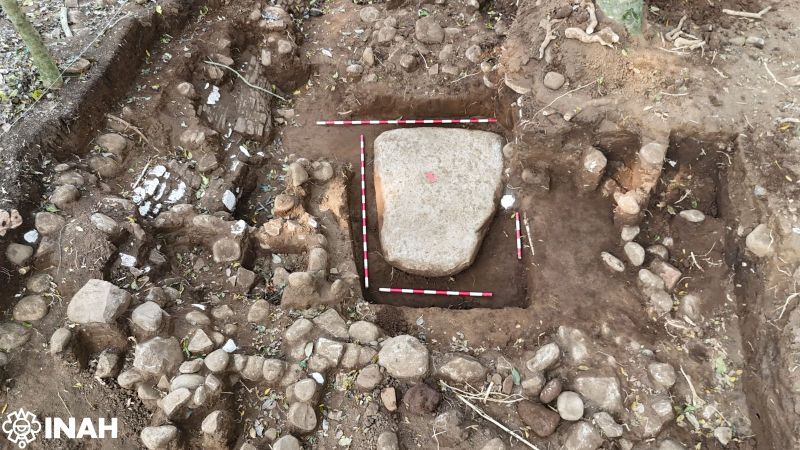
The monolith measures 1.88 meters high and 1.47 meters wide at its broadest point. At its narrowest, it is 68 centimeters wide, with a thickness ranging between 22 and 25 centimeters.
Its most striking feature is not its size, but its imagery.
According to INAH, the carved scene shows two elite individuals in a seated position. Both wear elaborate attire and appear to receive a fluid in a container. The source of that liquid is a divine entity placed on a higher plane.
That arrangement gives the sculpture a strong ceremonial character. The figures are not shown in an ordinary domestic or political scene. They are placed in a symbolic exchange with a supernatural being, suggesting a ritual act involving authority, offering, fertility, sacred nourishment, or communication with the divine.
INAH has not yet identified the fluid. That caution matters. In Mesoamerican art, liquids can carry many meanings, including water, blood, pulque, maize-based drinks, rain, or other ritually charged substances. Without laboratory analysis, inscriptions, or a clear local parallel, the safest reading is that the image represents a sacred transfer of liquid rather than a specific substance.
One of the figures also shows possible “Maya-like” features, according to the archaeologists. That does not mean the site was Maya. Instead, it may point to long-distance contacts, shared visual conventions, or a local group that absorbed elements from wider Mesoamerican networks.
A Platform Unlike Others in the Region
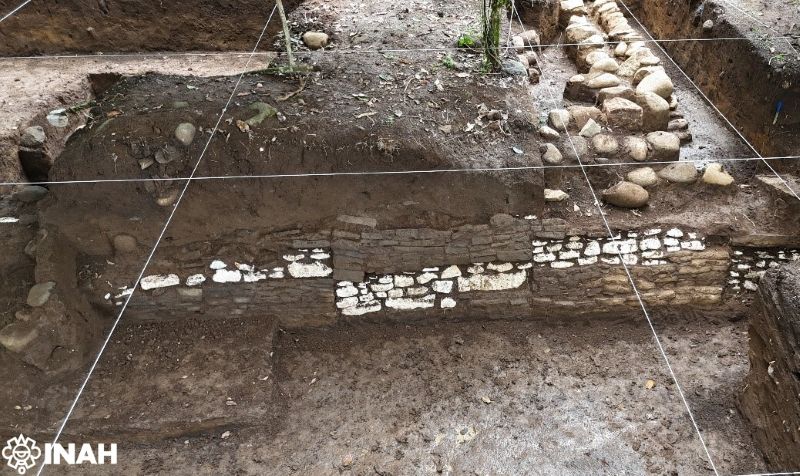
The monolith was found in association with a platform measuring about 30 meters long and 12 meters wide. It was built with stone slabs and faced white limestone with a gypsum-like texture.
INAH suggests that this white finish may have been intentionally produced, possibly through a form of heating or firing, to decorate the walls. The platform’s decoration includes lines or square-like figures, as well as circular stones placed on two of its flanks.
These circular stones are especially important because INAH says such attributes are not typical of the region and had not been previously documented there.
The platform’s form and decorative program suggest that the structure was not merely functional. It likely belonged to a civic-ceremonial space, where architecture, visual symbols, and ritual activity worked together.
Offerings Found Around the Structure
The excavation also produced several associated pre-Hispanic materials. Archaeologists recovered charred maize remains, interpreted as offerings, along with buried vessels and a greenstone bead fragmented into four pieces.
These finds will be sent for laboratory study. Their analysis may help clarify the chronology of the structure, the nature of the offerings, and the cultural identity of the people who used the site.
Charred maize is especially relevant because maize was not only a staple crop in ancient Mesoamerica. It was also deeply tied to ideas of life, ancestry, agricultural cycles, and ritual obligation. In this context, its placement as an offering strengthens the interpretation of the platform as a ceremonial setting.
Why INAH Is Avoiding a Simple Totonac Label
The discovery was made in Veracruz, a region often associated with Totonac history. However, INAH is being cautious.
Although the term “Totonac” is commonly used for populations that developed between the Cazones and Papaloapan rivers, the archaeologists say the evidence found at San Lucas does not yet provide clear indicators that the material belongs to that civilization.
For now, specialists propose that the remains may belong to a local culture with attributes of Gulf Coast groups.
That distinction is important. Archaeological cultures are not assigned only by geography. They require patterns in architecture, ceramics, iconography, burial customs, settlement layout, and material culture. In this case, the newly found platform and monolith seem to combine local features with elements not previously seen in the area.
A Rescue Excavation Before Urban Development
The finds were made on private land covering about 12 hectares. The archaeological work began in late 2025 as part of a rescue excavation linked to a land-use change request for private urban infrastructure.
The project was authorized by INAH’s Archaeology Council and is being coordinated by archaeologists Alberto Vázquez Domínguez and Lino Espinoza García of the INAH Veracruz Center.
The field team includes archaeologists Mireya Moreno Aguirre, Erika Ramírez Córdoba, Jorge Ulises Mota Landa, Emmanuel Hernández Sánchez, and 30 field workers.
INAH expects the fieldwork to conclude in mid-August 2026, while the analysis of the recovered materials is expected to continue until February 2027.
The discoveries are also part of a longer research effort around Campo Viejo, an archaeological area near San Lucas where the INAH Veracruz Center has carried out work since 2000.
A Rare Window into an Unclear Culture
Both the platform and the monolith were found in good condition. The structure will require restoration, consolidation, and maintenance. The sculpture has already received consolidants, and soil elements that could damage it have been removed.
For now, the monolith remains the most compelling part of the discovery. It preserves a scene that seems to place elite authority, divine presence, and ritual liquid in a single carved image.
That combination makes the find more than an isolated carved stone. It may offer a rare glimpse into how a local Gulf Coast community represented power, sacred exchange, and contact with the supernatural during the Early Classic period.
The interpretation is still preliminary. But if the dating and cultural reading are confirmed, the Veracruz monolith could become one of the most unusual ritual images yet documented from this part of eastern Mexico.
Cover Image Credit: INAH
