12 January 2026 The Future is the Product of the Past

8000-year-old with balcony architectural structure belonging to the Prehistoric period found in Anatolia

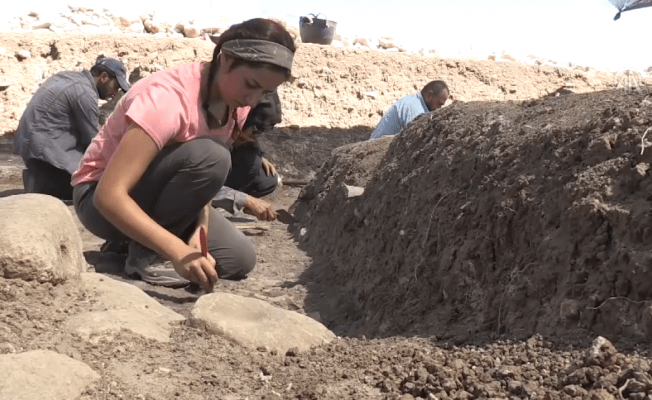
During the excavations in Domuztepe mound, it was revealed that an architectural structure thought to be 7-8 thousand years old had more than one storey and a balcony.

This year’s part of the excavation works, which continues within the borders of Kelibişler District, under the coordination of the Ministry of Culture and Tourism and under the direction of Hacettepe University Faculty of Letters Archeology Department Associate Professor Halil Tekin, has been completed.

AssociateProfessor Halil Tekin told Anadolu Agency (AA) that they had reached valuable findings during this year’s excavations.

Stating that an architectural structure, which is considered to be 7-8 thousand years old among the finds, has more than one floor and has a balcony, Tekin said that the balcony feature of the building is a situation seen for the first time in prehistoric Anatolian architecture.

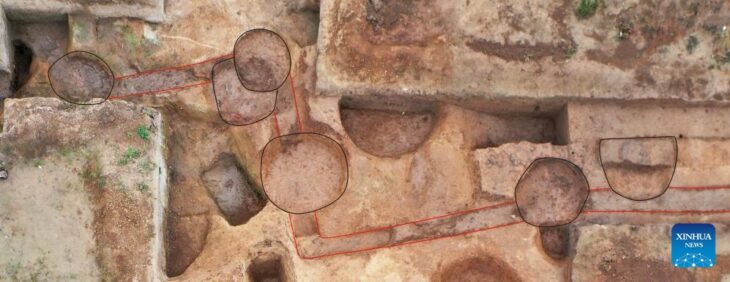
Tekin stated that they only reached the stone foundations of the buildings in the excavation area and that they could obtain information about the upper parts of the buildings thanks to the motifs on the pottery, and noted that they determined that the buildings in the region had stone foundations, wooden and multi-story structures.


📣 Our WhatsApp channel is now LIVE! Stay up-to-date with the latest news and updates, just click here to follow us on WhatsApp and never miss a thing!!
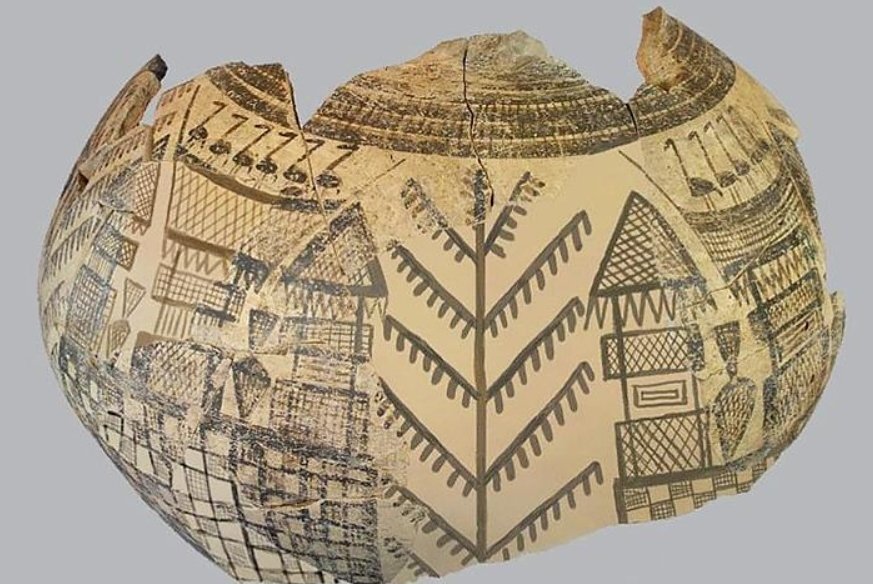


Domuztepe pottery
The motifs on the pottery give information about the upper parts of the structures.

Tekin said that Göbeklitepe reflects with the relief technique on its steles, Çatalhöyük with its wall paints, and Domuztepe with its paint decorations on pottery the stone age art.

He pointed out that concrete data on the aftermath of Göbeklitepe were obtained in Domuztepe and that these regions were the leading representatives of visual art in the world neolithic.

Domuztepe will be animated in 3D

The settlement, which was found during the excavations of the Domuztepe Mound in the Türkoğlu district of Kahramanmaraş and is thought to belong to 7-8 thousand years ago, will be animated in three dimensions.

domuztepe prehistoric era
Photo: İzzet Mazı/AA

Emphasizing that they started to work on the 3-dimensional revitalization of the region, Tekin said, “We have embarked on a big project with the approval of the Ministry of Culture and Tourism. With the financial support of Türkoğlu Municipality, we will make copies of these structures so that they can be perceived in 3D, when visitors come, they can clearly perceive what kind of architecture was in Domuztepe 7-8 thousand years ago,” he said.

Türkoğlu Mayor Osman Okumuş said that rescue excavations of Domuztepe and Gavur Lake Swamp were carried out in the district, and new finds come to light in the regions every year.

Stating that the archeopark project, which was prepared to exhibit the finds and open them to world tourism, is coming to an end, Okumuş said:

“How they lived here 7-8 thousand years ago, will be animated in 3D and our children will go back thousands of years. At the same time, this was a region full of swamps and lakes at that time. Domuztepe is also in the Gavur Lake basin, which is on the world’s largest bird migration route. “We found elephant fossils during excavations sponsored by us this year. We are preparing a project that will be a first in the world with these elephant fossils,” he said.

Okumuş added that their support for the excavations will continue in the following periods as well.

Related Articles

Unexpected finds under the Tel Aviv Suburban

21 August 2021

21 August 2021

In preparation for a planned residential building project in suburban Tel Aviv, archaeologists from the Israel Antiquities Authority have begun...

2,000-year-old Roman Military Sandal with Nails Found in Germany

25 June 2024

25 June 2024

Archaeologists have discovered the remains of a 2,000-year-old Roman Military Sandal near an auxiliary Roman camp in Germany. Archaeologists from...

A marble block depicting the mythological story of Actaeon, who was killed by his dogs, was found in the ancient city of Prusias ad Hypium

7 August 2022

7 August 2022

A marble block depicting the mythological story of Actaeon  (Akteon), who was killed by his dogs, was found during the...

Scientists discover 4 new Nazca Geoglyphs using AI deep learning

4 June 2023

4 June 2023

Scientists from Japan used AI deep learning to discover new geoglyphs in the Arid Peruvian coastal plain, in the northern...

Underwater Archaeologists Discover a 7,000-Year-Old Road in Croatia

8 May 2023

8 May 2023

A team of underwater archaeologists from the University of Zadar has discovered the sunken ruins of a 7,000-year-old road that...

Archaeologists discovered large Roman baths under city museum in Croatia

8 December 2023

8 December 2023

Archaeologists who helped with the restoration work of the Split City Museum, one of the most important and visited museums...

A Unique Discovery in Europe: Ancient Stone Circles Cover 2,800-Year-Old Graves of Children in Norway

29 June 2024

29 June 2024

Archaeologists from the Museum of Cultural History in Oslo discovered an unknown burial site in a quarry near Fredrikstad, in...

Archaeologists may have found the lost 2,000-year-old ancient city of Bassania in Albania

19 June 2022

19 June 2022

Polish archaeologists may have discovered the 2,000-year-old lost city of Bassania in Albania. The remains of two large ancient stone...

Archaeologists found 5 unique sculptures representing the Kakatiya art style in Siddipet

19 July 2021

19 July 2021

13th-century statues were found near a temple tank in the Siddipet district in the northern province of Telangana, India. On...

18,000 years ago, late Pleistocene humans may have hatched and raised the “World’s Most Dangerous Bird.”

2 October 2021

2 October 2021

Researchers say the eggshell is an understudied archaeological material that has the potential to clarify past interactions between humans and...

An engraving on an almost 2,000-year-old knife believed to be the oldest runes ever found in Denmark has been discovered by archaeologists

22 January 2024

22 January 2024

Archaeologists have found a small knife with a completely unique runic inscription that can be dated almost 2000 years ago....

The Lost Georgian King: Archaeologists Discover the Tomb of Ashot the Great Beneath Gevhernik Fortress

8 October 2025

8 October 2025

High in the misty mountains of northeastern Türkiye, where emerald valleys carve through the rugged Artvin landscape, an ancient fortress...

Archaeologists uncover Europe’s oldest lakeside stilt village behind a fortress of defensive spikes

11 August 2023

11 August 2023

Under the turquoise waters of Lake Ohrid, the “Pearl of the Balkans” Scientists have uncovered what may be one of...

People may have been cooking curries in South-East Asia for at least 2000 years

22 July 2023

22 July 2023

Archaeologists have found remnants of eight spices on a sandstone slab from an archaeological site in Vietnam, showing the early...

A burial complex dating to the Second Intermediate Period has been discovered at the Dra Abu el-Naga necropolis at Luxor

12 April 2023

12 April 2023

At the Dra Abu el-Naga necropolis in Luxor, a family burial complex from the Second Intermediate Period has been found....