
14 April 2026 The Future is the Product of the Past

3,500-Year-Old Wooden Well Discovered Near Gloucester Reveals Hidden Bronze Age Water Strategy

A routine excavation ahead of a housing development in southwest England has led to a striking discovery: a 3,500-year-old wooden well, preserved in remarkable condition and offering an unusually intimate look at daily life during the Middle Bronze Age.

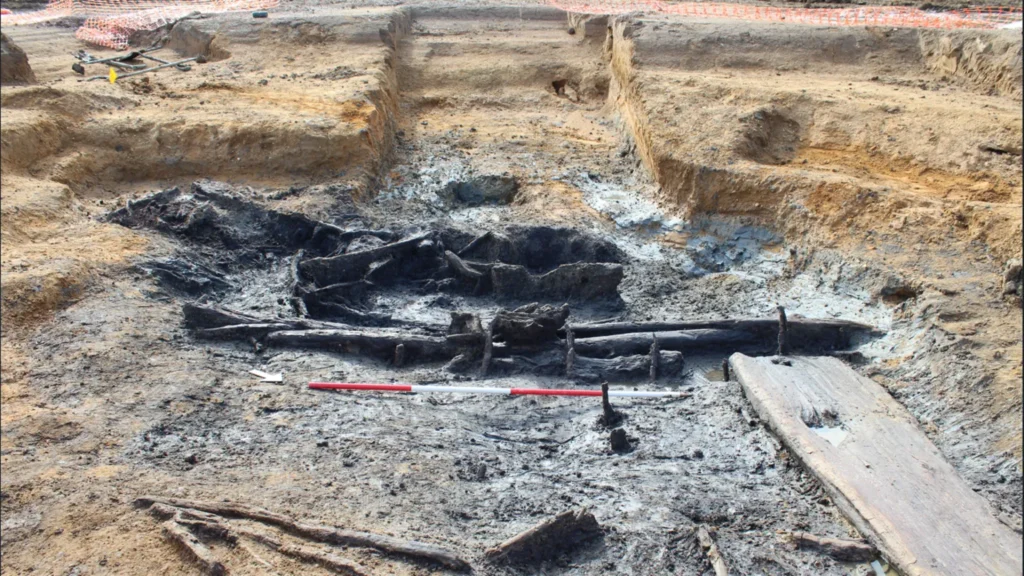
Unearthed just south of Gloucester, the structure initially appeared as scattered fragments of timber buried in saturated soil. But as archaeologists from Cotswold Archaeology began to expose the site more carefully, a far more complex picture emerged—one of deliberate engineering, environmental adaptation, and long-forgotten resource management.

A Rare Survival of Organic Architecture

Finds made from organic materials such as wood rarely survive for millennia, making this discovery particularly significant. The well owes its exceptional state of preservation to the waterlogged conditions of the surrounding soil, which effectively sealed the timber from oxygen and slowed decomposition.

“This kind of preservation is incredibly uncommon,” said Paolo Guarino, post-excavation manager at Cotswold Archaeology. “We don’t often encounter wooden structures of this age in such a complete state. Waterlogged environments are among the few conditions where organic materials like timber can endure.”

The structure itself reveals a carefully designed system. At ground level, archaeologists identified a platform constructed from fitted planks and rounded wooden beams. From this platform, a ladder—also made of timber—descends into a lower chamber where water would have been collected and stored.


📣 Our WhatsApp channel is now LIVE! Stay up-to-date with the latest news and updates, just click here to follow us on WhatsApp and never miss a thing!!


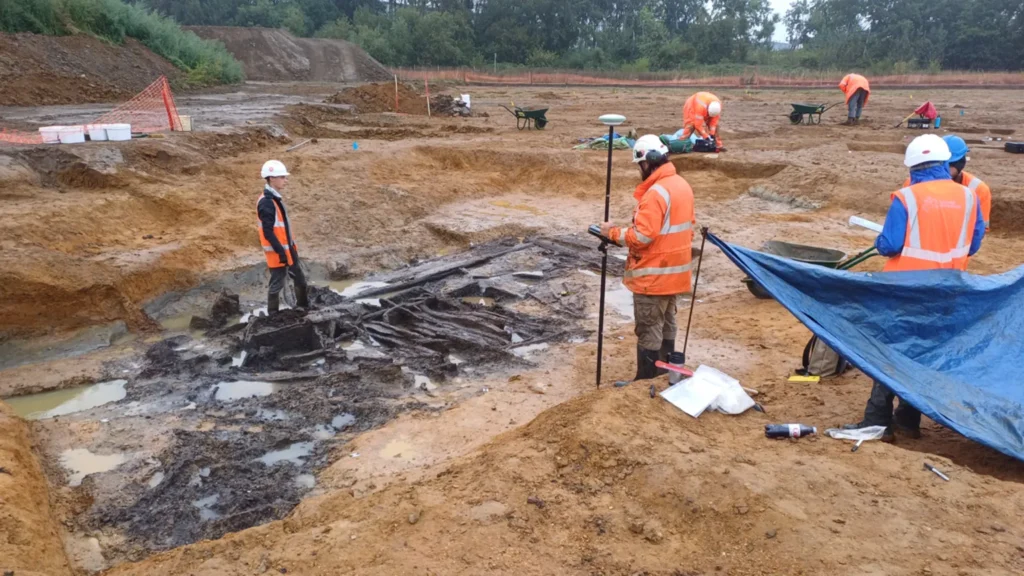
Archaeologists working across multiple digs at a development site near Gloucester. Credit: Cotswold Archaeology

Why Build a Well in a Water-Rich Landscape?

One of the most intriguing aspects of the discovery is its location. Today, the surrounding region is rich in natural water sources, including streams and rivers. This raises a key question: why would Bronze Age communities invest effort into building a well here?

Researchers believe the answer may lie in ancient climate conditions. Pollen analysis from the site indicates that the region experienced a period of warming during the Middle Bronze Age. This shift likely altered local water availability, making it less reliable than it appears today.

According to reporting by the BBC, archaeologists interpret the find as evidence that communities were actively adapting to environmental pressures by constructing wells close to their settlements, ensuring a stable and controlled water supply.

Guarino notes that similar features have been identified elsewhere in Britain, suggesting this was not an isolated solution but part of a broader pattern of environmental adaptation. “We are beginning to see that these communities were far more responsive to climate fluctuations than we once assumed,” he explained.

Preservation Through Irony

There is a certain irony in the well’s survival. The same high groundwater levels that may have developed long after the well fell out of use ultimately created the conditions that preserved it. Over time, the rising water table sealed the structure in a protective, oxygen-poor environment, allowing it to remain intact for more than three millennia.
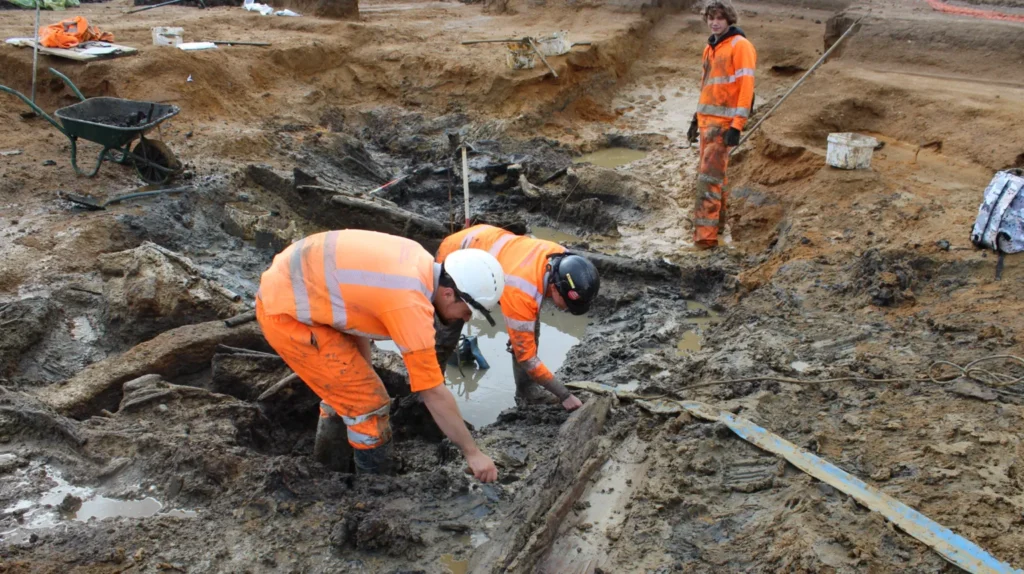
Archaeologists digging deeper into the well and discovering layered platforms. Credit: Cotswold Archaeology

What Happens Next?

Fieldwork at the site has now been completed, and the findings have been shared with local authorities and development planners. Meanwhile, the recovered timbers are undergoing detailed analysis by specialists. Some pieces have already been selected for long-term conservation, ensuring that this rare glimpse into Bronze Age life will be preserved for future study.

The discovery may also have wider implications. The area around Gloucester is already known for its Roman and Anglo-Saxon heritage, but this well adds a much earlier chapter to the region’s history. Archaeologists believe it could prompt further investigations, potentially revealing additional evidence of prehistoric settlement and infrastructure.

For now, the wooden well stands as a quiet but powerful reminder: even in landscapes that seem familiar today, the past often tells a very different story—one shaped by changing climates, practical ingenuity, and the enduring human need for water.

Cover Image Credit: Cotswold Archaeology

Related Articles

2,000 Bronze Statue Fragments Found in Ancient Scrap Yard

20 January 2025

20 January 2025

Archaeologists in Izmir, Turkey have made an extraordinary discovery in the ancient city of Metropolis: Approximately 2,000 bronze statue fragments...

Legendary Lost Medieval City Discovered in Chechnya May Rewrite the History of the North Caucasus

7 April 2026

7 April 2026

A groundbreaking archaeological discovery in southern Russia is stirring excitement across the global academic community, as researchers believe they may...

Poseidon Temple in Greece Larger than Previously Assumed

27 January 2024

27 January 2024

New excavations at Kleidi-Samikon in Greece’s Western Peloponnese show that the temple, discovered in 2022, is more monumental than previously...

Gold jewelry from the time of Nefertiti found in Bronze Age tombs in Cyprus

1 December 2021

1 December 2021

Archaeologists from the University of Gothenburg have concluded an excavation of two tombs in the Bronze Age city of Hala...

2,800-Year-Old Urartian Inscriptions Found in Türkiye Describe the Capture of an Unconquered City

4 February 2026

4 February 2026

A remarkable archaeological discovery in eastern Türkiye is reshaping what scholars know about the ancient Kingdom of Urartu. During rescue...

Egyptian archaeologists discovered 16 meters long ancient papyrus with spells from the Book of the Dead

19 January 2023

19 January 2023

Archaeologists working in Egypt’s Saqqara region have unearthed a 16-meter-long ancient papyrus for the first time in a century. Saqqara...

4,000-Year-Old Bronze Age Cemetery and Possible Neolithic Henge Discovered in Greater Manchester

9 November 2025

9 November 2025

Archaeologists in northern England have unearthed what could be one of the most significant prehistoric discoveries in the Greater Manchester...

Mine-clearance divers discovered an ancient shipwreck dating from the 3rd century BC

25 June 2023

25 June 2023

As a result of collaborative training exercises between Croatian and Italian naval mine-clearance divers, one of the earliest fully preserved...

Archaeologists Discovered 8,200-year-old Eyeliner in Türkiye’s Yeşilova Höyük

16 September 2024

16 September 2024

During the archaeological excavations in Yeşilova Höyük (Yeşilova Mound) in Bornova district of Izmir, an 8,200-year-old kohl made of stone...

Etruscan Bride and Groom Reborn: 2,400-Year-Old Bottarone Urn Restored After Florence Flood Damage

27 February 2026

27 February 2026

More than half a century after the catastrophic 1966 Arno flood submerged vast sections of Florence, one of the city’s...

A large hall from the time of Viking Harald Bluetooth discovered

26 December 2022

26 December 2022

A large hall from the reign of King Harald Bluetooth of Denmark and Norway was unearthed during housing construction work...

Extraordinary Polychrome Mural Reveals 1,400-Year-Old Zapotec Tomb in Oaxaca

25 January 2026

25 January 2026

An extraordinary polychrome mural uncovered in a 1,400-year-old Zapotec tomb in Oaxaca reveals new insights into ancient rituals, art, and...

2,500-Year-Old Burial Site in Negev Highlands Reveals Ancient Trade Routes and Evidence of Human Trafficking

5 February 2025

5 February 2025

The Israel Antiquities Authority announced on Wednesday the discovery of a 2,500-year-old burial site in the Negev Highlands. This significant...

3,000-year-old necropolis found in southeast of Türkiye

16 October 2023

16 October 2023

A 3,000-year-old necropolis was unearthed during the excavations carried out in the Cehennem Deresi (Hell Creek) in Bağözü village of...

3000 Years Old Bronze Age Settlement Unveiled Ahead of New Stadium Construction

27 July 2025

27 July 2025

Archaeologists have uncovered an expansive Late Bronze Age settlement in Wolmirstedt, Saxony-Anhalt, ahead of the construction of a new multimillion-euro...