
19 June 2026 The Future is the Product of the Past

300-Year-Old Sacred Mummified Mermaid From Japan’s Mystery Solved

A mummified mermaid has been worshiped in Japan for centuries because locals believe it has healing powers. However, upon closer inspection, it was discovered that the item was not as mysterious as it appeared because it was only artificial.

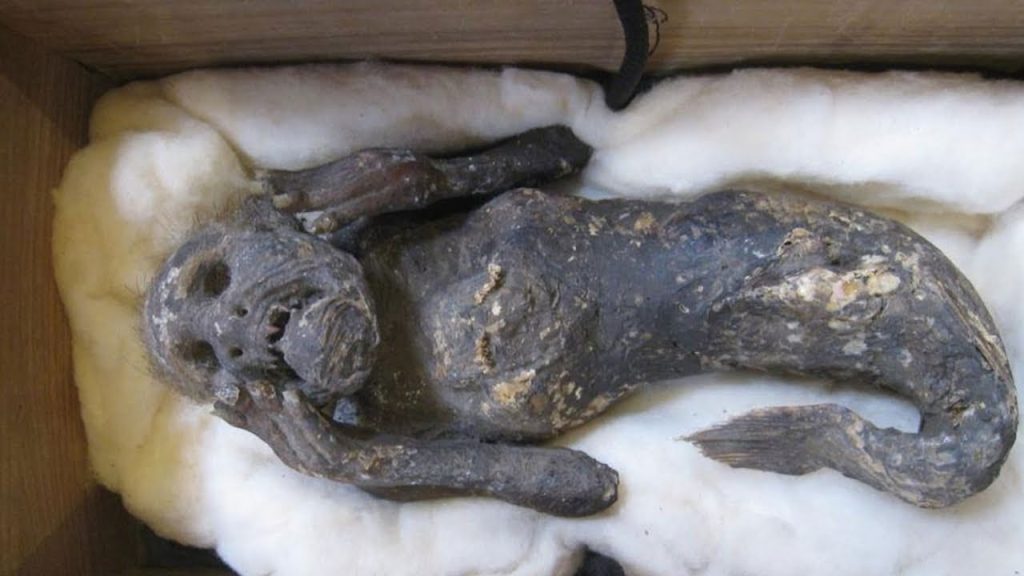
In Japan, there is a legend that the 300-year-old mummified mermaid will grant immortality to anyone who eats its flesh. The mysterious object has been on display for four decades at the Enjuin Temple in Asakuchi.

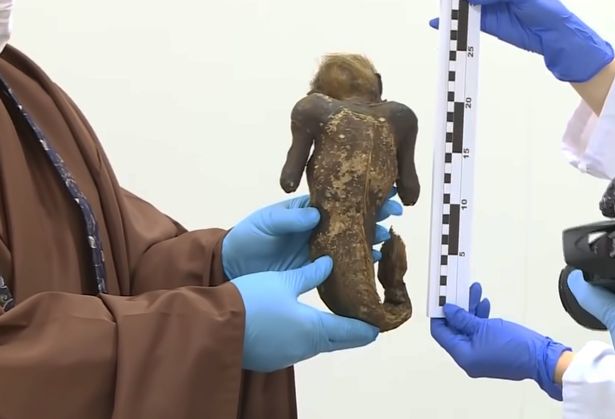
The 12-inch creature was allegedly caught in the Pacific Ocean, off the Japanese island of Shikoku, between 1736 and 1741.

The creature has two hands reaching up towards its grimacing face. Hair is still visible on its head and it has the remains of sharp, pointy teeth in its mouth. But its body gives way to a distinctly fish-like tail.
The fish-like lower half of the 'mermaid's' body gives way to a strange-looking tail. Photo: Newsflash
The fish-like lower half of the ‘mermaid’s’ body gives way to a strange-looking tail. Photo: Newsflash

Scientists have been perplexed by the finding for years.


📣 Our WhatsApp channel is now LIVE! Stay up-to-date with the latest news and updates, just click here to follow us on WhatsApp and never miss a thing!!


Chief priest Kozen Kuida told the Japanese newspaper The Asahi Shimbun they even worshipped it in the hope it would help to “alleviate the coronavirus pandemic”.

Last year, researchers from the Kurashiki University of Science and the Arts took the mummy for tests and CT scans in a bid to unravel its secrets.

They subjected the ‘mermaid’ to tests to determine if its an organic creature or not. Sadly, they have now discovered that the creature is completely artificial – made in the late 1800s. It has no skeleton as its body is made of paper, cloth, and cotton.

Radiocarbon dating also showed that the mummy dates back to the late 1800s, which fit the team’s initial estimations for when it was made.

The lower portion of the body was indeed from a fish’s tail, according to the scientists, but they thought that it had only been added later. Its head was from a mammal, and its jaw and teeth were also taken from fish.

Hiroshi Kinoshita, a board member of the Okayama Folklore Society, became aware of its existence after seeing a photo of the bizarre creature in a mythical encyclopedia. It still remains a mystery how the mermaid mummy ended up inside the Okaya temple.

Related Articles

Remains of a 3,700-year-old domed oven were discovered in the ancient city of Troy

10 September 2022

10 September 2022

Remains of a 3,700-year-old domed oven were found in the ancient city of Troy, located in the Tevfikiye district of Çanakkale...

Persian-era plaster walls were discovered during excavations at Zeyve Höyük in central Turkey

2 August 2022

2 August 2022

This year’s excavations at Porsuk-Zeyve Höyük (Zeyve Mound) near the Porsuk village of the Ulukışla district of Niğde, located in...

The earliest manuscript of Gospel about Jesus’s childhood discovered in Germany

14 June 2024

14 June 2024

A newly deciphered manuscript dating back 1,600 years has been determined to be the oldest record of Jesus Christ’s childhood,...

Traces of Lost Early Christian Churches Beneath the White City: Mosaic Evidence from Ancient Antipatrea, Albania

9 March 2026

9 March 2026

Explore the hidden traces of lost early Christian churches beneath the White City of Berat. Mosaic evidence from ancient Antipatrea...

Ice Age turtle finds near Magdeburg point to canned food from the Stone Age

2 May 2024

2 May 2024

Experts have recovered around 50,000-year-old turtle shell fragments from the Barleben-Adamsee gravel pit near Magdeburg. The turtles could have been...

Scientists unlock the ‘Cosmos’ on the Antikythera Mechanism

13 March 2021

13 March 2021

Scientists may have finally made a complete digital model of the 2000-year-old Cosmos panel of a mechanical device called the...

Newly Uncovered Bronze Age Megasettlement in Wicklow Challenges Long-Held Beliefs About Ireland’s First Towns

2 January 2026

2 January 2026

A major archaeological discovery in County Wicklow may rewrite what historians thought they knew about the origins of urban life...

The sensational second discovery in Croatia: Greek-Illyrian Helmet 2500 years old

16 April 2024

16 April 2024

Archaeologists found a 2500-year-old Greek-Ilyrian helmet during excavations in the Gomila area in the town of Zakotorac on Croatia’s Pelješac...

Ancient ceremonial chariot found in Pompeii

27 February 2021

27 February 2021

The Archaeological Park announced that a gorgeous Roman chariot was found “almost intact” near Pompeii, where it was buried, calling...

2,300-year-old Buddhist temple discovered in Pakistan

23 December 2021

23 December 2021

Remains of a 2300 years old Buddhist Temple have been discovered in Northwest Pakistan by a joint team of Pakistani...

2,000-Year-Old Unique Composite Fish Scaled Armor Found in Ancient Tomb

20 December 2024

20 December 2024

Chinese researchers have recently found fish-scaled armor in the tomb of Liu He, Marquis of Haihun from the Western Han...

World’s Only Ancient Wooden Twin-Hulled Boats Unearthed in Vietnam

20 May 2025

20 May 2025

A groundbreaking archaeological discovery in Bac Ninh province, northern Vietnam, has brought to light two remarkably well-preserved ancient wooden boats,...

Horse cemetery in Westminster revealed as likely resting place for elite imported animals

25 March 2024

25 March 2024

Archaeological analysis of a medieval horse cemetery discovered in London nearly 30 years ago has revealed the international scale of...

Lost Children’s Circle: Seven Infant Remains Unearthed in Mysterious Hittite Ritual Structure at Uşaklı Höyük

8 August 2025

8 August 2025

At the heart of Uşaklı Höyük (Uşaklı Mound), archaeologists have uncovered the “Lost Children’s Circle” — a mysterious Hittite-era ritual...

Export barred on roundel manuscript gifted to Queen Elizabeth I by Archbishop

12 September 2022

12 September 2022

A rare presentation manuscript that Archbishop of Canterbury Matthew Parker gave to Queen Elizabeth I in 1573 has been sold...