
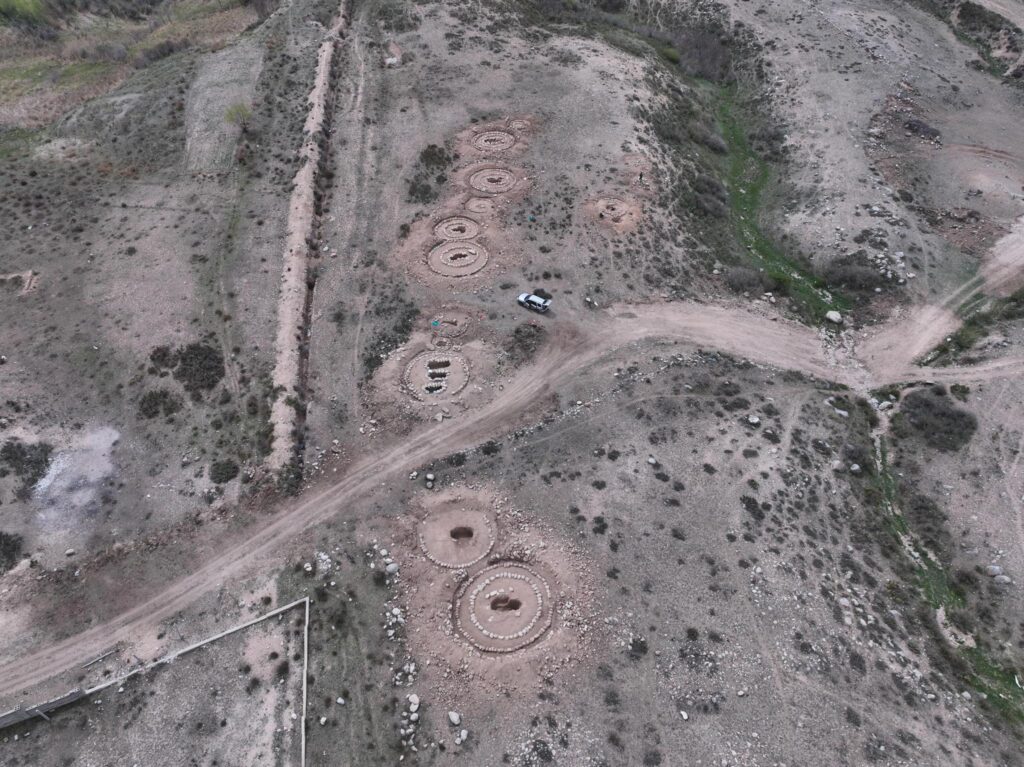
A rescue excavation near Cholpon-Ata, on the northern edge of Kyrgyzstan’s Lake Issyk-Kul, has revealed a group of burial mounds and a large stone enclosure that officials have preliminarily attributed to the early Saka period, broadly dated in Central Asian archaeology to the 8th–6th centuries BCE.
The archaeological work began on April 5 in an area affected by the construction of a bypass road around Cholpon-Ata. According to Kyrgyzstan’s Ministry of Culture, Information and Youth Policy, the excavations are being carried out under the direction of archaeologist Aida Abdykanova, Candidate of Historical Sciences.
The project is not a planned academic excavation in the usual sense. It is an emergency rescue operation, launched to document and preserve cultural heritage remains before modern construction permanently changes the landscape. Such excavations often produce crucial information because roadworks, pipelines and urban expansion cut through areas that have remained undisturbed for centuries.
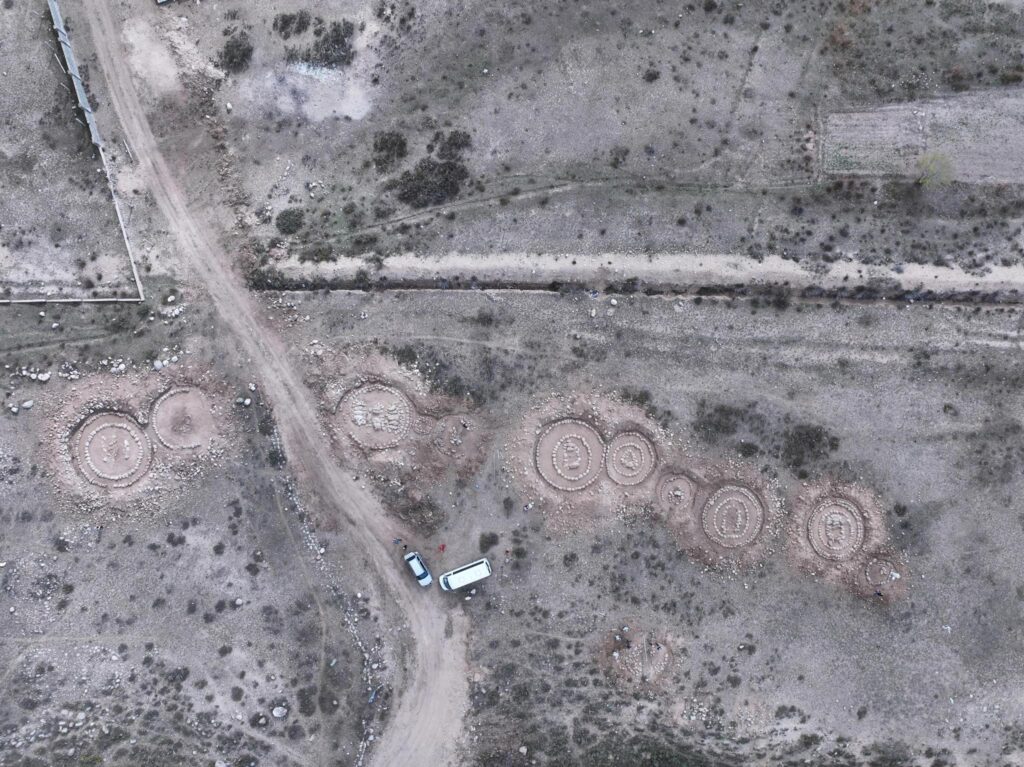
So far, archaeologists have examined 22 of the 30 planned heritage objects in the construction zone. The investigated features include 21 kurgan burials and one large stone enclosure, locally described in the ministry statement as a tash-koroo. The finds recovered from the graves include ceramic vessels, a bronze pin and a stone whetstone.
The ministry identifies the discoveries as belonging to the early Saka period, a phase associated with the wider Scythian-Saka cultural horizon of the Eurasian steppe and Central Asia.
A burial landscape on the edge of Issyk-Kul
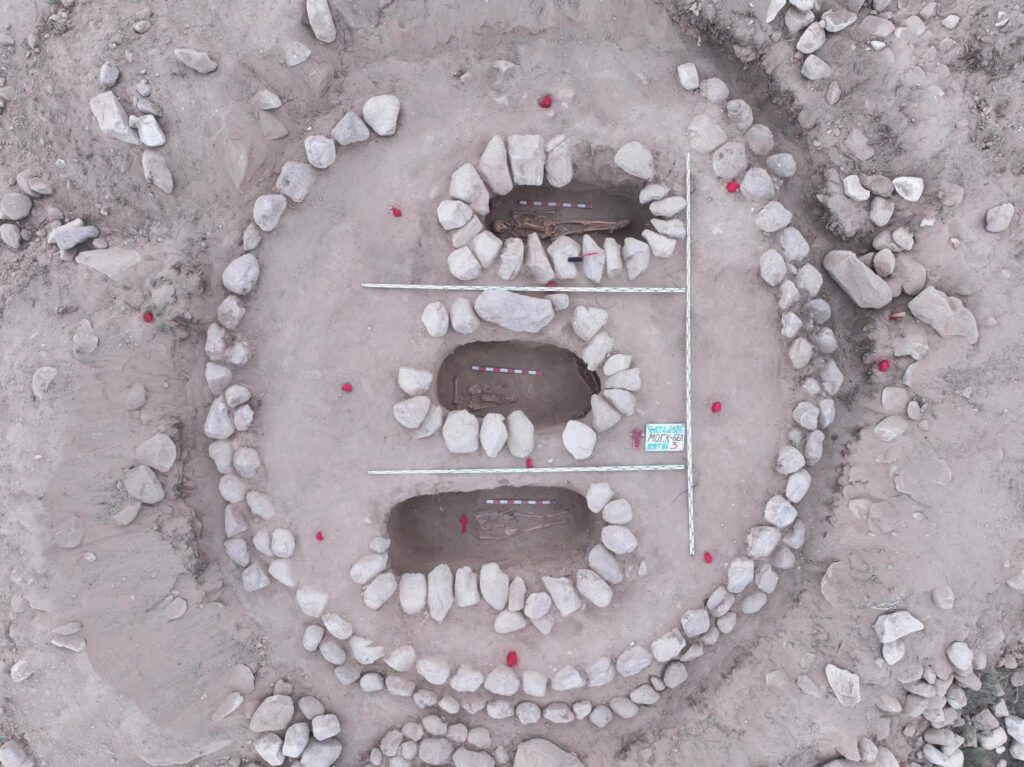
The aerial photographs from the site show a striking archaeological landscape. Circular stone settings mark several burial mounds, while exposed rectangular grave pits can be seen inside some of the stone rings. The layout suggests a carefully organized funerary zone rather than isolated burials.
This is especially important because Issyk-Kul was never a marginal region in antiquity. The high mountain basin sits between the Tien Shan ranges and long served as a corridor between Central Asia, the steppe world and the routes leading toward the Tarim Basin and western China. Communities living around the lake were part of a broad network of mobility, exchange and seasonal movement.
The Saka, often described in ancient sources and modern archaeology as eastern branches of the Scythian world, were not a single centralized state. They were mobile pastoral groups with shared cultural traits, including horse-based lifeways, kurgan burial traditions, animal-style art and elite grave goods. Across Central Asia, their cemeteries often preserve evidence of social ranking, ritual practice and long-distance cultural contact.
In this case, the finds from Cholpon-Ata are modest but meaningful. Ceramic vessels may point to burial offerings or food-related rituals. A bronze pin could have been part of clothing or personal adornment. A stone whetstone suggests everyday tools and craft practices were included in funerary contexts, either as practical possessions or symbolic items connected with the deceased.
Why the stone enclosure matters
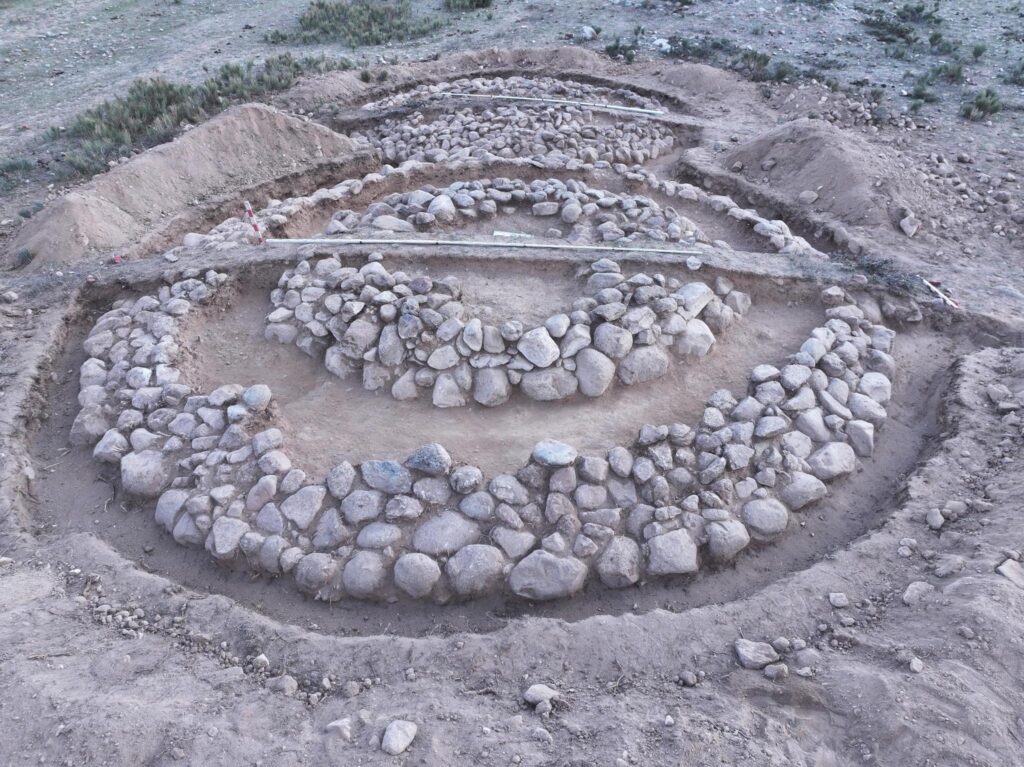
One of the most intriguing elements of the excavation is the large stone enclosure. Specialists are still studying the structure to determine its date and cultural function. The ministry has not yet given a final interpretation, which is important. Stone enclosures in steppe and mountain archaeology can be linked to ritual activity, burial architecture, animal management, commemorative spaces or later reuse of older sacred landscapes.
The current caution is therefore appropriate. The enclosure may belong to the same early Saka phase as the burials, or it may represent another stage in the use of the area. Only detailed excavation, stratigraphy, artifact analysis and dating can clarify its role.
Still, its presence beside a concentration of kurgans raises an important possibility: the Cholpon-Ata site may preserve not just graves, but a wider ritual landscape connected to early nomadic communities around Issyk-Kul.
Kyrgyzstan’s Saka heritage comes into sharper focus
Kyrgyzstan is rich in archaeological remains from the Bronze Age, early Iron Age, Turkic period and medieval Silk Road era. Yet many sites, especially in mountain valleys and around lake basins, remain only partially studied. The new Cholpon-Ata excavation offers a chance to expand knowledge of early Saka communities in the Issyk-Kul region.
The discovery also highlights the growing importance of rescue archaeology in Central Asia. Development projects can threaten ancient remains, but when properly monitored, they can also lead to major discoveries. In Cholpon-Ata, the bypass road project has opened a window onto a burial ground that may have been part of the region’s ancient nomadic landscape more than two millennia ago.
For now, archaeologists continue to examine the stone enclosure and the remaining heritage objects in the construction zone. Further study may reveal whether the burials belonged to a small local group, an elite lineage, or a broader Saka community using the northern Issyk-Kul basin as part of a seasonal and ritual landscape.
What is already clear is that the discovery adds another layer to the deep history of Kyrgyzstan. Beneath the modern roadworks of Cholpon-Ata, archaeologists are uncovering traces of a world shaped by movement, memory and stone-marked graves at the foot of the Tien Shan.
Kyrgyzstan’s Ministry of Culture
Cover Image Credit: Ministry of Culture, Information and Youth Policy of the Kyrgyz Republic via Facebook
