
23 January 2026 The Future is the Product of the Past

A stone statue (Balbal) with height up to 3 meters found in the Issyk-Kul region of Kyrgyzstan

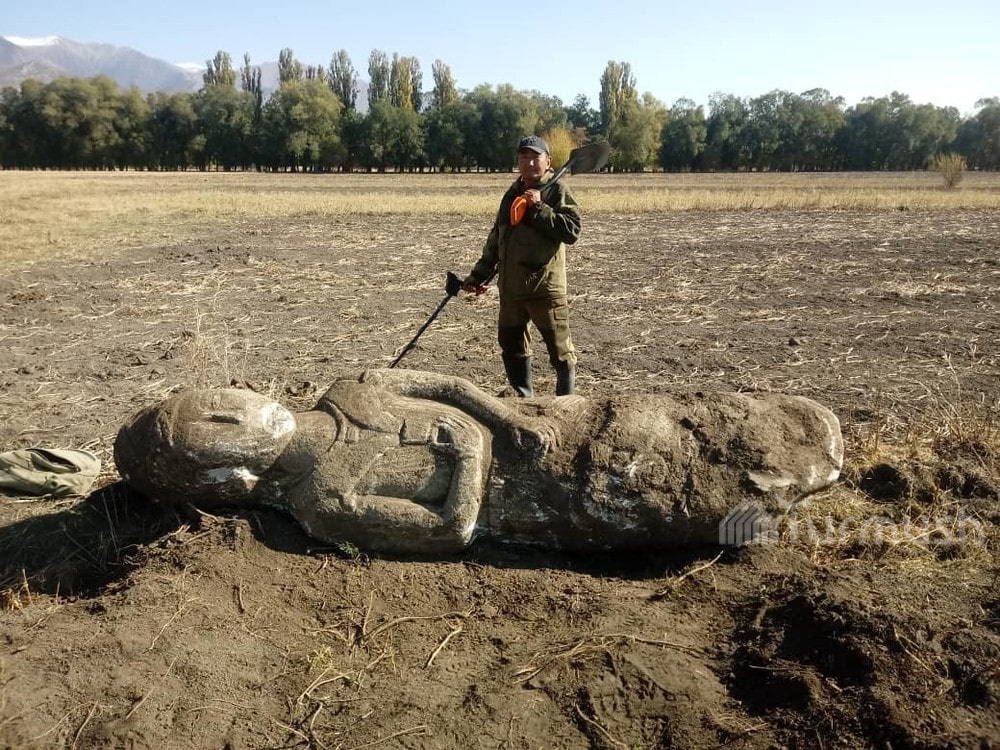
A balbal (stone statue) with a height of up to 3 meters was found during agricultural work in the Ak-Bulun village of Tyup district in the Issyk-Kul region of Kyrgyzstan.

Balbal, is the name given to the tombstone that was erected around the grave or some of the kurgan people for the memory of the person in ancient Turks.

Erkin Turbaev, 60, discovered the balbal on October 15 in the evening. When the plow suddenly broke on something, he was preparing to plant potatoes. Turbaev made the decision to dig it out and discovered a more than two-meter-long stone statue at a depth.

According to Turbaev, who leased 80 acres of land between the Ak-Bulak and Belovodskoye settlements, ” A great historical find for this village. It will bring good fortune.”

Many Balbals have been found in Kyrgyzstan before. Many stone warriors (balbals) of the nomadic Turks are found in Çolpan Ata and Karakol on the shores of Issyk Kul. It is estimated that the balbals were erected in the 6th century. These grave markers in Kyrgyzstan and throughout Central Asia were erected by nomadic Turkish tribes, and almost all of the balbals in Kyrgyzstan are distributed in the Chuy Valley.


📣 Our WhatsApp channel is now LIVE! Stay up-to-date with the latest news and updates, just click here to follow us on WhatsApp and never miss a thing!!


The Balbals to the sculptures of the Central Asian Turks, usually in the form of a sword and figure, usually carved on a piece of stone, symbolizing the enemies that the warrior had killed, and the people believed to be his servants in the other world, planted around the tombs of the deceased warriors at the time of widespread preservation of the validity of the shamanic religion.
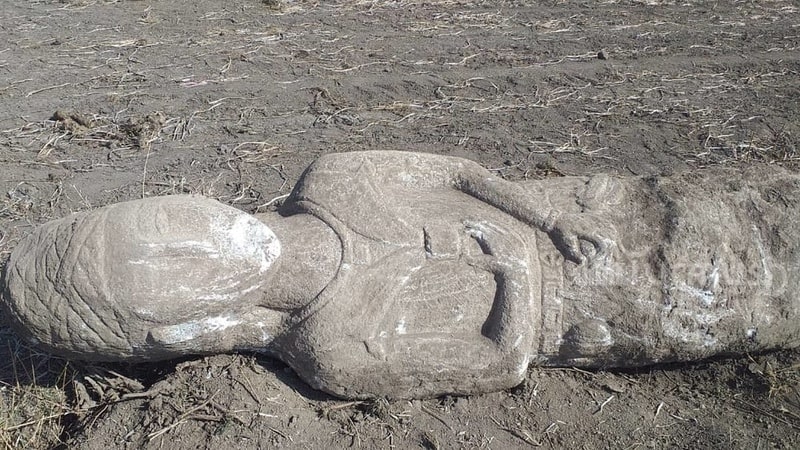
Stone statue (Balbal) with height up to 3 meters found in Issyk-Kul

When the number of these stones is the right of the dead person; the power, the courage, the hero of the hero. The balbals, which is prevalent in the pre-Islamic period, left its place to gravestones after acceptance of Islamic religion. Balbal word is a word from the Old Turkic language and means, to strike. However, the meaning of the word is disputed.

The stone balbals in Kyrgyzstan, which are located on the outskirts of the townships of Sai and Bulak villages, are exhibited in the Kara-Batkak museum.

Historian Zhanbolot Abdykerimov said that many historical monuments can be located on the territory of the rural municipality.

“There are historical kurgans (burials) that date back to the 3rd century BC between the settlements of Ak-Bulun and Frunze. There are such kurgans in Fergana and Almaty. There is historical evidence that the ancient city of Sarybulun [Chigu or Chiguchen – in Chinese sources, the “City of the Red Valley”] was in the eastern part of Issyk-Kul,” the historian noted.

According to Abdykerimov, that the statue has special marks: inscriptions on the head, a pendant in the neck area and a hand in the middle indicating belonging to some title. There are pictures on the back and a belt. A short sword similar to an akinak is drawn. Such weapons were actively used during the Saka period. It is difficult to determine without archaeologists to which period the balbal belongs, the historian noted.

Balbal, which was slightly damaged by tractor drivers during excavations, is 2 meters 70 centimeters long. It was stated that such stone sculptures had not been encountered before in the village.

Related Articles

16 New Ancient Rock Art Sites Discovered In Jalapão, Brazil

13 March 2024

13 March 2024

Archaeologists at Brazil’s National Institute of Historical and Artistic Heritage (Iphan) discovered 16 new archaeological sites while surveying a large...

Archaeologists may have discovered the site where Otto the Great, founder of the Holy Roman Empire, died

5 October 2023

5 October 2023

Archaeologists believe they have found the site where Emperor Otto I (936-973), known as the Great, founder of the Holy...

Botanical Findings Analysis from Biblical area of Goliath sheds Unprecedented Light on Philistine Ritual Practices

27 February 2024

27 February 2024

Bar-Ilan University researchers shed “unprecedented light” on Philistine ritual practices, such as the use of psychoactive and medicinal plants, by...

Queen Kubaba: Some 4,500 years ago, a woman rose to power and reigned over one of the largest civilizations in ancient Mesopotamia

28 December 2023

28 December 2023

Is it possible to say who was the first queen in history? Given the size and diversity of human civilization,...

Ancient Footprints Offer Evidence Humans Wore Shoes 148,000 Years Ago

12 September 2023

12 September 2023

A new analysis of ancient footprints in South Africa suggests that the humans who made these tracks might have been...

Knights-era painting found behind bricked-up arch at Museum of Archaeology in Malta

30 November 2021

30 November 2021

A newly found Knights-era painting hidden behind a bricked-up arch at the Museum of Archaeology might give insight into the...

1,800 years old Sewer system found in ancient city of Mastaura

17 May 2022

17 May 2022

Archaeologists found an 1800-year-old sewer system during excavations in the ancient city of Mastaura, in the Nazilli district of Aydın...

Digitally Reconstructed: Roman Roads That Shaped 1,000 Years of Travel Across Medieval Britain

21 May 2025

21 May 2025

Researchers digitally reconstruct medieval England and Wales’ travel routes, revealing how Roman roads shaped post-Roman mobility over a thousand years....

Analysis of Ancient Scythian Leather Samples Shows Ancient Scythians Made Leather from Human Skin

20 December 2023

20 December 2023

The ancient Scythians’ history as fearsome warriors dates back more than 2,000 years, and now research from a multi-institutional team...

A Monument complex and inscription belonging to Ilteris Kutlug Kagan, the founder of the Eastern Göktürk Khanate, were found

24 August 2022

24 August 2022

A Turkish inscription of İlteriş Kutlug Kağan was found during the joint scientific archaeological expedition of the International Turkic Academy...

What Did Mummies Smell Like in Ancient Egypt? The Surprisingly Pleasant Results Revealed

1 April 2025

1 April 2025

A groundbreaking study led by researchers from University College London’s Institute for Sustainable Heritage and the University of Ljubljana has...

Ancient Babylon Excavation Uncovers 478 Artifacts Including Cuneiform Tablets, and Cylindrical Seals

16 October 2024

16 October 2024

The Iraqi State Board of Antiquities and Heritage (SBAH) announced that 478 artifacts were uncovered during an excavation expedition in...

Archeologists unearth largest rare wooden “Haniwa” Statue in Japan

10 December 2022

10 December 2022

The remains of a 3.5-meter-tall wooden “haniwa” statue have been discovered at one of the “kofun” ancient burial mounds that...

Medieval Rye: From Humble Weed to Powerful Staple – New Study Reveals Surprising Farming Secrets

27 May 2025

27 May 2025

Discover how medieval rye cultivation was far more advanced than previously believed. New research reveals intensive farming and fertilizing techniques...

Extraordinary Discovery at Göbeklitepe: 12,000-Year-Old Human Statue Found Inside Wall

19 September 2025

19 September 2025

Türkiye’s Minister of Culture and Tourism Mehmet Nuri Ersoy has announced a groundbreaking archaeological discovery at Göbeklitepe, the world-renowned UNESCO...