
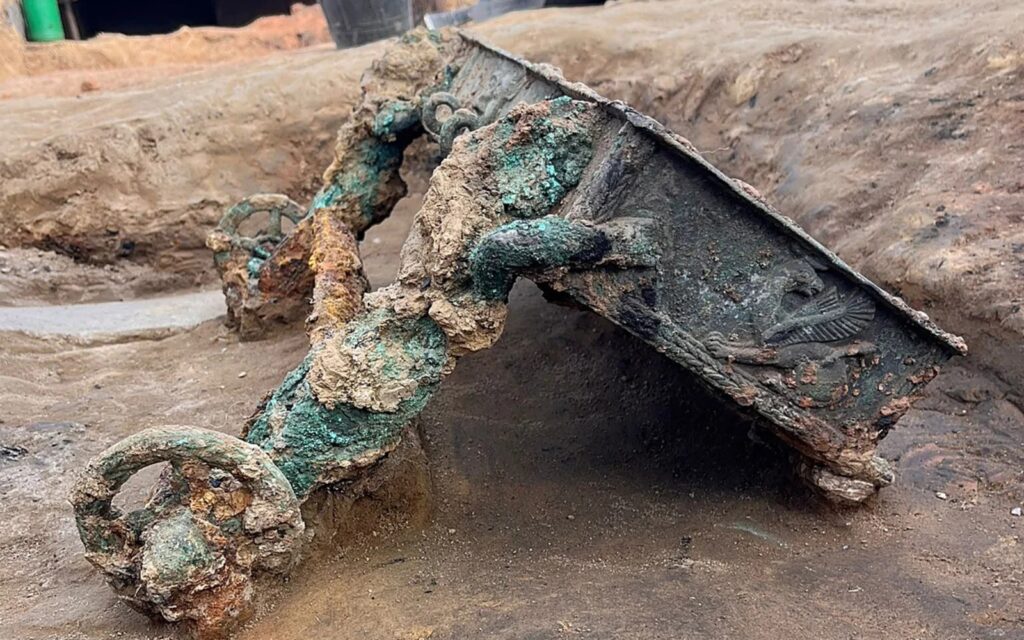
A small bronze cart, broken in half but still crowded with mythological figures, has emerged from one of the most puzzling archaeological sites in Spain. Found at Casas del Turuñuelo in Guareña, Badajoz, the 2,500-year-old object is now being described as a unique ritual piece, with no known parallel in the Iberian Peninsula.
The discovery was made during the eighth excavation campaign at the Tartessian site, a monumental building from the late first millennium B.C. whose sudden destruction and careful burial have preserved an extraordinary record of ritual, architecture, and long-distance exchange.
The campaign is led by CSIC archaeologists Esther Rodríguez and Sebastián Celestino, who described the bronze cart as a find without any clear parallel. “We have searched by land, sea, and air, and we have found nothing like it,” the researchers said, underlining the exceptional character of the object.
The cart is not a vehicle in the usual sense. It is a small ceremonial platform on wheels, probably used in religious activity. Archaeologists believe it may have held embers or aromatic resins, turning it into a kind of mobile incense burner during ritual celebrations. That interpretation remains cautious, but the object’s iconography leaves little doubt that it belonged to a highly symbolic setting.
A bronze cart with griffins, Achelous, and possible Atlantes
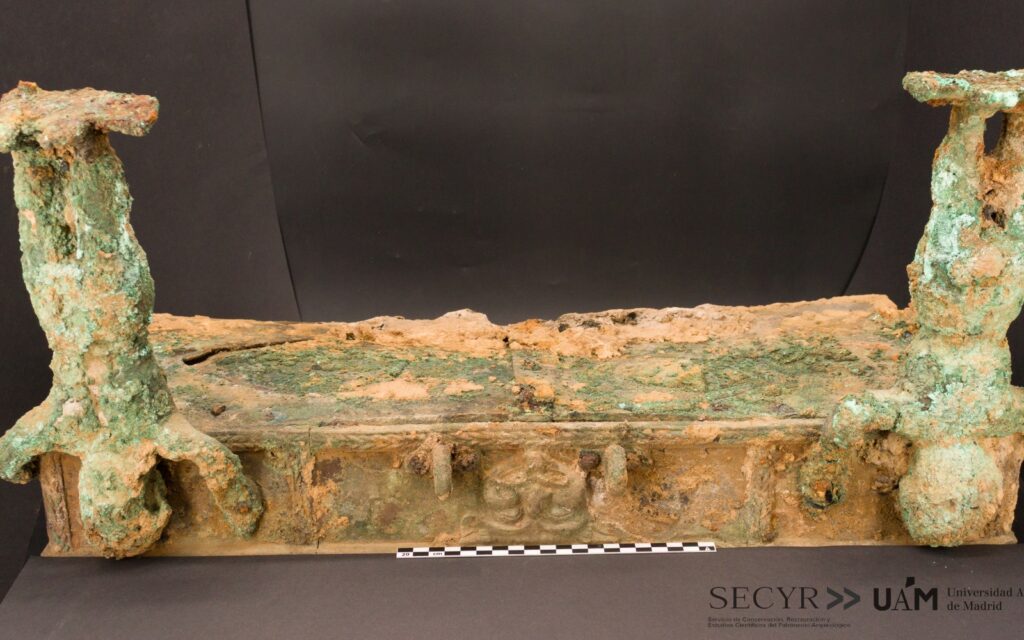
Only half of the cart has been recovered so far, but the surviving portion is enough to show its unusual character. The piece preserves two wheels and part of the main box, measuring about 60 centimeters in length and 47 centimeters in height.
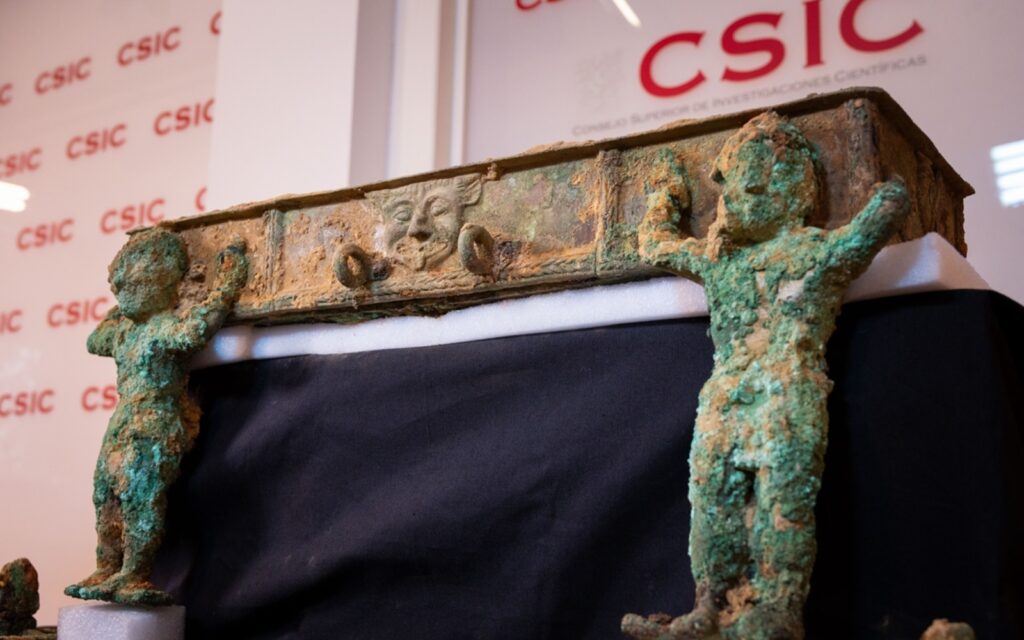
On its sides are griffins, mythical creatures with the body of a lion and the head and wings of an eagle. Such figures had deep roots in the visual traditions of Egypt and Mesopotamia before spreading through Greek and Etruscan art. On the front is a horned face identified as Achelous, the river god known in Greek mythology and also present in Etruscan imagery.
The detail that has caught the attention of researchers is the god’s protruding tongue. That gesture is more commonly associated with gorgons, such as Medusa, than with Achelous. For that reason, the figure may represent a hybrid image, combining a river deity with darker, underworld associations. If confirmed, it would make the cart not just rare, but iconographically exceptional.
Two bearded male figures, dressed in short kilts and positioned like Atlantes, appear to support the structure. Their condition is more fragile because of oxidation, and their precise identification will depend on further restoration.
A luxury object from a connected world
The cart’s construction suggests advanced metalworking. It was assembled from multiple bronze elements with iron components, including a central axle system that allowed the wheels to turn. Researchers are still awaiting isotopic analyses that could help identify the bronze’s origin.
For now, Etruria appears to be one of the strongest possibilities. Similar ritual carts are known from the Etruscan world, although none matches the Turuñuelo example in its decorative program or structure. A Greek origin has not been ruled out, but the technique seems to point more clearly toward the central Mediterranean.
That uncertainty is part of the story. The cart does not offer a simple answer about Tartessos. Instead, it shows a society deeply involved in Mediterranean networks, receiving, adapting, and possibly reinterpreting objects and symbols from different cultural spheres.
This matters because Tartessos was long known through fragments of myth, classical references, and scattered archaeological evidence. Sites such as Turuñuelo have changed that picture. They show a wealthy, complex society in the southwest of the Iberian Peninsula, shaped by local traditions and by contact with Phoenician, Greek, Etruscan, and Egyptian worlds.
The “year of imports” at Casas del Turuñuelo
The bronze cart was not the only major find of the latest campaign. Archaeologists also uncovered two complete braziers, a large bronze cauldron, a patera, and other bronze vessels or fragments. One basin with handles ending in palmettes has been identified as a possible podanipter, a Greek ritual vessel used for washing the feet.
This is especially interesting because a marble altar column discovered in 2025 also pointed toward Greek ritual practice. Together, the two objects may have belonged to a shared ceremonial sphere, possibly linked to rites of purification, hospitality or marriage.
The campaign also produced an Egyptian alabastron, a small container usually used for perfume or aromatic substances, along with hundreds of ivory fragments. These ivories preserve vegetal, animal, and human scenes, including warriors, serpents, lions, and lotus motifs. Their reconstruction may offer a rare view of the visual language circulating between the eastern Mediterranean and the Iberian interior around the sixth and fifth centuries B.C.
The finds strengthen the idea that Casas del Turuñuelo was not an isolated inland monument. It was part of a wider Mediterranean exchange system, capable of drawing high-value objects into the Guadiana Valley.
A building sealed after a violent ritual ending
Casas del Turuñuelo has become one of the most important Tartessian sites because of its state of preservation. The building, sealed beneath a mound of clay after destruction and fire, still preserves two construction levels. Its architecture includes a monumental staircase, sophisticated hydraulic features, lime-and-clay mortars, and rooms that suggest administrative, residential, and ceremonial functions.
The lower courtyard had already produced one of the most dramatic discoveries at the site: the remains of a large animal sacrifice, mostly horses, along with cattle, pigs, and a dog. The animals appear to have been arranged as part of a controlled ritual sequence connected with the final abandonment of the building.
This final act remains unexplained. At the end of the fifth century B.C., several Tartessian sites in the Middle Guadiana region were destroyed, burned, buried, and abandoned. Whether the cause was social crisis, religious closure, political collapse or a combination of pressures is still debated.
At Turuñuelo, the destruction damaged many objects. Sculptures were broken, vessels were scattered, and the newly discovered cart was split in two. Yet it was not completely smashed. That detail has led the excavators to wonder whether the divine image on the cart may have inspired caution, even during the building’s ritual destruction.
A site still only partly revealed
The bronze cart joins a growing list of discoveries that have made Turuñuelo central to the study of Tartessos. Earlier campaigns uncovered the first known human sculptural representations from this culture, a slate tablet bearing one of the earliest Paleohispanic alphabets, luxury objects of Mediterranean origin, and the remains of large-scale ritual activity.
Nearly half of the site remains unexcavated. That leaves open the possibility that the missing half of the bronze cart may still lie somewhere within the building’s sealed layers.
For now, the surviving half is already enough to complicate the old image of Tartessos. It suggests a society that did not simply import foreign luxury goods, but understood their ritual use, absorbed their symbols, and placed them within its own ceremonial world.
The cart from Turuñuelo is small, but its implications are large. In its griffins, horned river god, possible Atlantes, and moving wheels, it preserves a fragment of a Mediterranean world where myth, trade, and ritual crossed the western edge of Europe.
Cover Image Credit: Ayuntamiento de Guareña
