
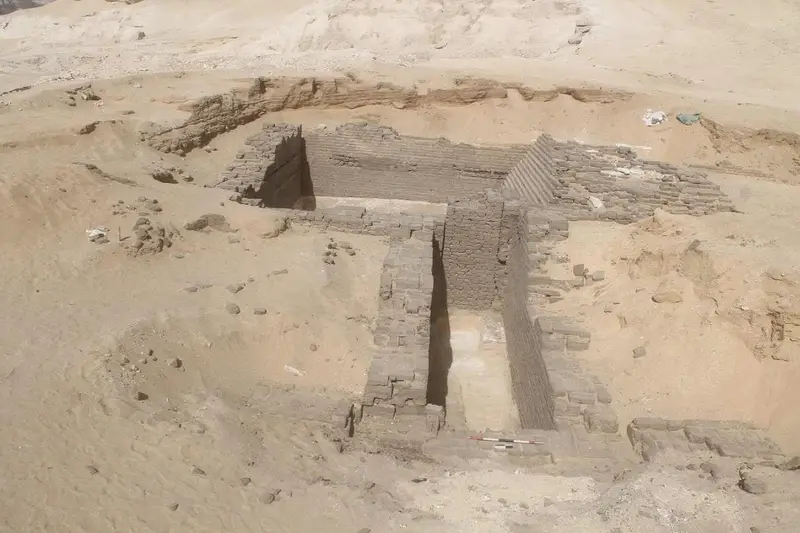
On a limestone rise near the Nile in Middle Egypt, archaeologists have uncovered a burial landscape that seems to preserve several chapters of ancient Egyptian history in one place.
An Egyptian archaeological mission working at Jabal al-Tayr in Minya Governorate has discovered two Early Dynastic tombs, along with burials dating to the Predynastic period and the Late Period. Announced by Egypt’s Ministry of Tourism and Antiquities, the find offers rare evidence for how funerary architecture evolved in the centuries before the age of pyramids.
A mission from the Supreme Council of Antiquities carried out the excavation. According to Egypt’s Minister of Tourism and Antiquities, Sherif Fathy, the discovery adds important evidence to the record of Egyptian archaeology because it helps trace the development of tomb architecture across different periods of ancient Egyptian history.
Two Early Dynastic tombs with an unusual design
The most striking finds are the two tombs dated to the Early Dynastic period, a formative era when the first pharaonic state was taking shape, roughly between 3100 and 2686 BC.
Dr. Hisham El-Leithy, Secretary-General of the Supreme Council of Antiquities, said preliminary studies show a notable resemblance between the newly discovered tombs and the famous tomb of King Den at Abydos. Den was one of the most important rulers of Egypt’s First Dynasty, and his burial complex is often studied for what it reveals about early royal power, ritual, and monumental construction.
That architectural link gives the Jabal al-Tayr discovery wider significance. It suggests that builders in different parts of Egypt may have shared ideas about funerary design during the earliest centuries of the Egyptian state.
A building method that points toward later monuments
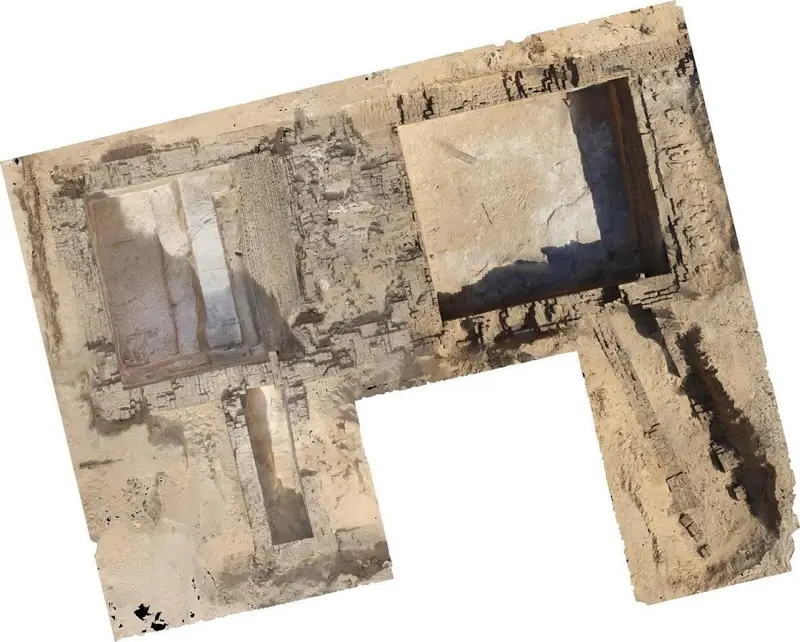
The first tomb is especially important because of its wall construction. Mohamed Abdel Badie, head of the Egyptian Antiquities Sector, explained that the walls were built with a gradual change in thickness. They are broader at the base and become thinner toward the top.
This was not a decorative choice. It appears to reflect an early understanding of stability, weight, and structural balance. Egyptian archaeologists believe this building principle may represent an early stage in the engineering thought that later contributed to the development of the step pyramid and, eventually, the fully formed pyramids.
Parts of the first tomb were damaged in later periods, probably when stone blocks were removed for reuse. Even so, the surviving remains preserved details that are valuable for understanding ancient construction techniques. Excavators identified oxide lines on the stone, likely connected with the careful cutting and preparation of blocks. They also found large wooden supports used to reinforce the walls. Some stretched along the full length of the structure, while others were placed as separate straight elements.
The second tomb lies south of the first and follows a very similar architectural plan. Unlike its neighbor, it does not appear to have suffered the same level of stone removal. Its better preservation gives archaeologists a clearer view of the original design.
A cemetery used across thousands of years
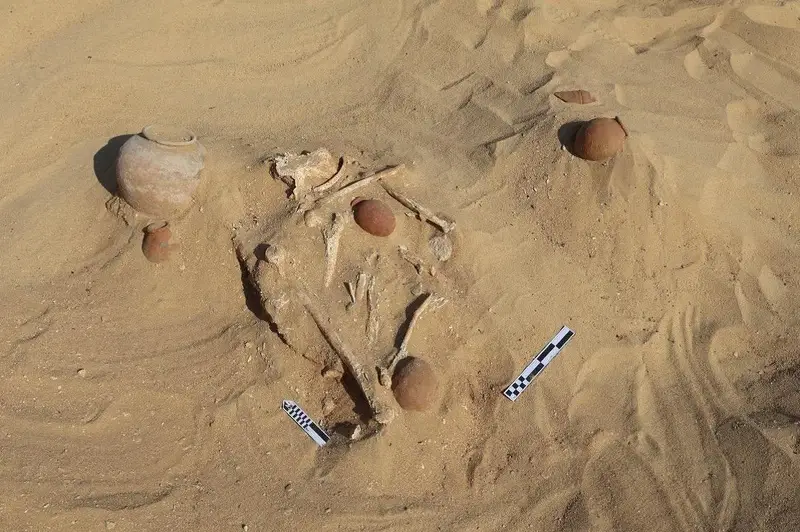
The site was not limited to the Early Dynastic period. Dr. Sami Dardiri, head of the mission and head of the Central Administration for Middle Egypt Antiquities, said the team also uncovered part of a Predynastic cemetery.
Several burials were found in a crouched position, a common funerary practice before the rise of dynastic Egypt. Some bodies had been wrapped in plant mats, now mostly decomposed. Pottery vessels with black-topped rims were found beside several of the deceased, allowing archaeologists to date the burials to the Naqada II and Naqada III periods. These were crucial phases before Egypt’s political unification.
The mission also identified individual and collective human burials from the Late Period. Some were found inside the remains of decayed wooden coffins, showing that Jabal al-Tayr continued to be used as a cemetery long after the Early Dynastic tombs had been built.
Taken together, the discoveries show that Jabal al-Tayr was not a short-lived burial ground. It was a place repeatedly chosen for the dead across major turning points in Egyptian history, from the Predynastic age to the Late Period.
Excavations are still continuing at the site. For now, the newly discovered tombs provide a rare look at the architectural experiments that came before Egypt’s great stone pyramids, when builders were still learning how to turn burial, power, and engineering into monuments meant to endure.
Egypt’s Ministry of Tourism and Antiquities
Cover Image Credit: Courtesy of Egypt’s Ministry of Tourism and Antiquities
