
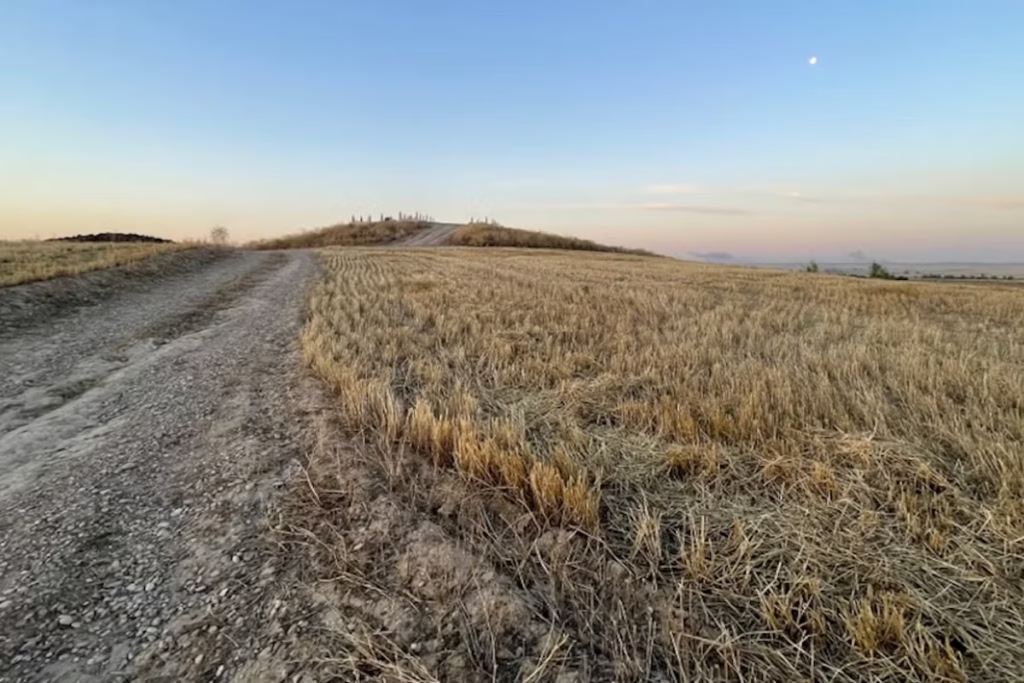
A University of Central Florida (UCF) led excavation in northern Iraq has revealed what researchers are calling “Mesopotamia’s Pompeii”: a 4,000-year-old city where palace archives, human remains, burned buildings, and siege evidence preserve the final days of ancient Qabra.
“Mesopotamia’s Pompeii” may be an imperfect phrase, but at Kurd Qaburstan in northern Iraq, the comparison is easy to understand. Nearly 4,000 years ago, a fortified city appears to have met a violent end: palace rooms burned, bodies were left in destruction layers, and clay tablets remained sealed in the debris.
A University of Central Florida-led excavation in the Kurdistan Region of Iraq, near Erbil, has uncovered rare evidence of life and conflict during the Middle Bronze Age. The project, directed by UCF Associate Professor Tiffany Earley-Spadoni and supported by the U.S. National Science Foundation, is strengthening the case that Kurd Qaburstan may be the ancient city of Qabra, a politically important center known from Old Babylonian-period texts.
A destroyed palace and a lost archive
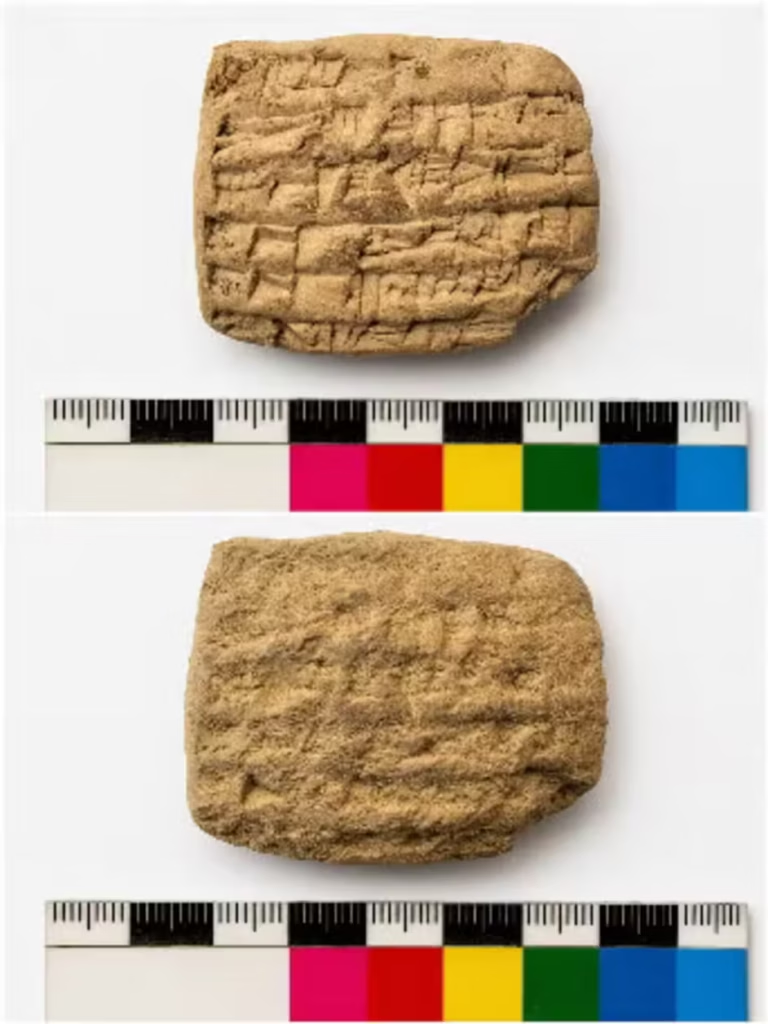
One of the most important discoveries came from the Lower Town East Palace, where researchers recovered 20 cuneiform tablets and more than 100 administrative sealings from destruction layers. It is the first substantial group of cuneiform tablets found in the Erbil region, making the archive unusually valuable for understanding palace administration in northern Mesopotamia.
Most of the texts appear to be administrative records, the kind of documents that tracked goods, labor, and palace activity. One tablet may have been written by a high-ranking official connected to Qabra. Several tablets are dated within days of one another, a detail Earley-Spadoni says fits the possible timeline of the city’s fall.
The tablets are now being studied by epigraphers Paul Delnero of Johns Hopkins University and Parker Zane of Yale University, together with art historian Marian Feldman of Johns Hopkins University. Early readings suggest that some inscriptions may correspond to events described on the Victory Stele of Dadusha, a key ancient source connected with the conquest of Qabra.
The human cost of a Bronze Age siege
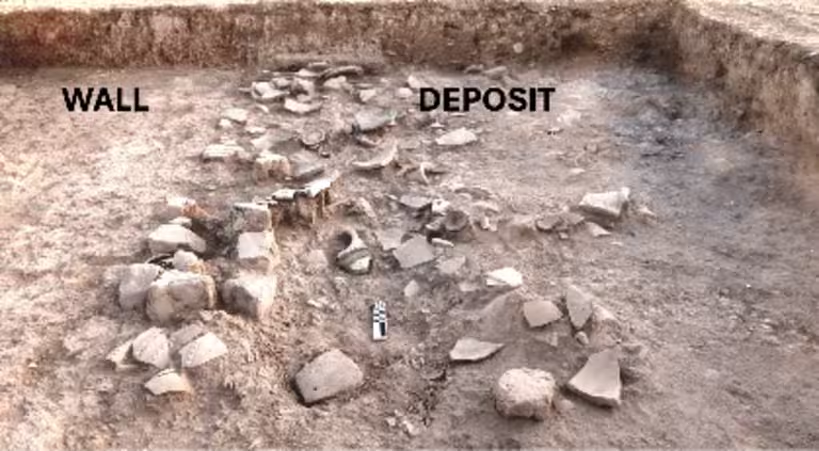
The destruction at Kurd Qaburstan was not limited to architecture. Excavators found burned layers, collapsed buildings, dense ceramic debris, and the remains of 17 individuals inside the palace destruction deposits. Bioarchaeologist Andrea Zurek-Ost of Michigan State University is studying the remains.
The dead were not placed in formal graves and were not accompanied by burial goods. Some seem to have been left where they died, including possible palace workers. One individual was found face down over a stone basin, a detail that gives the archaeological record an unusually immediate human dimension.
Earley-Spadoni has described the evidence as one of the clearest archaeological cases of Middle Bronze Age siege warfare yet found in northern Mesopotamia. The team identified two superimposed destruction events, which may match the historical sequence of Qabra’s siege and later conquest by Shamshi-Adad I.
Fortifications across the Erbil Plain
To understand the scale of the ancient city, researchers carried out a magnetometer survey across more than 80 hectares. The survey, led by Andrew Creekmore III of the University of Northern Colorado, detected a monumental wall with bastions surrounding the site.
That finding is important because the fortifications resemble those depicted on the Victory Stele of Dadusha. If the identification with Qabra continues to hold, Kurd Qaburstan may offer the physical counterpart to a city known for generations mainly through texts.
Qabra occupied a strategic landscape on the Erbil Plain, in a region linked to routes, agriculture, and political competition between northern Mesopotamian powers. Its possible fall in the early second millennium BCE belongs to the same broader world as the Old Babylonian period, when palaces, archives, and military campaigns shaped the political map of Mesopotamia.
Northern Mesopotamia was not a margin
The discoveries also challenge an old imbalance in how Mesopotamian history is often told. Southern cities such as Uruk, Ur, and Babylon have long dominated public imagination, but Kurd Qaburstan shows that northern cities could be large, fortified, administratively active, and politically significant.
Beyond the palace, excavators documented a preserved street with an engineered drainage system and domestic spaces associated with food processing and textile production. These details point to an organized urban community, not a remote settlement on the edge of better-known civilizations.
Laboratory work is now expected to add another layer to the story. Isotopic and ancient DNA analyses of the 17 individuals may help determine where they came from, whether they were related, and how they fit into the city’s final days.
For archaeologists, Kurd Qaburstan matters because text and earth meet here. The tablets speak of administration and perhaps crisis. The walls show the scale of the city’s defenses. The destruction layers preserve the violence of its end. Together, they bring Qabra closer to history, not as a name on a stele, but as a lived city whose final moments were sealed in the ruins of war.
Cover Image Credit: Kurd Qaburstan Project
