

Demons at Tarquinia may have encountered far more than painted walls and a burial chamber. New research suggests that prolonged echoes, low-frequency sound, darkness and the tomb’s unsettling supernatural imagery could have combined to create an intensely disorienting, even trance-like sensory experience.
The fifth-century BCE Etruscan tomb, known as the Tomba dei Demoni Azzurri, has now been examined using acoustic measurements, 3D modelling and artificial intelligence. The results indicate that its architecture and imagery created a sensory environment strikingly different from that of another painted tomb at Tarquinia, the Tomba del Gallo.
Researchers Maurizio Forte of Duke University and Jacqueline K. Ortoleva of the University of Oxford examined two fifth-century BCE tombs in the Monterozzi Necropolis at Tarquinia, Italy: the Tomba del Gallo and the Tomba dei Demoni Azzurri, or Tomb of the Blue Demons. Rather than treating their wall paintings simply as images to be interpreted, the researchers asked a different question: what would it actually have felt like to enter these underground spaces during an Etruscan funerary ritual?
Their results point to two strikingly different environments. The smaller Tomba del Gallo appears to have guided visitors through a relatively controlled visual sequence, while the much larger Tomba dei Demoni Azzurri combined prolonged echoes, restricted lighting, and unsettling imagery in ways that may have caused disorientation and, under some conditions, a trance-like sensory state.
A tomb with the acoustics of a monumental interior
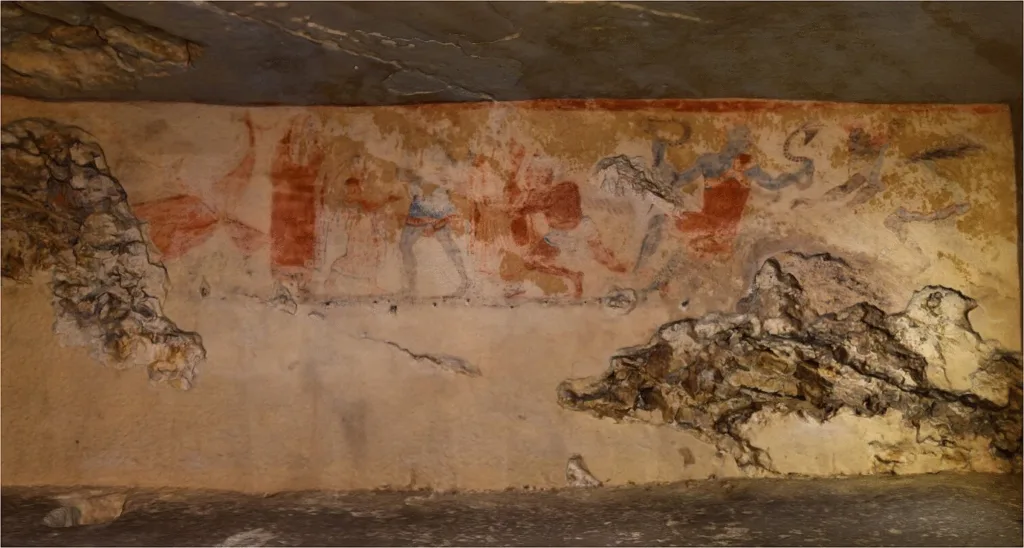
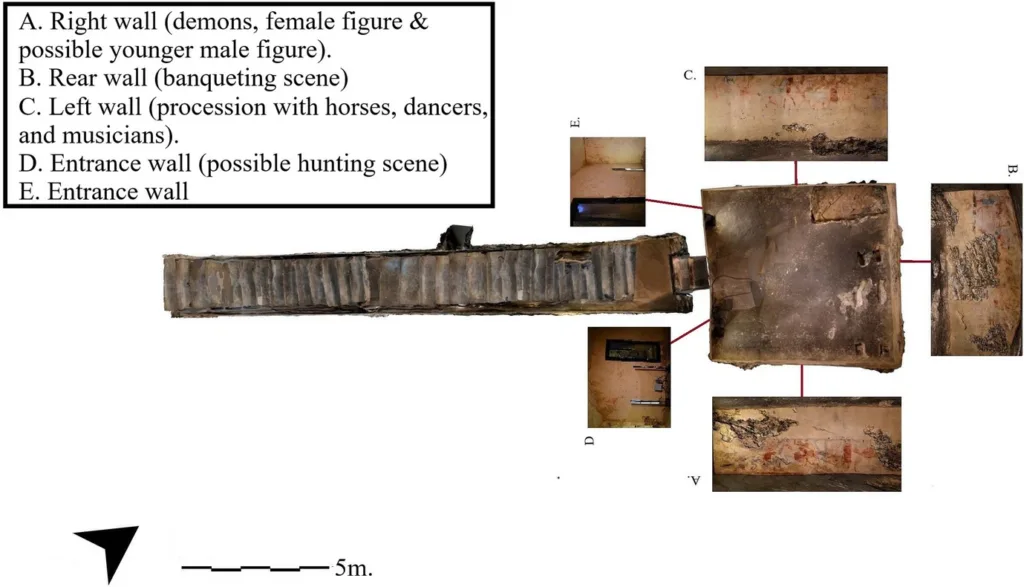
The most unusual results came from the Tomba dei Demoni Azzurri, dated to around 450–420 BCE. Acoustic measurements revealed extraordinarily long reverberation times in parts of its burial chamber, with several values comparable to those recorded in large cathedral interiors such as St. Paul’s Cathedral in London. The strongest reverberation occurred around the rear and left sides of the chamber, where banqueting and procession scenes were painted.
At the rear wall, which carries the tomb’s banquet scene, the researchers recorded a reverberation time of 7.52 seconds at frequencies of 125 Hz and below. Such low-frequency sound behaves differently from ordinary speech: it can be felt physically as well as heard, and sustained resonance can make it difficult to identify where a sound originates. In a dark underground chamber filled with music, voices, or rhythmic instruments, the effect could have been intense.
The tomb also allowed sound to travel between the burial chamber and the entrance corridor. During the survey, speech produced outside the chamber could be clearly heard from within, while sounds generated inside could propagate toward the exterior. The researchers therefore argue that drums, clappers, male and female voices, and other ritual sounds could have moved through the monument in ways that blurred the boundary between interior and exterior space.
The Blue Demon as a “visual trap”
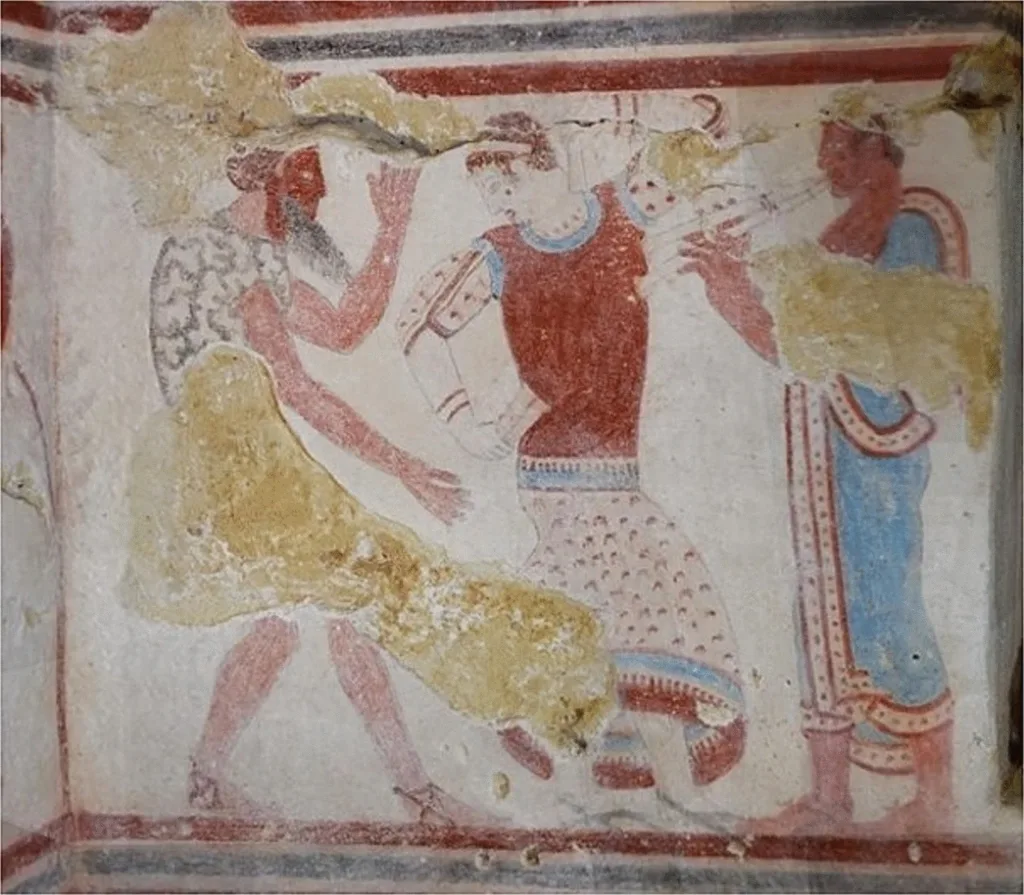
Sound was only one part of the experience. Computer-based visual saliency analysis identified the tomb’s famous Blue Demon, painted prominently on the right wall, as the strongest visual attention point in the chamber. Its unusual colour, central position and threatening posture would have distinguished it sharply from the surrounding imagery.
The researchers describe the figure as a kind of “visual trap.” A visitor moving through the chamber could encounter the demon precisely where the acoustic character of the space also changed. According to the study, the combination of visual shock, reduced ability to understand speech, and difficulty locating sounds may have produced a moment of heightened uncertainty or fear.
This does not mean that an Etruscan visitor would automatically have responded in exactly the same way as a modern observer. The study does not claim to reconstruct ancient thoughts or emotions directly. Instead, it uses measurable features of the tomb—geometry, colour, visual contrast, sound behaviour and probable lighting—to model the kinds of sensory pressures that the architecture could have imposed on the human body.
From observation to fear and immersion
The researchers propose a three-stage model for movement through the Tomb of the Blue Demons. Near the entrance and procession scene, the environment may initially have encouraged relatively calm observation. When the visitor turned toward the wall carrying the Blue Demon, visual shock and acoustic confusion could have increased alertness and tension. Deeper inside the chamber, the exceptionally reverberant banquet zone may then have produced a more immersive state.
To explore this possibility, the authors compared their sensory model with patterns known from modern cognitive neuroscience. They associate the calmer entrance phase with conditions linked to alpha activity, the threatening demon zone with beta and gamma responses associated with heightened arousal, and the intensely reverberant rear of the tomb with conditions that may favour theta-like states associated in modern studies with immersion and trance.
The distinction is important. No ancient brain activity was measured, and the researchers do not present these brain-wave states as direct evidence of what Etruscans experienced. The model instead provides a neurocognitive framework for considering how combinations of darkness, low-frequency sound, visual surprise, and spatial disorientation can influence human perception.
A very different experience in the Tomba del Gallo
The comparison with the nearby Tomba del Gallo makes the Blue Demons tomb even more unusual. Although both monuments belong to roughly the same period and contain painted scenes associated with music and banqueting, their acoustic and spatial characteristics differ sharply.
Inside the Tomba del Gallo, most frequencies produced reverberation times of around one to 1.5 seconds. Its narrow entrance corridor, compact burial chamber and visual arrangement appear to have directed attention gradually toward the painted interior rather than overwhelming the visitor with sound. The researchers characterise the tomb as predominantly visual, ceremonial and controlled, in contrast with the more immersive and potentially destabilising environment of the Tomba dei Demoni Azzurri.
AI-generated saliency maps reinforce that distinction. In the Tomba del Gallo, attention tends to concentrate around architectural thresholds and painted scenes without the abrupt visual peak seen at the Blue Demon. The result is a more ordered environment in which imagery could be viewed and interpreted while visitors remained spatially oriented.
Was the Tomb of the Blue Demons primarily a ritual space?
The study raises another intriguing possibility: the Tomba dei Demoni Azzurri may not have functioned solely as a place where bodies were deposited.
Excavations uncovered animal remains from dogs, pigs, goats, and horses in the entrance corridor, along with evidence that sacrifices or other cult activities occurred there during more than one phase. At the same time, the researchers note the absence of clear evidence for intact human burials inside the chamber and only limited cremated human remains. Architectural features in the floor also suggest that the tomb underwent changes after its initial construction.
Taken together, the evidence raises the possibility that the tomb continued to serve as a place for funerary rituals, ancestral ceremonies or commemorative gatherings over an extended period. The authors treat this interpretation cautiously and describe it as a hypothesis requiring further investigation, but the tomb’s unusual acoustics and iconography make the possibility difficult to dismiss.
Etruscan tombs may have been designed as experiences
The broader significance of the research lies in the idea that Etruscan painted tombs were not simply decorated containers for the dead. Their architecture may also have shaped the behaviour and perception of the living.
In the two Tarquinia tombs, differences in chamber size, corridor width, imagery, lighting conditions and reverberation produced fundamentally different sensory environments. One appears to have encouraged controlled viewing and continuity; the other may have moved participants through disorientation, fear and eventual sensory immersion. The researchers argue that such variation could reflect different social, familial or ideological approaches to death and commemoration.
Whether Etruscan architects deliberately engineered particular acoustic effects remains unresolved. The authors explicitly leave intentionality as an open question: the unusual sound properties may have resulted from conscious planning, or they may have emerged from architectural traditions and construction practices. Further acoustic surveys of other Tarquinian tombs will be needed before that question can be answered.
What the study does show is that painted Etruscan tombs can be investigated as multisensory environments rather than static works of funerary art. By combining real acoustic measurements with 3D spatial models, visual-attention analysis and agent-based simulations, the researchers have reconstructed not a single ancient ritual, but the physical conditions under which such rituals may have been experienced.
For visitors entering the Tomb of the Blue Demons nearly 2,400 years ago, the journey may therefore have involved much more than looking at painted walls. In darkness broken by flickering light, surrounded by voices and sounds that seemed to lose their source, the sudden appearance of a supernatural figure could have transformed the chamber into a place where the boundary between the living and the dead was not merely represented, but physically felt.
Forte, M., Ortoleva, J.K. Performing Power and Transitional Space: the Use of Acoustics and Multimodal AI in Etruscan Painted Tombs. J Archaeol Method Theory 34, 13 (2027). https://doi.org/10.1007/s10816-026-09820-1
