
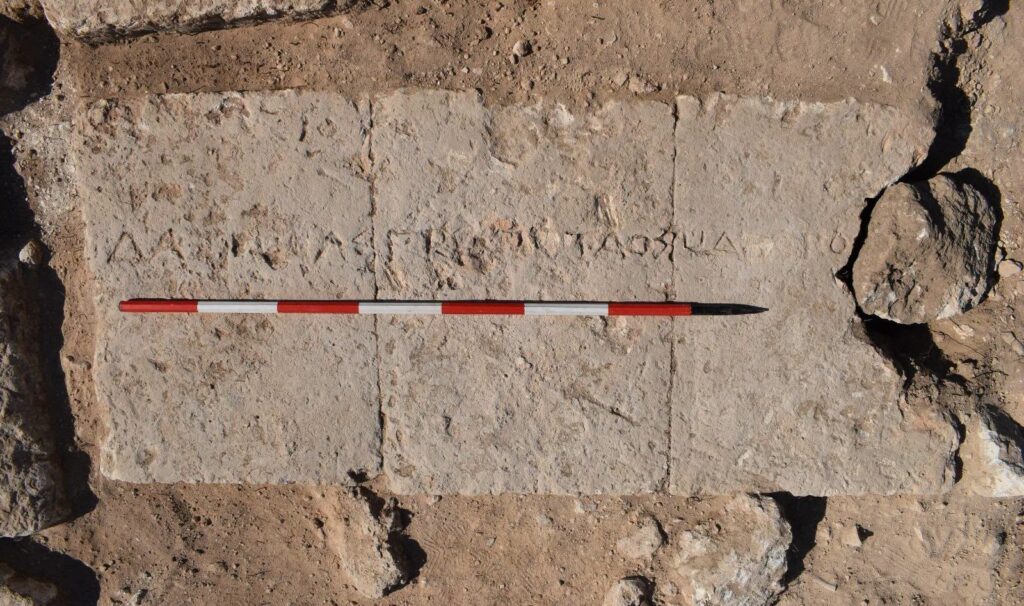
Archaeologists have discovered a 2,300-year-old monumental tomb in southern Italy containing two Messapic inscriptions and painted religious symbols. The evidence suggests that the burial may belong to a priestess associated with the ancient cult of Demeter.
The inscription was carved into one of three large stone slabs that originally sealed Tomb 17 in the ancient Messapian city of Manduria. Inside, a second inscription painted in red and blue appears alongside decorative motifs and images possibly representing religious objects. Together, these findings have led researchers to consider whether the deceased held an important priestly role in the cult of Demeter.
The discovery was made during archaeological excavations funded by Italy’s Ministry of Culture and conducted by the Soprintendenza responsible for the provinces of Brindisi, Lecce, and Taranto. The findings were announced at a press conference in Lecce on October 29, 2026. Experts note that the inscriptions and decorations of Tomb 17, as it has been named, are still undergoing detailed scientific analysis.
Inscribed Female Name and Priestly Title on the Tomb Lid
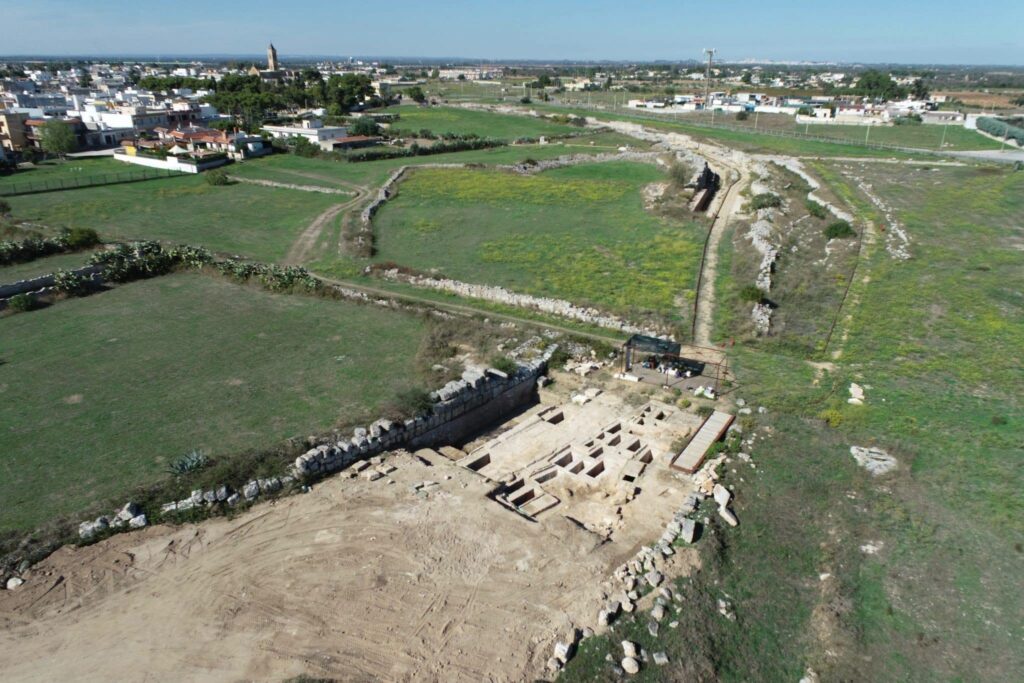
Archaeologists uncovered Tomb 17 within the necropolis of the Messapian city at the Mura Messapiche Archaeological Park in Manduria. The monumental tomb, carved into bedrock, was originally sealed with three large stone slabs. The inscriptions carved into the outer surfaces of these slabs provided the first major clue to the identity of the deceased.
The text, written in the Messapic language, extends across all three stone blocks. Initial epigraphic analysis revealed a woman’s name, her father’s name, and the word thabara. Researchers interpret the latter, used in the genitive case, as a title associated with a priestly role.
This feature suggests the tomb may belong not only to a wealthy woman but also to someone who held religious authority within the community. However, the exact reading of the woman’s name and the full scope of her duties remain undisclosed.
The findings inside the tomb further support this interpretation. The figures and the second inscription visible on the inner surfaces of the stone slabs have led researchers to question not only the identity of the tomb’s occupant but also the religious traditions with which she was associated.
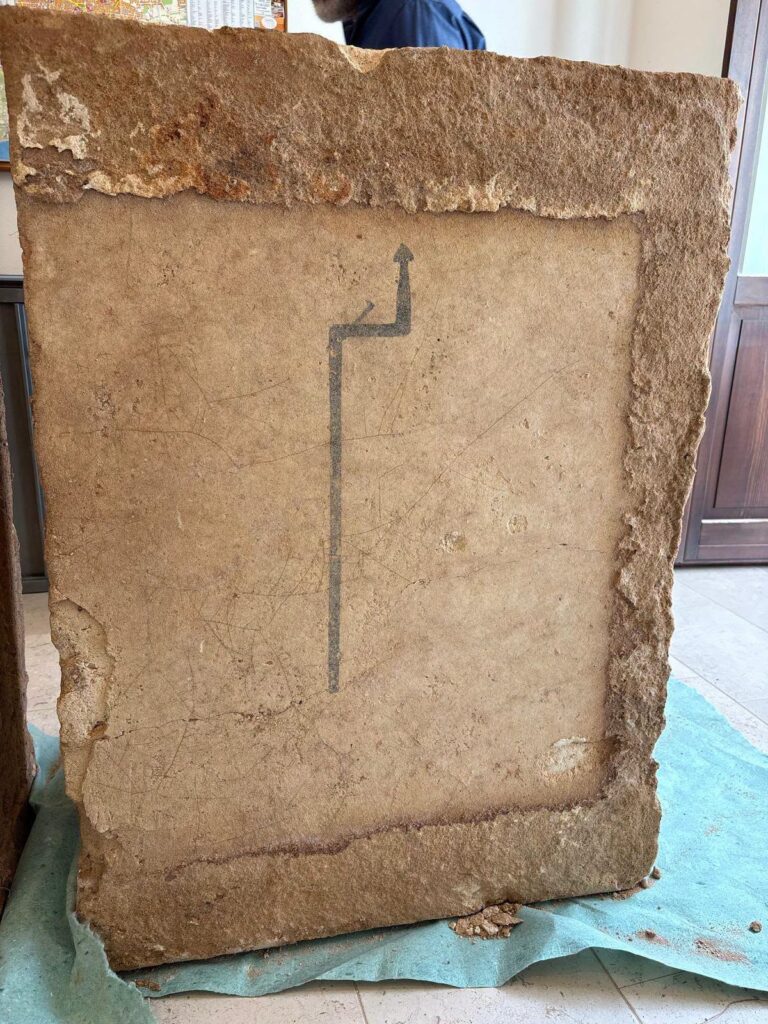
Painted symbol on a stone slab from Tomb 17, interpreted as a possible sanctuary key associated with religious duties. Credit: Soprintendenza Archeologia, Belle Arti e Paesaggio per le province di Brindisi, Lecce e Taranto
Second Inscription Points to Demeter
Inside Tomb 17, traces of red and blue paint survive on the stone slabs, including a meander pattern running along the upper section. Other images appear to depict a temple key and a thymiaterion, a vessel used for burning incense. Both objects may have had religious significance, particularly the key, which ancient Greek priestesses sometimes carried as a symbol of their responsibilities at sanctuaries.
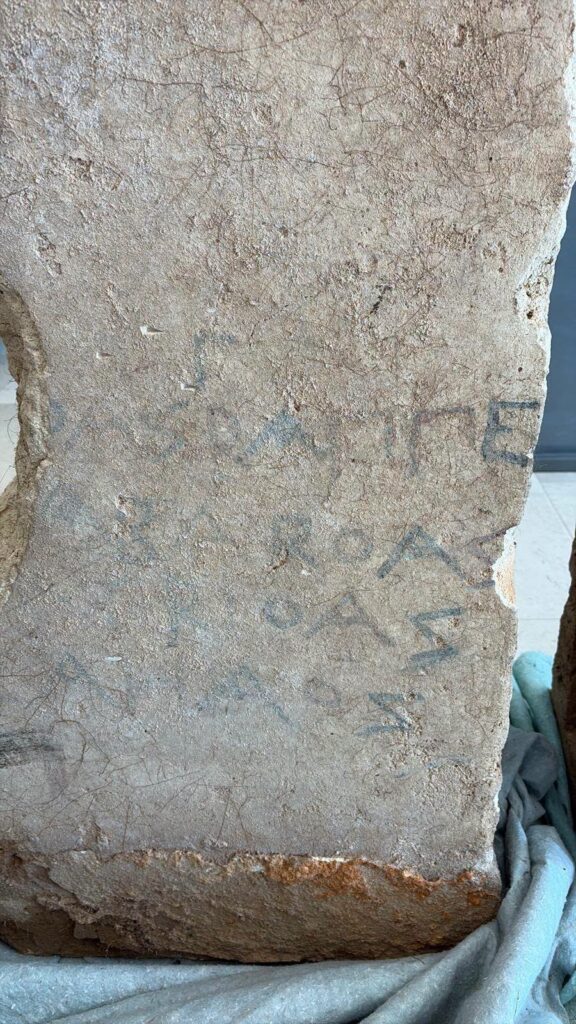
The most intriguing detail, however, is a second Messapic inscription painted on the inner face of one of the slabs. Unlike the inscription carved into the tomb’s outer covering, this four-line text uses colored pigments. Although earlier looting damaged parts of it, researchers identified the term thabara, which also appears in the outer inscription and may refer to a priestly position.
The painted text contains another important clue: a name provisionally reconstructed as Damatrioas. Researchers are examining whether it relates to Demeter, the Greek goddess of agriculture and fertility, whose worship also had connections with death and the cycle of life.
Taken together, the two inscriptions and the painted objects strengthen the possibility that the tomb belonged to a woman with religious responsibilities. Whether she served specifically as a priestess of Demeter remains an open question, however, and further study of the Messapic texts will be essential to establishing her identity.
Who Were the Messapians, and Why Was Manduria Important?
The Messapians were a community that inhabited southern Italy’s Puglia region, particularly the Salento Peninsula, before Roman dominance. They had their own distinct language and inscription traditions and developed close ties with the Greek world due to their strategic location between the Adriatic and Ionian Seas.
Ancient Manduria was one of the Messapians’ most important settlements. The city’s robust walls, gates, and extensive necropolises provide crucial archaeological evidence of its political and social organization.
Sources of information about Messapian religious life include tombs, votive objects, decorated artifacts, and inscriptions in the local language. However, many questions remain about the religious roles of women and the organization of local cults.
For this reason, the inscriptions in Tomb 17 are of particular importance. If the priestly title and Demeter connection are confirmed, the tomb could provide direct insights into the religious authority of women in Messapian society and how Greek-originating cults were adopted by local communities.
Looted Tomb Yields Remaining Artifacts
Tomb 17 had been disturbed by looters in the past, meaning archaeologists have lost some information about its original layout and the identity of the buried individual. Nevertheless, some grave goods have been preserved.
Among the finds are bronze fibulae (clasps), a silver ring, a silver coin attributed to the mint of Taranto, and an iron object whose function remains undetermined. According to reports in the Italian press, the silver ring features a snake motif, while the coin depicts the head of Athena and Heracles battling a lion.
The snake may be linked to the cult of Demeter, while the depiction of Heracles could carry religious significance. However, these interpretations remain speculative, and the objects alone cannot definitively prove that the tomb’s occupant was a priestess.
The limited preservation of human bone fragments further complicates efforts to identify the individual. Experts report that past disturbances and soil conditions have damaged organic remains.
24 Tombs and Changing Urban Layout of the Ancient City
The recent work in Manduria was not limited to Tomb 17. Researchers also conducted excavations around the East Gate of the archaeological park and in the southern sector. In the southern area, stratigraphic excavations covered approximately 180 square meters.
The team examined a total of 24 tombs, most of which date to the 4th and 3rd centuries BCE and had been damaged by looting. Despite this, the recovered ceramics, personal adornments, and other artifacts have provided new data on Messapian burial traditions.
The excavations also shed light on the evolution of the city’s defensive structures between the 5th and 3rd centuries BCE. The discovery that an area previously used as a necropolis was repurposed for road construction in the 3rd century BCE illustrates how urban space was reorganized over time.
Archaeologists Vincenzo Ria and Stefania Montanaro, working on behalf of the Soprintendenza, continue their efforts to decipher the inscriptions and interpret the tomb’s decorations. Plans include archaeobotanical analyses, the restoration of painted surfaces, and detailed examinations of the grave goods.
Authorities are considering preserving Tomb 17 in its original location while displaying the inscribed stone slabs and grave goods at the Manduria Archaeological Museum.
Soprintendenza Archeologia, Belle Arti e Paesaggio per le province di Brindisi, Lecce e Taranto
