
7 February 2026 The Future is the Product of the Past

Sewer Project Leads to Discovery of Rare Hellenistic Chamber Tomb

A major archaeological discovery has been made in Manduria, in Italy’s Taranto province, where construction work for new sewer pipelines has revealed a Hellenistic-era chamber tomb dating to the 4th century BCE. The find, supervised by the Soprintendenza Archeologia Belle Arti e Paesaggio (ABAP) for the provinces of Brindisi, Lecce, and Taranto, provides new evidence of the Messapian settlement’s sophisticated burial practices and confirms the archaeological importance of this area in southern Italy.

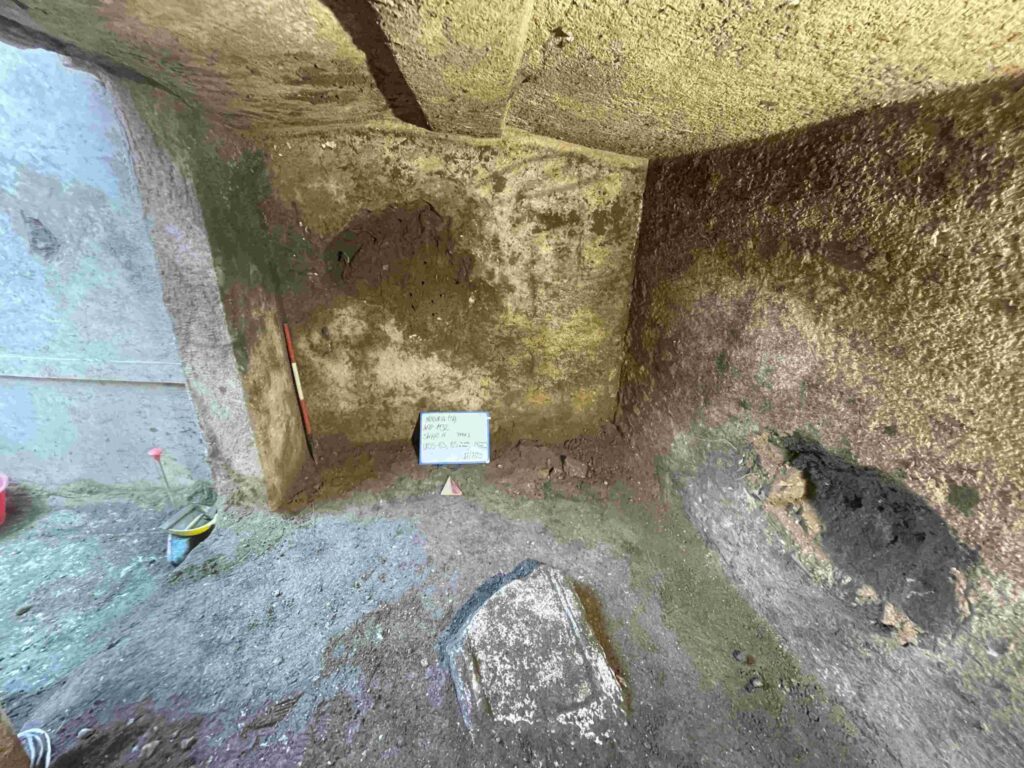
The tomb, located in Via Scarciglia, is part of a small funerary complex and consists of two separate rooms. The first space, interpreted as a dromos or antechamber, preserves traces of red-painted plaster with a raised white band running horizontally along the walls. Excavations here uncovered a rich assemblage of Hellenistic pottery in primary context, including vases, oil lamps, unguentaria, and plates—all firmly datable to the 4th century BCE.

The entrance to the main burial chamber features a moulded stone lintel that reflects careful craftsmanship and suggests the tomb may have belonged to an individual of elevated social status. The entrance was once sealed with a red-plastered double-leaf stone door, fragments of which were recovered during excavation. Inside the chamber, archaeologists identified additional painted plaster remains and four rectangular recesses carved into the southern floor—likely supports for a wooden funerary bed.
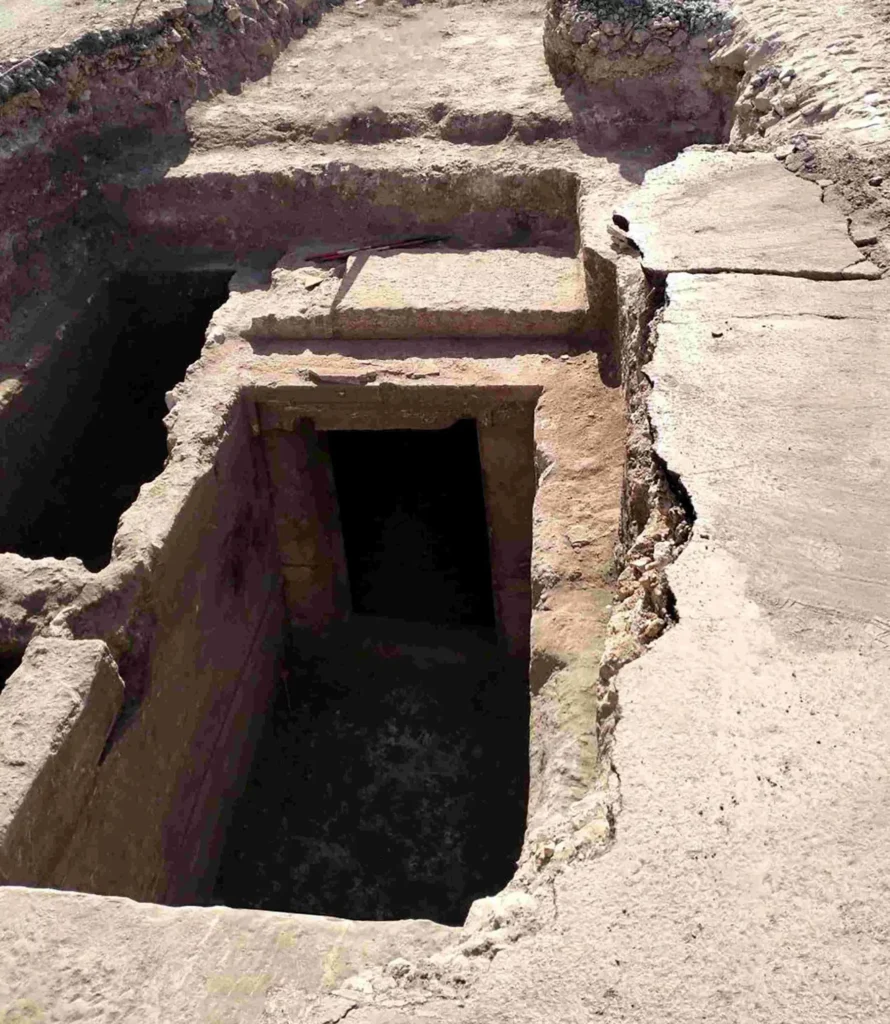
The chamber tomb from the Hellenistic period discovered in Manduria. Credit: Ministry of Culture – Soprintendenza Archeologia Belle Arti e Paesaggio for the Provinces of Brindisi, Lecce, and Taranto.

Evidence of Ancient Tomb Robbery

Archaeological investigation revealed that the tomb complex had been disturbed in antiquity. Several holes were cut through the chamber walls, likely in an attempt to reach nearby burials. Through one of these openings, archaeologists discovered a second tomb that had remained sealed externally but was found to be empty, suggesting it was looted in antiquity.

Despite the lack of grave goods, a Roman Republican denarius was recovered from the backfill of this second tomb. This small find indicates that the area continued to be used or visited well into the Roman period, offering a rare glimpse into the region’s changing funerary landscape.


📣 Our WhatsApp channel is now LIVE! Stay up-to-date with the latest news and updates, just click here to follow us on WhatsApp and never miss a thing!!


Who Were the Messapians?

The Messapians were an ancient Italic people who inhabited the Salento Peninsula in southern Apulia from at least the 8th century BCE. Thought to have Illyrian origins, they developed a distinct culture marked by fortified hilltop settlements, elaborate burial customs, and unique inscriptions written in the Messapic language, a non-Indo-European tongue.

By the 4th century BCE, Messapian society had been deeply influenced by Magna Graecia, adopting Greek architectural styles, pottery, and funerary traditions while preserving indigenous cultural traits. The discovery of the Manduria tomb adds valuable evidence to this cultural synthesis, illustrating the wealth and cosmopolitan character of Messapian elites during the Hellenistic era.
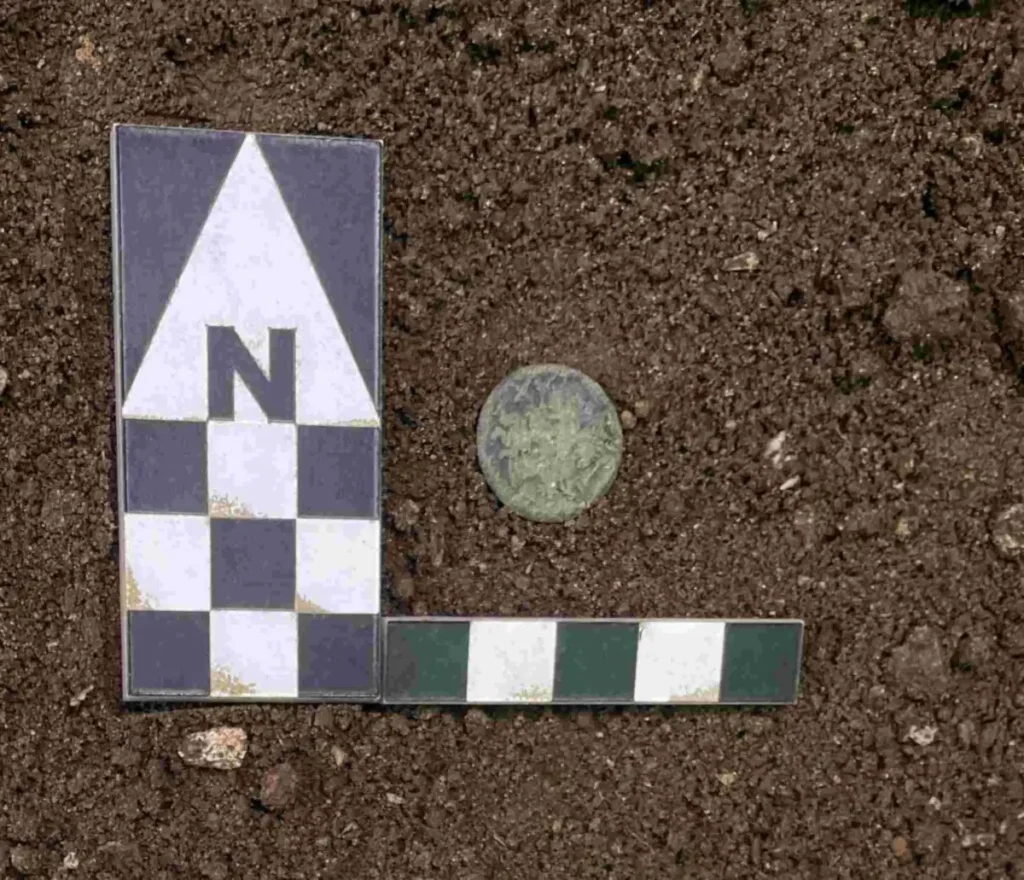
A Roman Republican denarius recovered at the excavation site. Credit: Ministry of Culture – Soprintendenza Archeologia Belle Arti e Paesaggio for the Provinces of Brindisi, Lecce, and Taranto.

Expanding Knowledge of Manduria’s Necropolis

This discovery follows earlier findings from late 2024, when the same sewer works exposed a cluster of 11 rock-cut pit graves along Via Scarciglia. Together, these finds confirm that this sector of Manduria functioned as a structured necropolis during the Hellenistic period.

Manduria, historically part of the Messapian culture of southern Apulia, is already known for its imposing city walls and archaeological richness. The newly discovered tomb adds depth to our understanding of Messapian burial customs, which blended local Italic traditions with influences from the wider Mediterranean world during the centuries following Magna Graecia’s expansion.

Collaboration Between Infrastructure and Heritage Protection

The excavation was conducted by Impact Soc. Coop., a specialized archaeological company, under the direct scientific supervision of the Ministry of Culture’s ABAP office. The works were carried out in compliance with Italy’s public procurement regulations, which mandate archaeological oversight during major infrastructure projects.

This successful coordination between the Soprintendenza and Acquedotto Pugliese (AQP), the water utility responsible for the sewer project, demonstrates how modern development can coexist with heritage conservation. AQP emphasized its commitment to cultural preservation, supporting ongoing excavation and documentation efforts to protect the archaeological record while completing essential infrastructure.
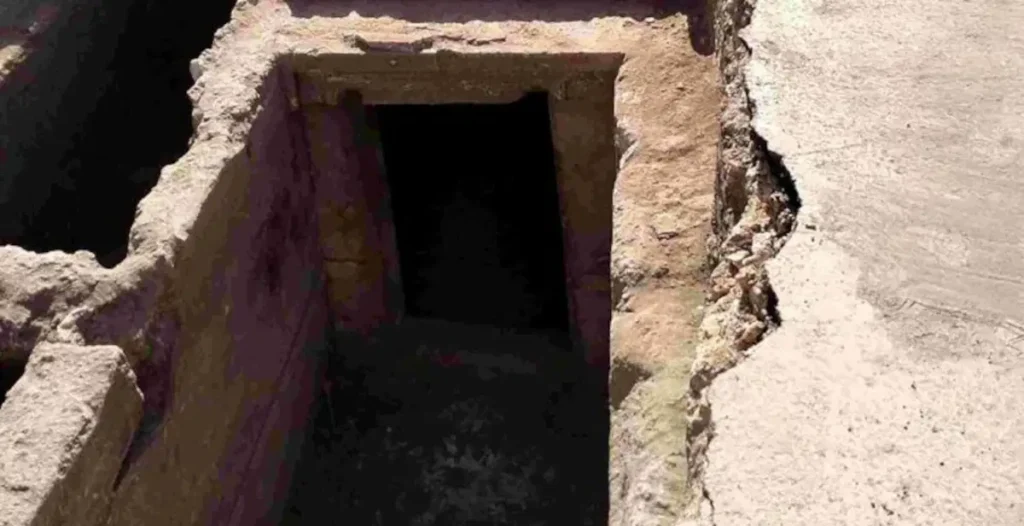
Hellenistic chamber tomb discovered during sewer works in Manduria, Italy. Credit: Ministry of Culture – Soprintendenza Archeologia Belle Arti e Paesaggio for the Provinces of Brindisi, Lecce, and Taranto.

Digital Preservation: A 3D Model of the Tomb

As part of the post-excavation process, experts are conducting a photogrammetric survey of the chamber tomb to create a high-resolution 3D digital model. This cutting-edge documentation method will ensure that the tomb’s architecture, decoration, and context are preserved for future study and potentially made accessible to the public through virtual reconstructions.

Such initiatives highlight the growing role of digital archaeology in Italy, enabling researchers, students, and the public to explore heritage sites even when direct access is not possible.

Soprintendenza archeologia belle arti e paesaggio Brindisi e Lecce

Cover Image Credit: The Hellenistic-period chamber tomb discovered in Manduria. Credit: Ministry of Culture – Soprintendenza Archeologia Belle Arti e Paesaggio for the Provinces of Brindisi, Lecce, and Taranto

Related Articles

A pendant made of mammoth bone with ‘mysterious dots’ could be the oldest known example of ornate jewelry in Eurasia

26 November 2021

26 November 2021

The fragments of an ancient pendant made of mammoth ivory were unearthed in Poland, and are regarded to be the...

Spectacular gold find from early medieval tombs in Basel

28 November 2022

28 November 2022

An excavation in Basel’s Kleinbasel neighborhood, Switzerland, has uncovered 15 graves, some richly furnished, from an early medieval burial ground....

4,000-Year-Old Seal Found at Tavşanlı Mound in Western Türkiye

17 August 2024

17 August 2024

4,000-year-old seal were found at the Tavşanlı Mound (or Tavşanlı Höyük) in Türkiye’s Kütahya province—located in the west of the...

A 1,700-Year-Old Roman Merchant Ship Lies Just Two Meters Below the Surface off Mallorca’s Playa de Palma

4 November 2025

4 November 2025

Just two meters beneath the turquoise waters of Playa de Palma, archaeologists have uncovered a remarkably preserved Roman merchant ship...

Unearthing One of the Earliest Examples of Roman Monumental Architecture: Ancient Basin Discovered in Gabii

21 October 2025

21 October 2025

Hidden beneath the soil of an ancient city just east of Rome, archaeologists from the University of Missouri have uncovered...

Iron Age Warriors Bend the Swords of Their Defeated Enemies

22 April 2021

22 April 2021

Archaeologists from the Westphalia-Lippe Regional Association (LWL) announced that a metal detector has discovered “one of the largest Iron Age...

A gilded silver Anglo-Saxon object “made by someone with a real eye for loveliness” has the experts baffled

2 January 2024

2 January 2024

An enigmatic Anglo-Saxon object has been unearthed in a captivating discovery near Langham, Norfolk, East of England. This gilded silver...

The researchers unearthed the earliest evidence of warfare and organized arming in the Southern Levant

28 November 2023

28 November 2023

Israel Antiquities Authority researchers have unearthed the earliest evidence of warfare and organized arming in the Southern Levant, dating back...

New insights into Scotland’s ‘bodies in the bog’

31 March 2022

31 March 2022

Fourteen bodies were found at Cramond near Edinburgh in 1975. New research suggests that two of the remains of these...

Germany: 700-year-old Causeway Found Under Central Berlin Street

19 February 2022

19 February 2022

Archaeologists from the Landesdenkmalamt Berlin (LDA) made a sensational find during their excavation at Molkenmarkt: about 2.50 m below Stralauer...

In Poland, a 45-meter-long mysterious tunnel found under the ruins of the Saxon Palace

9 September 2023

9 September 2023

A mysterious underground tunnel was found under the ruins of the Saski Palace in Pilsudski Square in Warsaw, the capital...

2000-year-old passage found after Latrina at Smyrna Theater

28 January 2022

28 January 2022

Archaeologists discovered a 2,000-year-old passage that was 26 meters long and constructed in an “L” form in the theater part...

Turkish researchers use Artificial Intelligence to read cuneatic Hittite tablets

9 January 2023

9 January 2023

Thanks to a project implemented in Türkiye, 1,954 ancient Hittite tablets are being read for the first time using artificial...

The World’s Earliest Ground Stone Needles Found in Western Tibetan Plateau

26 June 2024

26 June 2024

In western Tibet, six peculiar stone artifacts were discovered in 2020 by archaeologists excavating close to the shore of Lake...

Ancient Fish Traps in Denmark Challenge the Neolithic Revolution Narrative and Rewrite Stone Age History

1 July 2025

1 July 2025

A stunning archaeological discovery on the Danish island of Lolland is transforming our understanding of the Neolithic transition. Researchers from...