
9 December 2025 The Future is the Product of the Past

Outstanding Bronze Age artifacts discovered in the Auvergne-Rhône-Alpes region of France

Hundreds of bronze objects have been discovered buried in pottery in the Auvergne-Rhône-Alpes region of France.

The research team, led by Pierre-Yves Milcent of the University of Toulouse Jean Jaurès, is conducting archaeological research and excavations near the Sioule gorges, south of the Allier department.

Near Gannat, these studies recently led to the discovery of a large fortified settlement from the end of the Bronze Age (around 800 BC). Fortified settlements were numerous in the Late Bronze Age, but rarely this large (about thirty hectares). The site is currently France’s Bronze Age habitat, which delivered the largest number of metal objects.

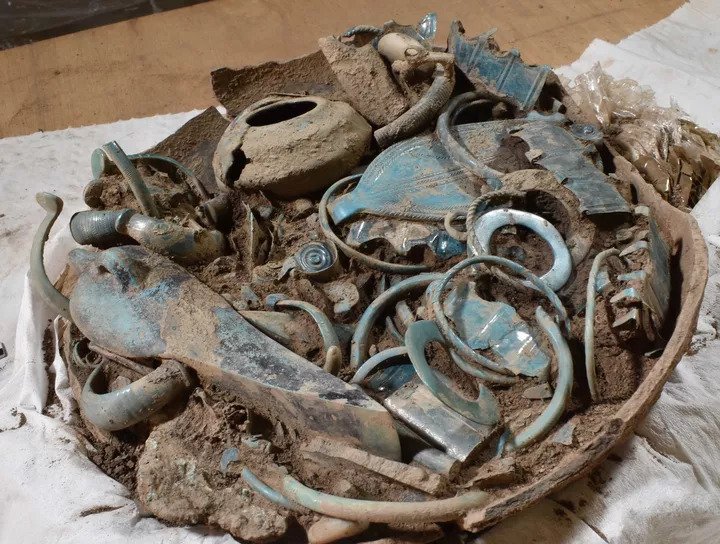
Women’s or children’s jewelry, such as bracelets, anklets, and pendants, were discovered in the bottom of two vessels discovered in 2020. Then there was a layer of tools and weapons in one, and chariot ornamentation, riding accouterments, and wheel pieces in the other. Bronze axes were then placed to the tops of each vessel.

The team revealed two new, pristine metal deposits in August 2021. One was placed in a pot covered with a vessel. The other consists of a series of ax blades carefully placed in a pit.


📣 Our WhatsApp channel is now LIVE! Stay up-to-date with the latest news and updates, just click here to follow us on WhatsApp and never miss a thing!!


Auvergne-Rhône-Alpes bronze age
The team revealed two new, pristine metal deposits in August 2021. One was placed in a pot covered with a vessel. The other consists of a series of ax blades carefully placed in a pit. Photo: (M. VALLÉE)

“They could be offerings as found in Greece at that time, deposited during the foundation or abandonment of the settlement, to help ensure divine protection”, said Dr. Pierre-Yves Milcent.

“This discovery, with intact artifacts, is exceptional because it allows us to better understand how and why they were buried”, he added.

With the new discovery, the team will be able to confirm the initial hypotheses raised during the excavation of the excavated sites in 2020. The hypothesis is that the finds are voluntary divine offerings.

The Bronze Age is an unknown period of European Protohistory, which, as stated in the press release, took place between 2200 and 800 BC. Therefore, the evaluation and analysis of the finds are of great importance.

Excavations and studies carried out in the Gannat region and within the framework of the Collective Research Project dedicated to the south of Allier during Protohistory and Antiquity, are organized by the University of Toulouse JeanJaurès. It was conducted by Jaurès and the TRACES-UMR 5608 Laboratory and was conducted with the support of the Auvergne-Rhône-Alpes Archaeological Regional Service, the Allier Department Preventive Archeology Service (SAPDA), and the Anne-de-Museum of Arts and Archeology.

University of Toulouse-Jean Jaurès

Press release

Over Photo: (F. BORD)

Related Articles

Excavations at Sheffield Castle Reveal the First Surviving Examples of 17th-Century Civil War Abatis

9 March 2025

9 March 2025

Excavations at Sheffield Castle, part of the Castlegate regeneration project by Sheffield City Council, have revealed the first known surviving...

Archaeologists Discover 8600-year-old Bread at Çatalhöyük May be the Oldest Bread in the World

5 March 2024

5 March 2024

Archaeologists have discovered about 8,600-year-old bread at Çatalhöyük, a Neolithic settlement in central Turkey. Çatalhöyük is noteworthy because it is...

A Previously Unknown Bronze Age Settlement Discovered in Switzerland

18 February 2024

18 February 2024

In advance of a construction project in Heimberg, the Archaeological Service of the Canton of Bern carried out a rescue...

3800-years-old Akkadian Cuneiform Tablet found in Turkey’s Hatay

11 August 2023

11 August 2023

A 3,800-year-old Akkadian cuneiform tablet was found during the archaeological excavations carried out in the Aççana Mound, the old city...

A Symbol of Elite Roman Luxury: Frescoed Villa with Fish Pond Discovered in Tripolis

19 July 2025

19 July 2025

A newly uncovered 1,600-year-old Roman villa in the ancient city of Tripolis dazzles with its colorful frescoes, sophisticated architecture, and...

Ancient Greeks Built a Road to Haul Cargo Overland: The Father of the Railway: Diolkos

6 May 2024

6 May 2024

The Diolkos, an ambitious road that crossed the entire Isthmus of Corinth and was partially paved with stone, was built...

A rare Ogham inscription found on Pictish stone in Scottish Kirkyard

8 November 2022

8 November 2022

A Pictish carved stone cross slab with a rare inscription in the early medieval ogham language has been discovered in...

Roman-era structures unearthed in northwestern Turkiye dam site rescue excavations

18 May 2024

18 May 2024

Rescue excavations at the Reşitköy Dam site in the northwestern Turkiye province of Balıkesir have unearthed Roman structures, including a...

Four-face ivory dice found at Keezhadi excavation site in India

18 February 2022

18 February 2022

The Tamil Nadu Archaeological department along with the Archaeological Survey of India has unearthed rectangular ivory dice,  in the excavation...

New study reveals the Milky Way’s hidden role in ancient Egyptian mythology

11 April 2024

11 April 2024

The ancient Egyptians were keen observers of the night sky. They incorporated their astronomical observations into their religion, mythology, and...

2,000-Year-Old Roman Stele Decorated with an Eagle and Greek Inscriptions Found in Manbij, Syria

23 August 2025

23 August 2025

A striking Roman-era stele carved from black basalt, featuring a detailed eagle clutching a wreath and adorned with Greek inscriptions,...

Stunning carved stone depicting a mystery naked horseman is discovered at the Roman fort of Vindolanda

30 June 2021

30 June 2021

Near Hadrian’s Wall in northern England, archaeologists discovered a carved sandstone slab portraying a naked horseman. During the annual excavations...

Scientists have developed a new tool that enables them to identify prehistoric and historic individuals’ relatives up to the sixth-degree

24 December 2023

24 December 2023

A new method of genetic analysis makes it possible to determine family relationships of prehistoric and historical individuals up to...

A 2000-year-old wooden figure was unearthed in a Buckinghamshire ditch

13 January 2022

13 January 2022

An extremely rare, carved wooden figure from the early Roman era has been discovered in a waterlogged ditch during work...

An unknown church with a special floor plan discovered in Erwitte, northwestern Germany

18 September 2023

18 September 2023

Archaeologists from the Westphalia-Lippe Regional Association (LWL) have discovered the remains of a former church from the 10th century near...