
Nine newly published inscriptions from the ancient Phrygian city of Akmoneia in western Türkiye are revealing separate but connected glimpses of Roman-period urban life: a torch-bearing statue dedicated by a local benefactor, a statue-lined main street, the first epigraphic evidence for Demeter Karpophoros in Phrygia, and a funerary poem for a man who appears to have died violently far from home
The inscriptions were discovered during archaeological surveys in the territory of Akmoneia, located at modern Ahatköy, about 10 kilometers from Banaz in Uşak Province. The study by Hüseyin Uzunoğlu of Akdeniz University and Münteha Dinç of Uşak University has been published in the journal Gephyra.
Akmoneia stood in the ancient region of Phrygia, a broad inland zone of western and central Anatolia. Long before Roman rule, Phrygia was associated with powerful local traditions, monumental landscapes, and figures such as the legendary King Midas. By the Roman imperial period, cities like Akmoneia had become part of a wider civic world in which Greek inscriptions, Roman institutions, local cults, and Anatolian religious traditions overlapped.
More than 300 inscriptions from Akmoneia and its surroundings had already been known. The new group adds nine more texts, but their value lies less in their number than in the details they preserve: a prominent citizen named Demades, a torch-bearing statue, a coordinated program of statues along the city’s main street, a new attestation of Demeter Karpophoros in Phrygia, and a funerary poem for a man apparently killed by “lawless hands.”
A torch-bearing statue dedicated by Demades
One of the most striking inscriptions concerns Demades, son of Dionysogenes, a member of Akmoneia’s local elite. He was already known from an earlier honorific decree securely dated to AD 68. The new inscription identifies him again as a lifelong priest of Athena Sebaste and also as priest of Pantheion or Pantheios, a term whose exact meaning remains debated.
The text records that Demades dedicated a lampadephoros, a torch-bearing statue, at his own expense for the people. The statue itself has not survived, or at least has not been identified, but the inscription is enough to show that such a monument once formed part of Akmoneia’s public or sacred landscape.
The researchers are careful not to claim that this was simply an ancient streetlamp. Still, comparisons from Miletos and Aphrodisias show that torch-bearing statues could serve more than a decorative role. They may have helped illuminate public spaces, sanctuaries, theaters, or banquet settings after dark.
For Akmoneia, that detail matters. It suggests that the city’s monuments were not only symbolic displays of wealth and piety. Some may also have shaped how people experienced the city at night.
A statue-lined main street
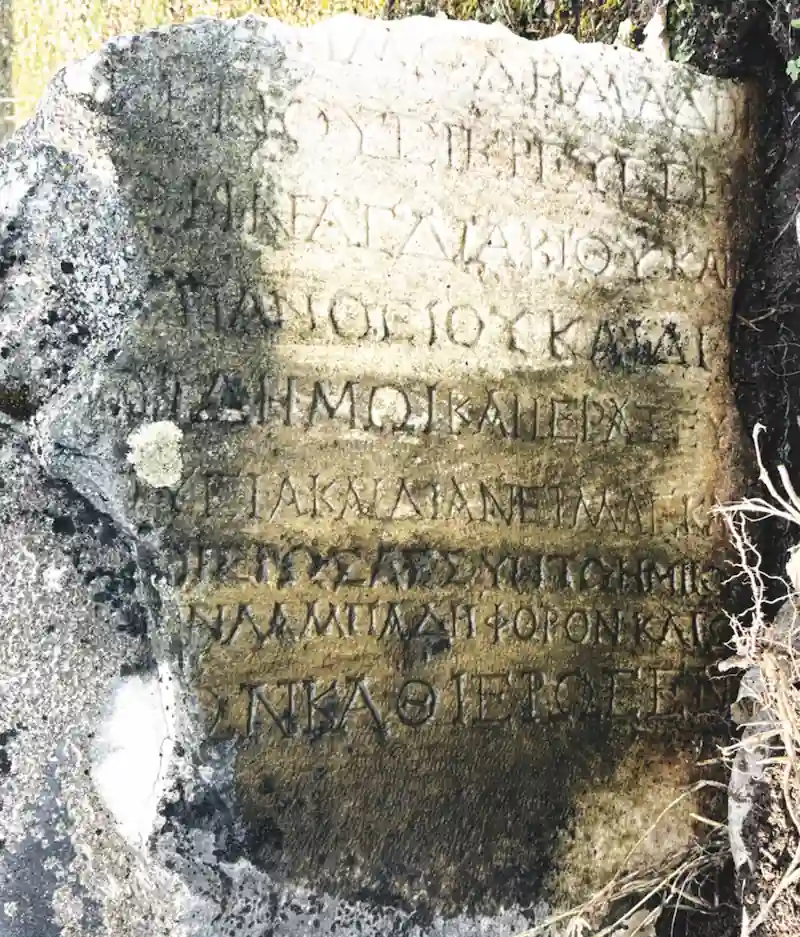
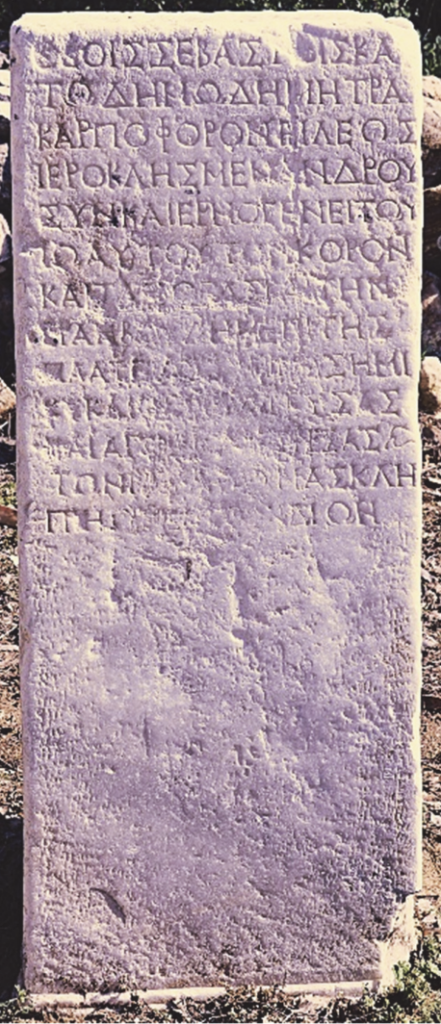
Another inscription turns attention to Akmoneia’s main street. It records that Hierokles, son of Menandros, together with his son Hermogenes, erected a statue of Demeter Karpophoros, “Demeter the Fruit-Bearer,” and dedicated it to the divi Augusti and the people.
The same text also says Hierokles and his son had set up statues of Koros, unspecified goddesses, and the Sacred Council, each with semicircular bases, along the city’s main street. This was not a random act of private generosity. The inscription points to a coordinated program of statue dedications in one of the city’s most visible public spaces.
The Demeter inscription is especially important because the authors identify it as the first epigraphic evidence for Demeter Karpophoros in Phrygia. The cult of Demeter Karpophoros is known elsewhere in Asia Minor, including major centers such as Ephesus, Pergamon, and Sardis, but this text appears to bring that title into the Phrygian epigraphic record for the first time.
Demeter’s title Karpophoros linked her to fertility, crops, and agricultural abundance. In a region where rural production and local landholding mattered deeply, such a goddess would have carried both religious and civic weight. The fact that her statue stood on the main street shows that agricultural prosperity was not hidden in the countryside; it was displayed in the city’s public language of honor, piety, and status.
Hierokles himself was not simply a donor. The inscription says he had served as priest and as agonothetes, or organizer, of the Great Asklepieia, a festival connected with Asklepios, the god of healing. That detail places him among the civic figures who paid for religious and public life, turning private wealth into visible prestige.
The old Phrygian city under Rome
By the time these inscriptions were carved, Akmoneia was not an isolated settlement but a Roman-period city with a dense civic identity. Its people honored benefactors, set up statues, marked priesthoods, held festivals, and buried their dead with carefully composed texts.
The new inscriptions show how local elites used religion and architecture to shape the urban experience. Demades funded statues and sacred dedications. Hierokles and Hermogenes arranged a sequence of monuments along the main street. The council and people honored prominent figures. The city’s religious world included Athena Sebaste, Demeter Karpophoros, Asklepios, Koros, and the ambiguous Pantheion or Pantheios.
That mixture is typical of Roman Anatolia. Imperial titles and Roman civic habits did not erase local traditions. Instead, they were absorbed into older landscapes where Anatolian, Greek, and Roman elements could stand side by side.
A violent death far from home
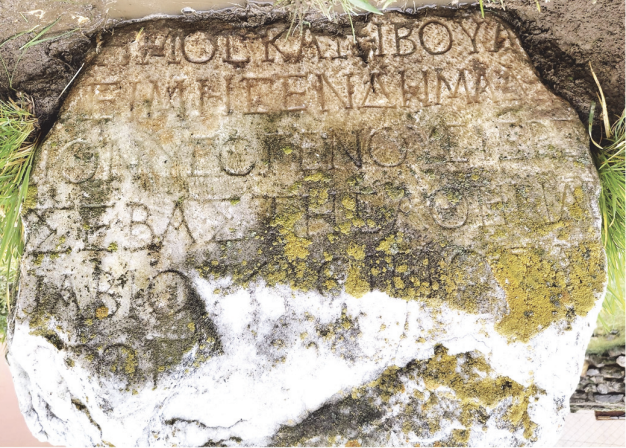
The most human text in the group is a funerary epigram on a marble stele from the territory of Akmoneia. It commemorates a man whose name is partly lost, but whose homeland was Synnada, another Phrygian city. The poem says he had been entrusted with a military command or unit and came to “famous, most ancient Akmoneia,” where he died after falling into the hands of lawless men.
The language is unusually vivid. The phrase translated as “under the fingers of lawless hands” suggests homicide. The authors note that it may even hint at the manner of death, possibly smothering, although that remains uncertain.
The man died at 40. His wife had the monument made as an expression of love.
The same stone carries a second epigram for a man named Thalamos, who also appears to have held an official position in the army. Because the two individuals cannot be identified as the same person, the authors suggest they may have been comrades commemorated together on a single funerary monument.
That possibility gives the stone unusual emotional force. It is not only evidence for Roman military presence or movement in inland Anatolia. It may preserve the memory of men whose service brought them away from home, and whose deaths were remembered not in official military language, but through grief, companionship, and poetry.
Priestesses, tombs, and the afterlife of stones
Other inscriptions add smaller but valuable pieces to Akmoneia’s social history. One funerary text concerns Mandana, described as high priestess of the city. Her name is of Iranian origin, but the authors caution that such names do not necessarily prove ethnic origin, since they could be adopted by local populations. More important is her title: Mandana appears as a woman who held a significant religious office in the city.
Another funerary monument includes a penalty clause of 2,500 denarii for anyone who opened the tomb. Such fines were common in the Roman world, but the details of this inscription, including references to family members and possible conditions concerning remarriage, point to the legal and emotional care invested in burial arrangements.
Several stones also had later lives. Some were reused in Late Antiquity, and one funerary stele was observed in a modern village setting, built into a staircase wall and partly obscured by concrete. In that sense, the inscriptions are not only records of Roman Akmoneia. They are also objects that moved, broke, were reused, and survived by chance.
For archaeologists and epigraphers, the nine new inscriptions do not transform Akmoneia in a single dramatic stroke. Their importance is cumulative. Together they restore fragments of a city’s public street, its statues, its religious offices, its benefactors, its military connections, and its dead.
For readers today, they show how much of an ancient city can survive in a few lines cut into stone.
Uzunoğlu, H., & Dinç, M. (2026). New Inscriptions from Akmoneia. Gephyra, 31, 103-123. https://doi.org/10.37095/gephyra.1942630
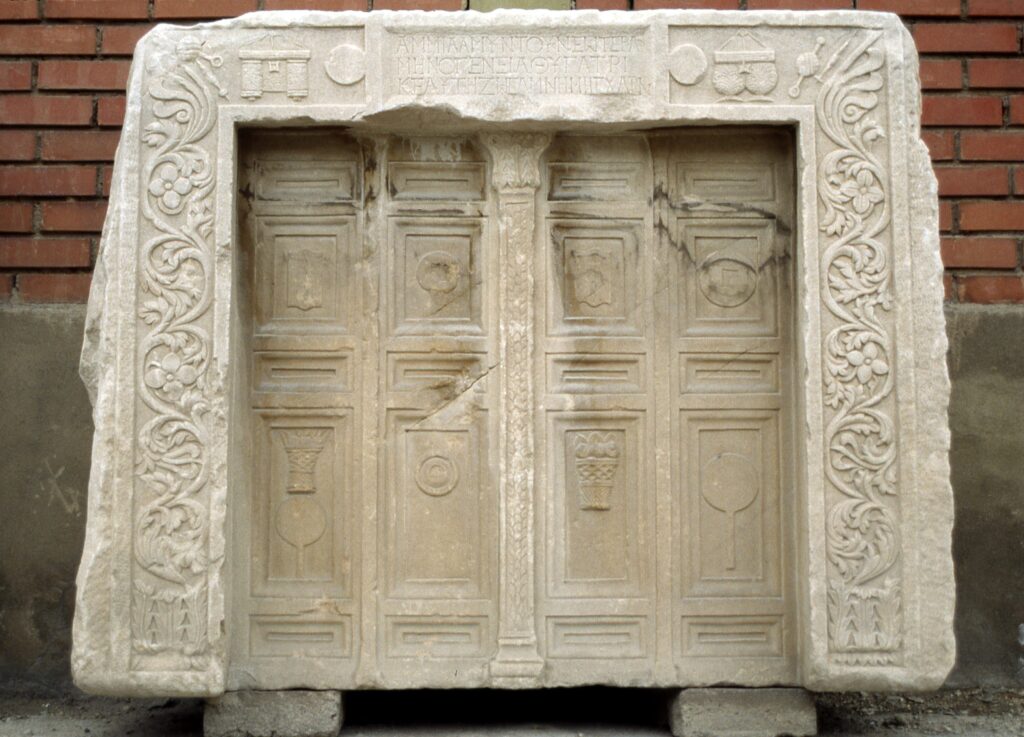
Cover Image Credit: Funerary stele from Acmonia. Mark Landon – Public Domain
