
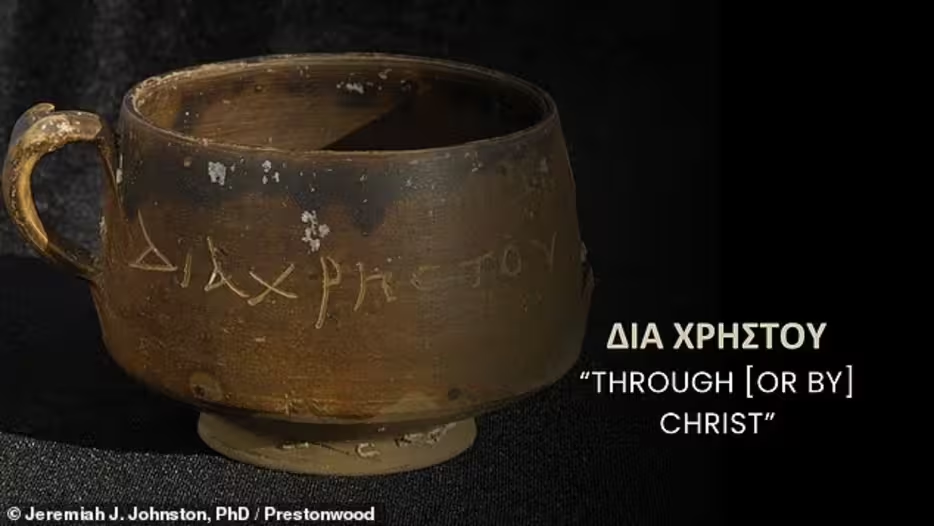
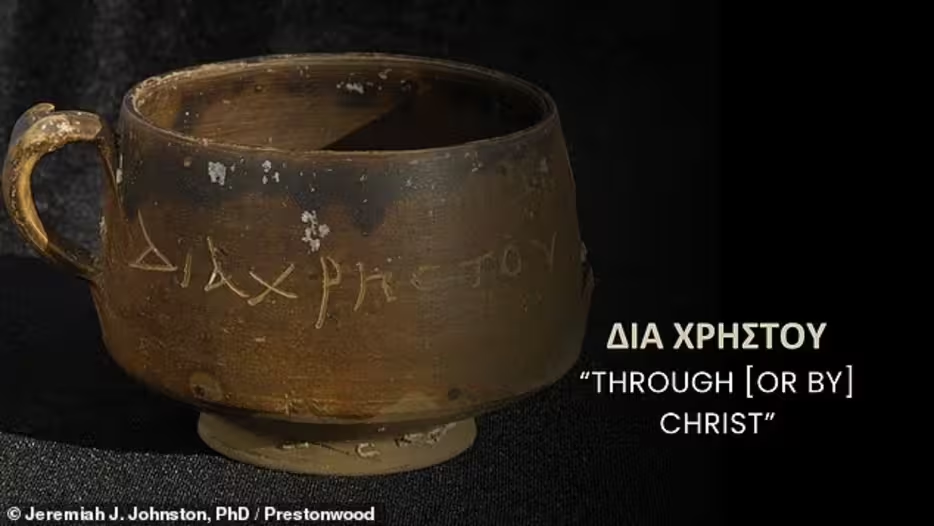
A ceramic bowl discovered in Alexandria, dubbed the “Jesus Cup” and inscribed “DIA CHRSTOU O GOISTAIS”, has sparked debate: might this be the oldest known non-biblical reference to Jesus Christ? Experts differ over translation, dating, and implications.
Discovery and Inscription
A remarkably well‑preserved ceramic bowl recovered in 2008 from underwater ruins in Alexandria, Egypt, is reigniting the debate over how early the figure of Jesus Christ entered material culture outside Christian texts. The artifact—dubbed the “Jesus Cup”—bears a Greek inscription “DIA CHRSTOU O GOISTAIS”, often translated as “Through Christ the magician/chanter.” If this refers to Jesus Christ, it might be the earliest known non‑scriptural reference to him, potentially revising assumptions about Christianity’s early spread.
The bowl was discovered by a team led by French marine archaeologist Franck Goddio during excavations of Alexandria’s ancient Great Harbor, specifically near the submerged island of Antirhodos, historically associated with Cleopatra’s palace. It is missing a handle, yet otherwise is in excellent condition. The bowl is thought to date between the late 2nd century BCE and early 1st century AD.
Scholarly Interpretations and Controversy
The meaning of the inscription has provoked wide scholarly debate:
Direct Christ reference: Some scholars, such as New Testament expert Dr. Jeremiah Johnston, argue that the inscription is an early reference to Jesus, supporting the view that his name and reputation spread quickly beyond Judea. Johnston explained in an interview on Trinity Broadcasting Network (TBN) that Jesus’s reputation as a healer and miracle worker made his name powerful even during his short ministry. “The disciples came to Jesus and said, ‘Teacher, people are using your name to cast out demons. Should we stop them?’ Jesus said, ‘No, a house divided against itself can’t.’ Jesus, through his own short ministry of just three years, others are invoking his name because it had so much power.” If authentic, it would mark the earliest archaeological evidence of Jesus Christ outside scripture.
Alternative readings: Other experts point out that Christou may actually be Chrestou, meaning “good” or “kind” in Greek, which would not necessarily refer to Jesus. The accompanying word Goistais could mean “magician” or “enchanter,” linking the inscription to oracular or magical rituals common in Alexandria.
Religious syncretism: Alexandria was a cosmopolitan hub where paganism, Judaism, and emerging Christianity intersected. Magical texts often borrowed divine names to lend authority to rituals. Thus, even if “Christ” is referenced, it might have been invoked as a powerful name within a broader magical context rather than as an expression of Christian belief.
Skeptical interpretations: Classical scholars such as Bert Smith and Klaus Hallof suggest that the inscription could be linked to a figure named Chrestos or to local cults, possibly even referencing deities such as Hermes, Athena, or Isis. Others argue the bowl might have been used for preparing ointments, with diakhristos referring to salve rather than the biblical Christ.
Implications if Authentic
If the inscription does indeed reference Jesus Christ, the implications are far‑reaching:
It would provide the oldest material evidence of Christ’s influence, dating to the first century AD.
It could demonstrate that knowledge of Jesus’s life and miracles reached Alexandria within decades of his ministry.
It would highlight Alexandria’s role as a center for religious innovation, bridging pagan, Jewish, and Christian traditions.
It might prompt historians to reconsider how Christianity spread beyond Judea, not solely through Rome but also through cultural exchange in Egypt.
Caution and Need for Further Study
Despite its intrigue, most scholars advise caution. The inscription’s brevity, the possibility of alternative translations, and the absence of corroborating evidence prevent a definitive conclusion. More research is needed to confirm whether “Christou” refers to Jesus Christ, another individual, or a symbolic term.
Recent reports emphasize that while the “Jesus Cup” is fascinating, it is not yet conclusive proof of the earliest reference to Christ. Archaeologists continue to analyze the artifact, calling for careful epigraphical study and contextual comparison with other finds from Alexandria’s harbor.
Conclusion
The “Jesus Cup” underscores the complexity of tracing early Christianity’s history. Whether it directly references Jesus or not, the artifact reflects Alexandria’s vibrant religious life and the blending of traditions in the ancient Mediterranean world. For now, the bowl remains a mystery—an object that could either be a groundbreaking witness to the earliest material mention of Christ, or a testimony to the diverse and experimental nature of religious practice in first‑century Alexandria.
Cover Image Credit: Dr Jerimiah Johnston
