
10 March 2026 The Future is the Product of the Past

2,000-Year-Old Kushan Coin Hoard Discovered in Tajikistan

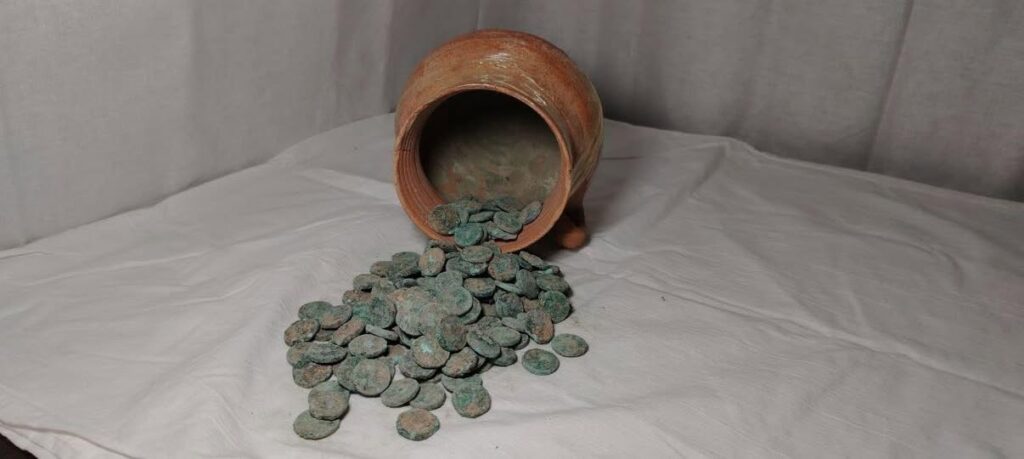
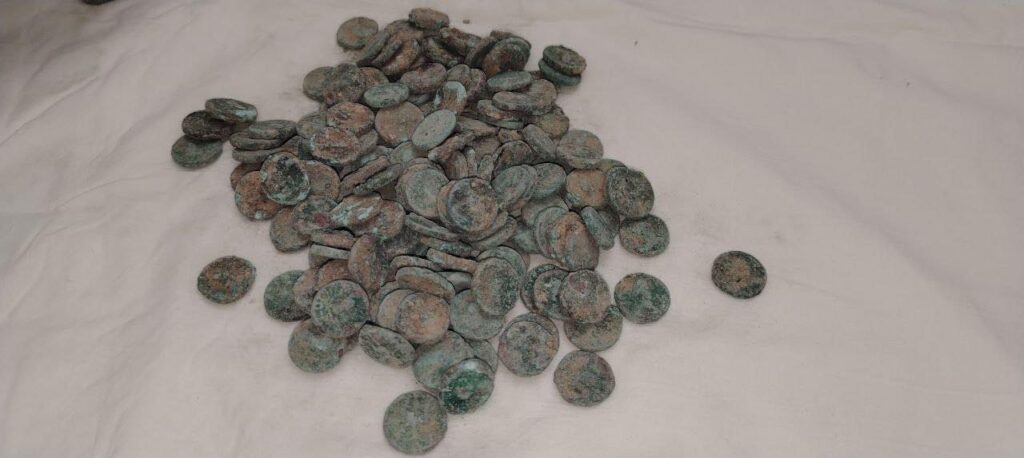
A chance discovery in southern Tajikistan has opened a new window onto the early history of the Kushan Empire. In the Shahritus district, more than 150 copper coins dating to the 1st century AD have been unearthed, offering rare material evidence from the formative phase of Kushan rule in Central Asia.

The find was announced in early 2026 by the National Academy of Sciences of Tajikistan, following the transfer of the hoard to state custody. According to officials, the coins were discovered accidentally by a local resident during routine agricultural work. Beneath the soil lay a small ceramic vessel, filled with heavily oxidized copper coins that had remained undisturbed for nearly two millennia.

Once the discovery was reported, specialists were dispatched to Shahritus to document the context and secure the find. The hoard was subsequently transferred to the Academy for study, conservation, and long-term preservation.

Coins Linked to Kushan King Vima Taktu

The numismatic importance of the hoard quickly became clear. Professor Abduvali Sharifzoda, one of Tajikistan’s leading numismatists, presented the coins to journalists, noting that the majority were minted during the reign of Vima Taktu.

Often overshadowed by his successor Kanishka I, Vima Taktu ruled during a crucial transitional period in Kushan history, likely in the late 1st century AD. His reign marked the consolidation of Kushan power following the expansion of the Yuezhi tribes into Bactria and northern India. Coins attributed to Vima Taktu are especially valuable to historians, as they help establish early Kushan chronology, political authority, and monetary policy.


📣 Our WhatsApp channel is now LIVE! Stay up-to-date with the latest news and updates, just click here to follow us on WhatsApp and never miss a thing!!


The Shahritus coins, despite corrosion, retain diagnostic features—iconography, legends, and weight standards—that firmly place them within this early imperial phase. Their presence in southern Tajikistan highlights the region’s role as an active economic and administrative zone within the Kushan world.
Credit: Asia+ via Facebook

Restoration and Scientific Study Underway

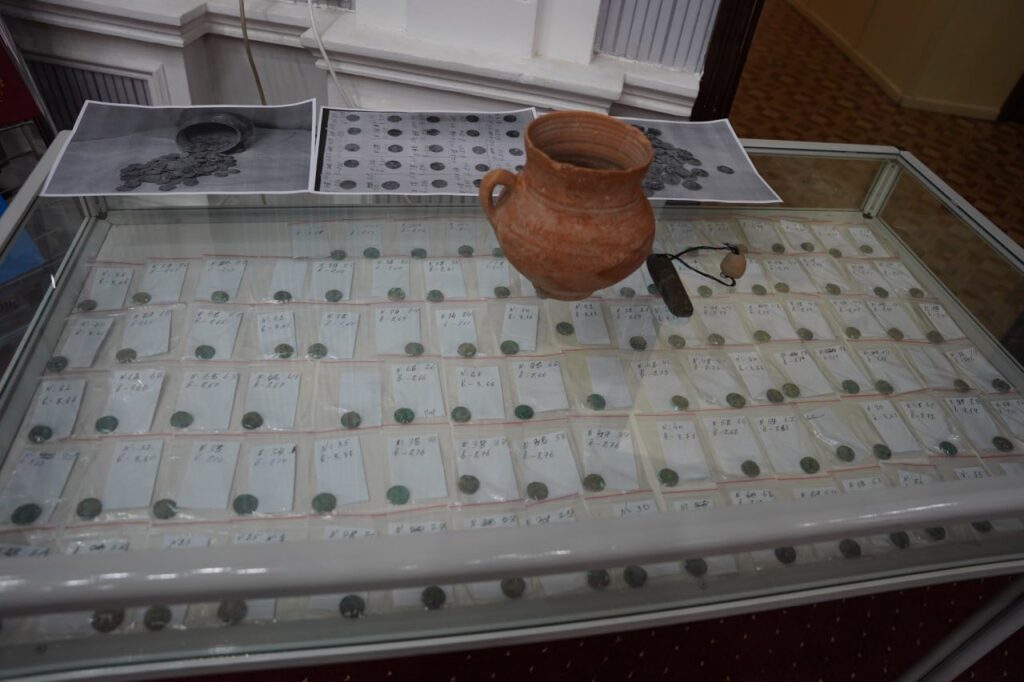
Conservation work is currently being carried out by Rustam Burkhanov and Manuchehr Rakhmonov, restorers at the Institute of History, Archaeology, and Ethnography under the Academy. The process involves careful cleaning, stabilization of the copper surfaces, and documentation of each specimen before further analysis.

Once restored, the coins are expected to provide data on minting practices, circulation patterns, and regional trade networks. Preliminary assessments suggest the hoard was intentionally buried—possibly during a moment of instability or local unrest—rather than being a casual loss.

The Kushan Kingdom and Central Asia’s Forgotten Superpower

The Kushan Empire was one of the great powers of the ancient world, controlling territory that stretched from modern-day Uzbekistan and Tajikistan through Afghanistan and deep into northern India. Positioned at the heart of the Silk Road, the Kushans facilitated long-distance trade between Rome, Parthia, China, and South Asia.

Under rulers like Vima Taktu, the empire developed a sophisticated monetary system that blended Hellenistic imagery, Iranian religious symbols, and emerging imperial ideology. Copper coinage, such as that found at Shahritus, played a vital role in everyday transactions, taxation, and military supply.

The discovery reinforces Tajikistan’s importance within this transregional empire, reminding scholars that Central Asia was not merely a corridor between civilizations but a dynamic center of political and economic life.
Credit: Asia+ via Facebook

A Find with Regional and Global Significance

As restoration continues, researchers anticipate that the Shahritus hoard will contribute to broader debates on Kushan chronology, state formation, and regional administration. Each coin adds a fragment to a larger historical puzzle—one that connects local communities in southern Tajikistan to the vast imperial networks of the early first millennium.

Far from being just a buried pot of coins, the find stands as tangible evidence of an empire at its formative peak—and of a king, Vima Taktu, whose reign helped lay the foundations of Kushan power across Central Asia and beyond.

Asia +

Cover Image Credit: Asia+ via Facebook

Related Articles

Only Those on the Righteous Path May Enter Here”: New Mosaics Unearthed in Antalya’s Olympos

19 June 2025

19 June 2025

A newly discovered mosaic inscription at the entrance of a church and elaborately decorated floor mosaics have come to light...

9,000-Year-Old Rock Art Suggests Early Humans Interacted with Dinosaur Footprints

22 February 2025

22 February 2025

In Brazil, researchers have made an extraordinary discovery of ancient rock art dating back over 9,000 years, found alongside dinosaur...

Google Earth Helped Archaeologists Make İmportant Discoveries in Leicestershire

26 April 2021

26 April 2021

After Google Earth revealed traces of underground structures, archaeologists digging at a Roman settlement in Leicestershire say they have made...

Archaeologists Unearth First-Ever Assyrian Inscription in Jerusalem — A 2,700-Year-Old Message Between Kings

23 October 2025

23 October 2025

Archaeologists in Jerusalem have uncovered a discovery of extraordinary significance: a tiny, 2,700-year-old pottery fragment inscribed in Assyrian cuneiform —...

1,800 years old Sewer system found in ancient city of Mastaura

17 May 2022

17 May 2022

Archaeologists found an 1800-year-old sewer system during excavations in the ancient city of Mastaura, in the Nazilli district of Aydın...

Electoral inscriptions just discovered in Pompeii reveal clientelism in ancient Rome

29 September 2023

29 September 2023

Several electoral inscriptions, the ancient equivalent of today’s electoral posters and pamphlets, have appeared on the walls of the room...

1,000-Year-Old Chimú “Sacred Road” and Temple Complex Discovered in Northern Peru

25 February 2026

25 February 2026

Archaeologists in Peru’s Chicama Valley have discovered a 2-kilometer Chimú “Sacred Road” geoglyph, a temple platform, and more than 100...

A pre-Hispanic ceremonial center with unknown characteristics was discovered in the Andes

15 April 2023

15 April 2023

While investigating at Waskiri, near the Lauca River and the Bolivian-Chilean border, archaeologists found an impressive circular construction on a...

The 890-million-year-old sponge fossil may be the oldest animal yet discovered

1 August 2021

1 August 2021

890-million-year-old fossil sponges found in the “Little Dal” limestones of northwest Canada may be the oldest animal ever found. According...

Archaeologists have unearthed a trove of artifacts at the necropolis of Saqqara

9 June 2022

9 June 2022

Archaeologists at the necropolis of Saqqara, near Cairo, have discovered a cache of 250 complete mummies in painted wooden sarcophagi...

A 2,000-Year-Old Fashion Fraud: Roman Textiles Imitated Royal Murex Purple

18 November 2025

18 November 2025

Ancient textiles from the Judean Desert reveal that many Roman-era “purple” garments were not dyed with costly murex but with...

A collection of 430 burial objects found in the tomb of a 3000-year-old Noblewoman in China

11 April 2024

11 April 2024

A tomb belonging to a noblewoman dating back about 3,000 years has been unearthed in North China’s Shanxi Province. The...

7,000-Year-Old Canoes Reveal Early Development of Nautical Technology in Mediterranean

21 March 2024

21 March 2024

The discovery of five “technologically sophisticated” canoes in Italy has revealed that  Neolithic people were navigating the Mediterranean more than...

Ancient gypsum furniture was discovered in a fire temple in the ancient region of Vigol in Iran

1 June 2021

1 June 2021

Sets of gypsum furniture, including a carved table and chairs, were discovered during an archaeological dig in central Iran. According...

Itbaraks in Turkic Mythology: The Human-Bodied, Dog-Headed Beings Who Defied Oghuz Khagan

5 July 2025

5 July 2025

In the mist-shrouded realms of ancient Turkic epics, there exists a race that haunts both myth and memory—the İtbaraks. These...