
15 February 2026 The Future is the Product of the Past

2,500-Year-Old Archaeological Site Discovered in Eastern Afghanistan’s Laghman Province

Archaeologists in eastern Afghanistan have identified a previously unknown archaeological site dating back more than 2,500 years, offering rare insights into life in the region long before Christianity reached Central and South Asia.

Local officials from Laghman’s Directorate of Information and Culture announced that the site was documented in the Alingar district, within the Saw Valley, near a settlement locally known as Situn village. Initial assessments suggest the remains date to between roughly 1000 and 500 BCE, corresponding to the early Iron Age in eastern Afghanistan.

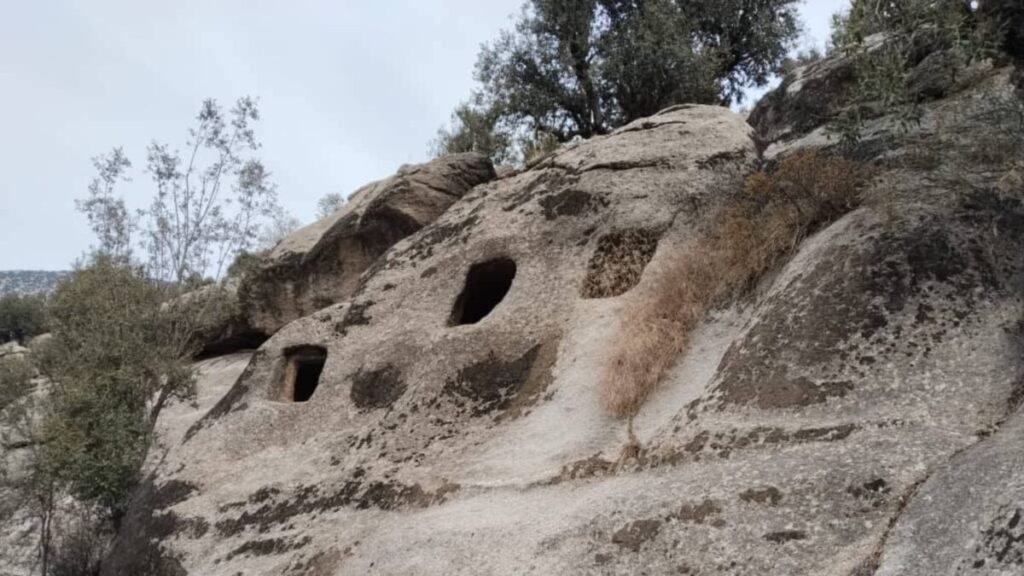
According to cultural heritage authorities, preliminary fieldwork has revealed a carefully constructed stone staircase alongside up to twelve rock-cut chambers carved directly into the hillside. These hand-hewn spaces are accompanied by additional architectural traces, indicating planned construction rather than temporary shelter or sporadic use.

Archaeologists also recovered a ceramic vessel believed to have been used for drinking liquids. Although modest in appearance, such everyday objects are considered key indicators of sustained human activity and may help clarify whether the site functioned as a residential area, a ceremonial complex, or a combination of both.

Laghman’s Role in Early Regional History

Laghman province occupies a geographically strategic zone linking the Kabul Valley with eastern Afghanistan and the broader Indus region. During the centuries around 1000 BCE, this corridor played a significant role in regional movement, trade, and cultural exchange.


📣 Our WhatsApp channel is now LIVE! Stay up-to-date with the latest news and updates, just click here to follow us on WhatsApp and never miss a thing!!


Historical and archaeological evidence suggests that eastern Afghanistan was home to early Iranian-speaking communities during this period, later becoming integrated into larger political frameworks such as the Achaemenid Empire by the 6th century BCE. The fertile valleys and river systems of Laghman would have supported agriculture, seasonal settlement, and small population centers long before the emergence of formal urban life.

Rock-cut architecture similar to that identified in Alingar is known from several ancient sites across eastern Afghanistan and neighboring regions. Such features often reflect long-term occupation or ritual use, particularly during the early Iron Age, when communities increasingly invested in durable architectural forms.
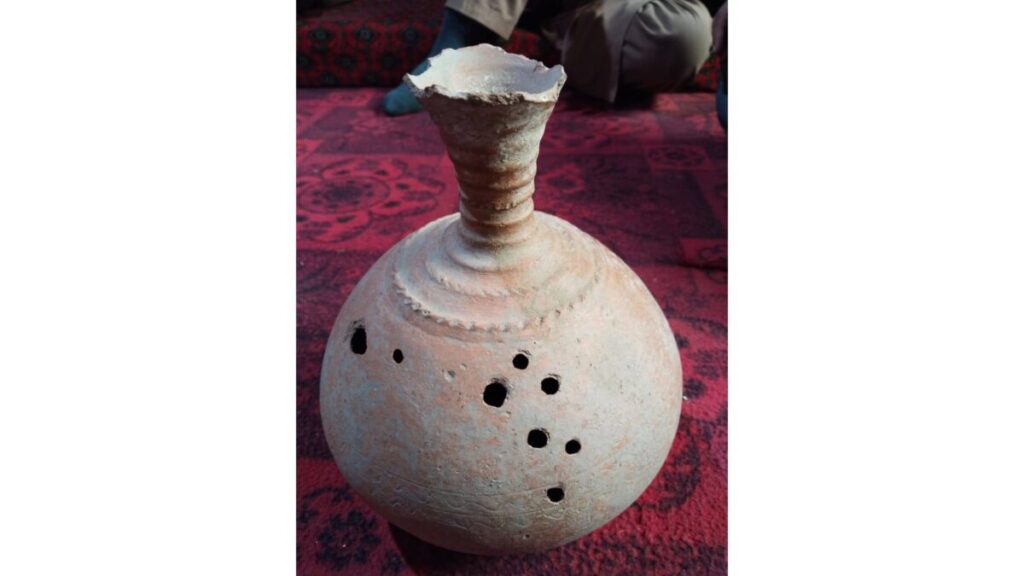
Archaeologists also recovered a ceramic vessel believed to have been used for drinking liquids.
Archaeologists also recovered a ceramic vessel believed to have been used for drinking liquids. Credit: AMU

Significance and Next Steps

Cultural officials emphasize that the newly identified site remains in an early documentation phase. No extensive excavation has yet been conducted, and specialists caution that further archaeological surveys will be necessary to establish a precise chronology and cultural attribution.

Nevertheless, authorities believe the discovery could significantly enhance understanding of Laghman’s ancient settlement patterns and its role in early regional civilizations. In recent years, multiple historical sites have been identified and registered across the province, highlighting its archaeological richness despite decades of conflict and limited research access.

As systematic study continues, the Alingar site may provide rare material evidence of daily life, architectural traditions, and social organization in eastern Afghanistan more than two millennia ago—at a time when the region served as a vital bridge between Central Asia, the Iranian plateau, and South Asia.

Cover Image Credit: AMU

Related Articles

1500-year-old Stunning Pendant Amulet Depicting the Prophet Solomon Spearing the Devil on Horseback Found in Türkiye

15 November 2024

15 November 2024

During the excavations in the ancient city of Hadrianopolis in Eskipazar district of Karabük, Türkiye, an amulet from the 5th...

Rare Five Bronze Age Axes found in the Forests of Poland

5 December 2023

5 December 2023

Archaeologists in Poland have discovered five Bronze Age axes in Starogard Forest District, located in Kociewie. A metal detectorist named...

INAH Archaeologists recover the coyote-man of Tacámbaro

26 January 2022

26 January 2022

Archaeologists win the coyote-man trial that lasted 30 years in Mexico. The litigation regarding the coyote-man of Tacámbaro, an important...

Anatolia’s first company was founded 4000 years ago with 15 kilos of gold!

26 May 2024

26 May 2024

A 4,000-year-old tablet found in Kültepe shows that the first company in Anatolia was established by 12 people with 15...

A gilded silver Anglo-Saxon object “made by someone with a real eye for loveliness” has the experts baffled

2 January 2024

2 January 2024

An enigmatic Anglo-Saxon object has been unearthed in a captivating discovery near Langham, Norfolk, East of England. This gilded silver...

International Sand Sculpture Festival Opens with the Theme “The Lost City of Atlantis”

6 May 2021

6 May 2021

The 16th edition of the International Sand Sculpture Festival (SANDLAND) has begun in Turkey’s Mediterranean resort city of Antalya. Every...

In 6750 BCE, A Neolithic City Built Its Own Ghosts: The Monumental Secrets of Ain Ghazal, Jordan

23 November 2025

23 November 2025

Long before the pyramids rose above the Nile or the great temples of Mesopotamia carved their mark into the ancient...

3,500-Year-Old Rice Discovery Marks Longest Early Ocean Journey

24 July 2025

24 July 2025

Breakthrough research reveals ancient rice remains in Guam, offering insight into early Austronesian culture and a remarkable 2,300-kilometer early ocean...

Hidden Fortune in the Desert: 2,300-Year-Old Silver Coins Linked to Alexander the Great Found in Mleiha, United Arab Emirates

13 September 2025

13 September 2025

Archaeology often surprises us with unexpected finds, but few discoveries capture the imagination like the recent unearthing of a simple...

Archeological park to be built at suburban Shanghai ancient ruins site in China

20 October 2021

20 October 2021

An archeological park will be built at the Qinglong Town ruins site of Baihe in Qingpu District as part of...

Archaeologists Discover Complete 13th-Century Rare Benahoarit Vase in Tijarafe Funerary Cave on La Palma

30 August 2025

30 August 2025

A remarkable archaeological discovery in Tijarafe, a municipality on the northwestern coast of La Palma in Spain’s Canary Islands, has...

Water Cultu in Hittites and Eflatunpınar Hittite Water Monument

4 February 2021

4 February 2021

The Hittites, which left their mark on the Bronze Age period in Anatolia, is a society that draws attention with...

Erotic Symbolism on a Potter’s Tool? Rare 5th Century BC Bone Stylus Found in Sicily

11 January 2026

11 January 2026

An extraordinary archaeological discovery in southern Sicily is reshaping scholarly understanding of ancient Greek craftsmanship and ritual symbolism. Excavations in...

31 Unknown Shipwrecks, Including a Rare Sailing Ship, Discovered in Lake Constance

13 August 2025

13 August 2025

In a groundbreaking underwater archaeology project, researchers have discovered 31 previously unknown shipwrecks lying silently on the floor of Lake...

1,600-year-old Roman-era wine shop unearthed in Greece

29 January 2024

29 January 2024

A team led by Scott Gallimore of Wilfrid Laurier University and Martin Wells of Austin College discovered a 1,600-year-old Roman-era...