
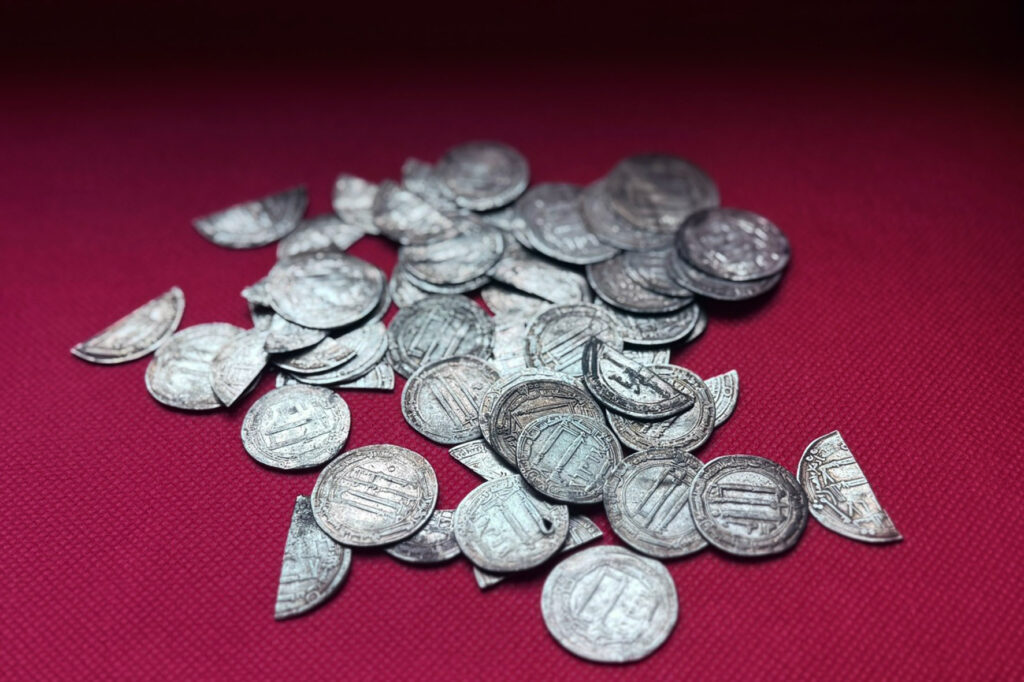
Archaeologists working on the Baltic coast near Kaliningrad have uncovered a hoard of 59 silver dirhams minted across the Arab Caliphate between AD 746 and 815. The coins travelled thousands of kilometres from cities in present-day Iraq, Iran and Afghanistan before reaching a small medieval settlement on the southern shore of the Vistula Lagoon.
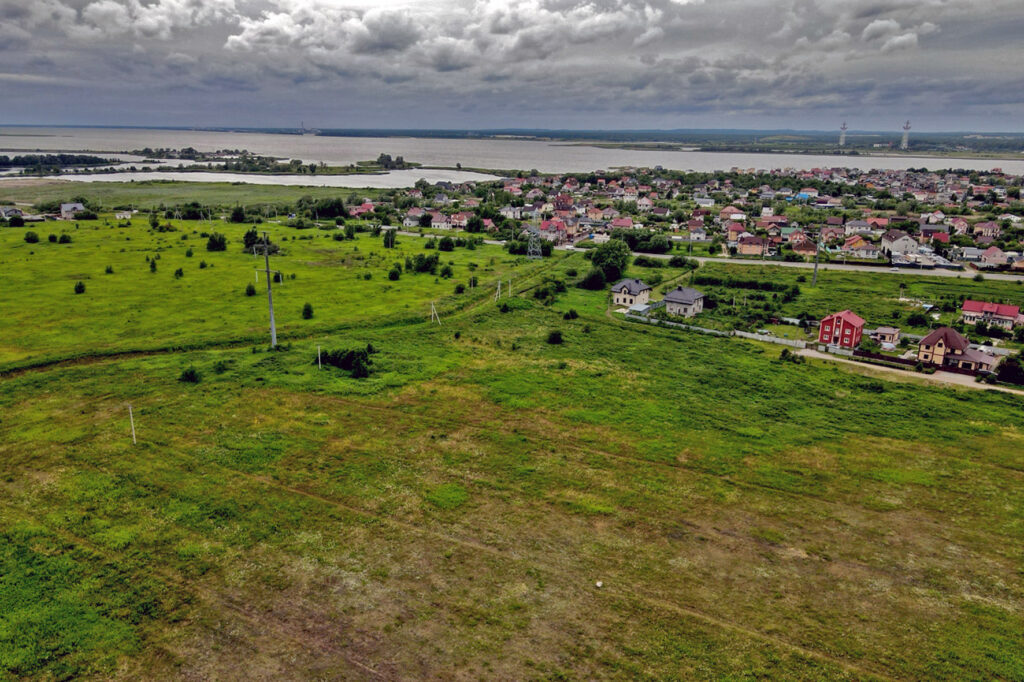
The hoard was discovered in May 2026 by the Sambian Archaeological Expedition of the Institute of Archaeology of the Russian Academy of Sciences. Although Islamic silver coins have previously been found in the Kaliningrad region, researchers describe this as the first securely documented hoard showing that the area had entered the long-distance trade network carrying eastern silver into the Baltic during the early ninth century.
The find consists of 29 complete coins and 30 fragments, many of them cut into roughly half-dirhams. Their dates span one of the most consequential periods in early Islamic history: the collapse of the Umayyad dynasty, the rise of the Abbasids, the reign of Harun al-Rashid and the civil war that followed his death.
A hoard buried at a Prussian settlement
The coins were not discovered during the excavation of a major port, fortress or wealthy trading centre. They came from an otherwise unremarkable medieval settlement covering approximately one hectare.
Fragments of handmade and early wheel-thrown pottery found in its cultural layer are characteristic of the Prussians, the Baltic people who inhabited the region before the medieval German conquest. The settlement appears to have been occupied between the eighth and twelfth centuries.
Because the archaeologists identified the hoard during a systematic survey, they were able to document its precise context and recover the complete group. This distinguishes it from many older coin discoveries that were dispersed, poorly recorded or found without reliable archaeological information.
The dirhams were identified by numismatist A.A. Gomzin.
From the last Umayyad ruler to the Abbasid Revolution
The earliest coin in the hoard was minted in AD 746 at Wasit, an Iraqi city situated between the established centres of Kufa and Basra. It is the only Umayyad dirham in the group and dates to the reign of Marwan II, the dynasty’s final caliph.
At the time, the Umayyad state was being shaken by rebellions and internal conflict. The Abbasid Revolution began the following year and ended with the defeat of Marwan II in AD 750. The new Abbasid dynasty transferred the political centre of the caliphate eastward, eventually establishing Baghdad—officially known as Madinat al-Salam—as its capital.
All the remaining coins in the Kaliningrad hoard were produced under Abbasid rule.
Among the cut fragments, dirhams issued during the reign of al-Mahdi, who ruled from AD 775 to 785, form the largest group. His reign belonged to the first generation of Abbasid rulers governing from Baghdad, when the dynasty was consolidating control over an empire stretching from North Africa to Central Asia.
Baghdad silver from the age of Harun al-Rashid
The complete coins are dominated by issues of Harun al-Rashid, the fifth Abbasid caliph, who ruled from AD 786 to 809. His reign is often associated with the political and economic high point of the Abbasid Caliphate, when Baghdad became one of the world’s largest cities and a central hub connecting trade across the Middle East and Eurasia.
Twenty-five of the complete dirhams were minted in Madinat al-Salam, the official name used on coins produced in Baghdad. One came from Kufa, while three others were struck farther east: one at Nishapur in historical Khurasan and two at al-Muhammadiyya in the Iranian region of Jibal.
The fragments have a more varied geographical distribution. Alongside coins from Baghdad, they include issues from Basra, Kufa and Wasit. The easternmost mint represented is Madinat Zarang, the principal city of historical Sijistan in present-day Afghanistan.
The different composition of the complete and fragmented groups suggests that they may have circulated separately before being brought together. One part was concentrated around Baghdad issues from the reign of Harun al-Rashid, while the other contained older coins and examples from a broader range of mints.
Coins, ornaments and pieces of weighed silver
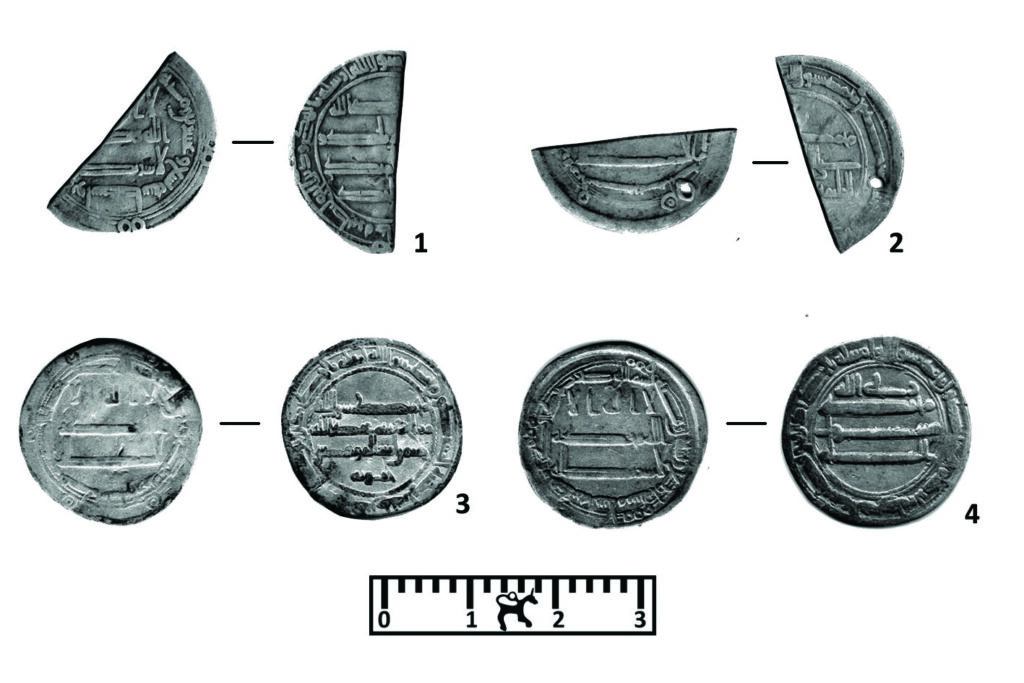
Several dirhams have holes pierced through them, indicating that they may have been worn as pendants or incorporated into jewellery. Others carry small cuts along their edges, possibly made to test whether the metal was genuine silver.
The large number of deliberately cut coins also reflects how Islamic silver was used in northern and eastern Europe. Dirhams could function as coins, but they were also divided and exchanged according to their weight. The same silver could later be melted down to produce rings, bracelets, neck ornaments and other objects.
From the late eighth century onward, large quantities of dirhams began moving north through trade routes connecting the Muslim world with Eastern Europe, Scandinavia and the Baltic. Scandinavian merchants and settlers played an important role in developing the river and overland networks that carried silver, furs, amber, enslaved people and other commodities between the regions.
Some of the earliest known northern hoards were deposited at Tuna in Sweden and Staraya Ladoga in northwestern Russia. Their latest coins date to AD 784 and 787, showing that Islamic silver had already reached the Baltic and nearby river systems before the end of the eighth century.
Buried during an Abbasid civil war
The youngest dirham in the new hoard was minted in AH 199, corresponding to AD 814–815. This places the formation of the collection in the middle of the 810s.
The coin was issued shortly after a destructive Abbasid civil war between the brothers al-Amin and al-Ma’mun. The conflict began after the death of Harun al-Rashid in AD 809 and ended when al-Amin was defeated and killed in Baghdad in 813. Al-Ma’mun then emerged as caliph, although political instability continued across parts of the empire.
Within only a few years, silver minted during this unsettled period had reached the southeastern Baltic.
The Kaliningrad hoard joins a small group of approximately 20 eastern silver hoards buried between the 780s and 830s in territories now belonging to Sweden, northern Poland, Estonia and Russia’s Kaliningrad region. Many were recovered only partially, limiting what researchers can learn from their original composition.
Two earlier dirham hoards are known from the Kaliningrad area. More than 330 coins were reportedly found near Insterburg, now Chernyakhovsk, while another group of approximately 150 coins was discovered near Kaliningrad in 1945. Only nine coins from the latter hoard were identified, making its burial date impossible to establish securely.
The newly recovered collection provides a much firmer chronological and archaeological record. Buried at a modest Prussian settlement around the middle of the 810s, its coins show that communities along the Vistula Lagoon were already connected to a commercial system extending from the Baltic coast to Baghdad and as far east as Afghanistan.
Sambian Archaeological Expedition of the Institute of Archaeology of the Russian Academy of Sciences
Cover Image Credit: E.B. Zaltsman, A.A. Gomzin, N.A. Makarov -Sambian Archaeological Expedition of the Institute of Archaeology of the Russian Academy of Sciences
