
A pair of gold-plated earrings found beside the skull of a woman buried more than 1,000 years ago in the Sayan Mountains is helping archaeologists reconstruct the status, identity, and far-reaching cultural connections of a medieval elite community in southern Siberia.
The burial, discovered at the Sayany-Pogranichnoye-4 cemetery near the Idzhim River in Russia’s Krasnoyarsk region, contained the remains of an adult woman and a newborn child. It was not an ordinary grave. Alongside the woman were personal ornaments, fragments of a Chinese-style mirror, a spindle whorl, a knife, and an unusually rich set of horse equipment. The burial also included what archaeologists call a “horse skin” deposit, consisting of the animal’s skull and limbs placed with its hide, a practice known from high-status nomadic burials across the Sayan-Altai region.
Researchers from the Institute for the History of Material Culture of the Russian Academy of Sciences, Novosibirsk State University, and Archaeology of Khakassia say the grave belongs to a rare category of elite medieval burials. Only a few dozen comparable examples are known across the wider Sayan-Altai region.
The burial was not an isolated find. Sayany-Pogranichnoye-4 belongs to a larger cluster of archaeological sites recorded in the Idzhim River valley of southern Krasnoyarsk Krai. The work was carried out by the Sayan Expedition of the Institute for the History of Material Culture of the Russian Academy of Sciences under the direction of Andrei Polyakov, as part of preparatory studies for the planned Kyzyl–Kuragino railway line.
Gold-plated earrings beside the woman’s skull
The most personal objects in the grave were the earrings. They were found near the woman’s skull, still close to their original position. Made of bronze with traces of gilding, the earrings have a ring-shaped form, long pendants, small decorative rings, and a bead-like terminal.
Laboratory analysis showed that the earrings were not simple ornaments. Different parts were made from different metal compositions. The main ring and upper bead were based on copper alloyed with tin and lead, while the lower bead, apparently designed to imitate a pearl, was made mostly of silver with smaller amounts of copper, gold, and lead.
Their form has close parallels in elite female burials with horses from the Altai Mountains and Mongolia. Similar earrings are known from ancient Turkic contexts, including burials where women were interred with rich riding equipment and imported luxury objects. For the researchers, this makes the earrings more than jewelry. They acted as visible markers of social position.
A grave built around horsepower and prestige
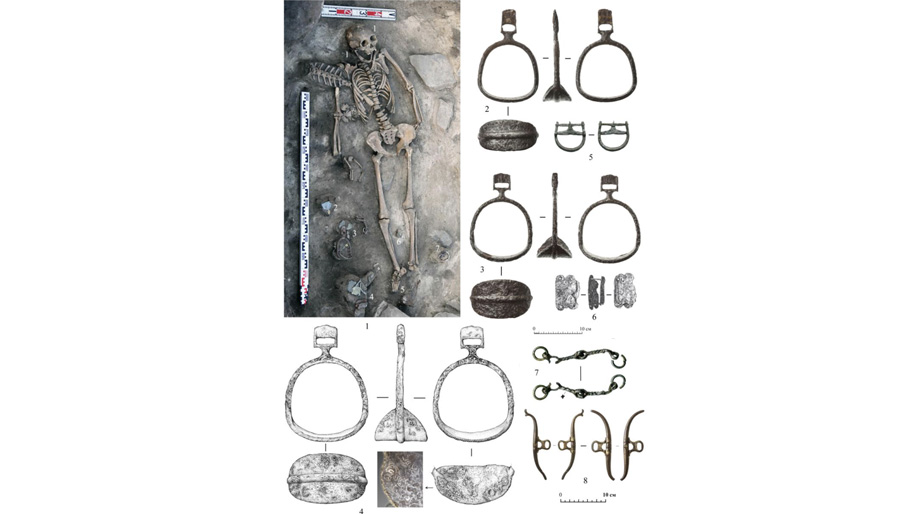
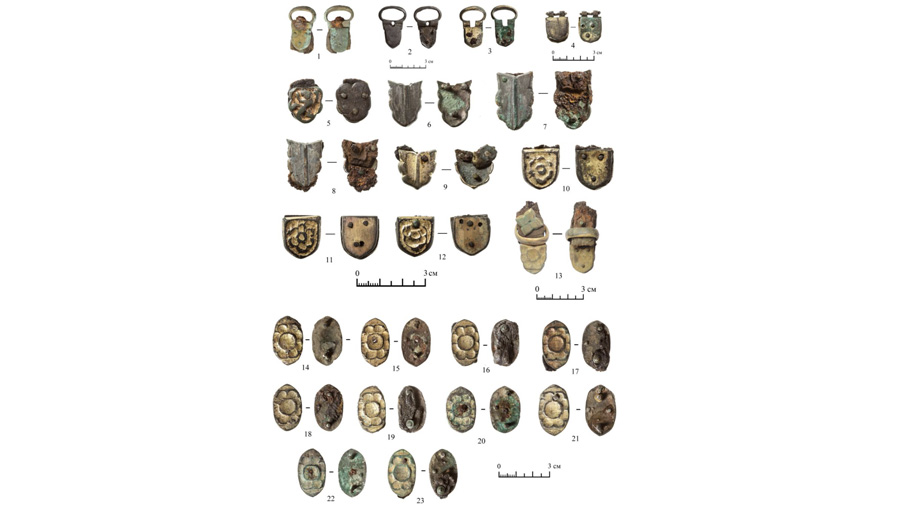
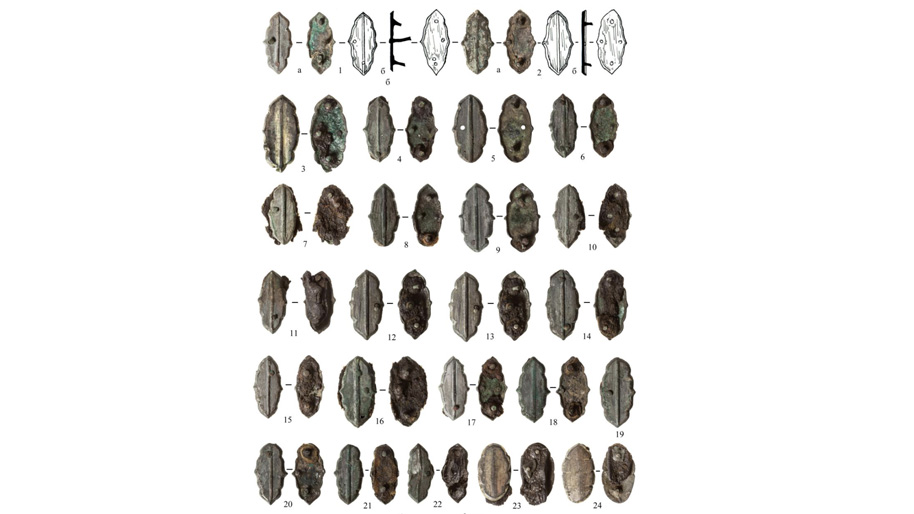
The woman’s burial was accompanied by 83 recorded objects. Most were not personal belongings but pieces of horse gear. The horse equipment included stirrups, iron bits, gilded bronze fittings, bridle decorations, belt terminals, pendants, buckles, and plaques.
One stirrup stood out. It was richly ornamented with silver wire inlay on iron, a technique known as damascening. The decoration covered both sides of the neck, arch, and footrest of the stirrup. According to the researchers, the style reflects Chinese decorative art of the late Tang period, especially the years around 860 to 907.
The second stirrup was plain. That contrast may not be accidental. Among nomadic groups, one highly decorated stirrup could be displayed on the more visible side of the horse, while the other remained functional and undecorated. The effect was practical, but also theatrical. The horse was not just a mount. It was part of the deceased woman’s public identity.
A Chinese mirror fragment in a Siberian grave
Another important object was a fragment of a cast metal mirror. Although broken, it preserved part of an ornament known as the “grape” motif, with vine tendrils, leaves, grape clusters, and a bird. Such mirrors are associated with Chinese artistic traditions and were popular among Tang aristocrats in the seventh and eighth centuries.
The mirror fragment from Sayany-Pogranichnoye-4 was made from a copper-based alloy with high tin content, a composition consistent with similar Chinese-style mirrors found across the steppe belt. Researchers note that dozens of such mirrors are known from scattered finds, but only a small number have been recovered from rich female burials.
In this case, the mirror had probably been broken long before it entered the grave. The smoothed fracture edges suggest it may have been kept and used for a long time as a meaningful fragment rather than as a functional mirror. In many Eurasian traditions, mirrors carried protective, ritual, or symbolic value. In burials, even a fragment could matter.
A noble woman in a connected steppe world
Radiocarbon dating places the burial broadly between the second half of the ninth century and the early thirteenth century, with one key range falling between 862 and 1224. But the style of the earrings, mirror, and horse gear allows archaeologists to narrow the most likely date to the second half of the ninth or tenth century.
Still, the burial speaks clearly about rank. The combination of gilded earrings, a Chinese “grape mirror,” a spindle whorl, a knife, and elaborate horse equipment matches a pattern seen in noble women’s graves across southern Siberia and Mongolia. The woman buried at Sayany-Pogranichnoye-4 appears to have belonged to a high-status community where personal adornment, horse ritual, and long-distance artistic influence were closely linked.
A rare glimpse of female status in medieval Siberia
The burial is especially valuable because it brings together two types of evidence often studied separately: the personal world of an elite woman and the ceremonial world of the horse. The earrings show how status could be worn on the body. The mirror fragment points toward cultural contacts reaching deep into East Asia. The horse equipment, with its gilded fittings and silver-inlaid stirrup, reveals a society in which mobility, display, and power were inseparable.
For archaeologists, the grave is not simply a collection of beautiful objects. It is a rare, intact portrait of elite female life and death on the medieval steppe frontier. More than a millennium later, the small gold-plated earrings found near the woman’s head remain the most human detail in a burial designed to project rank, memory, and prestige.
Amzarakov P.B., Lazaretov I.P., Poliakov A.V., Mitko O.A. Gold-Plated Earrings and Personal Items from a Medieval Burial on the Idzhim River (Western Sayan, Usinsk Basin). Vestnik NSU. Series: History and Philology. 2025;24(3):115-129. (In Russ.) https://doi.org/10.25205/1818-7919-2025-24-3-115-129
Cover Image Credit: Press Service of the Institute for the History of Material Culture of the Russian Academy of Sciences
