
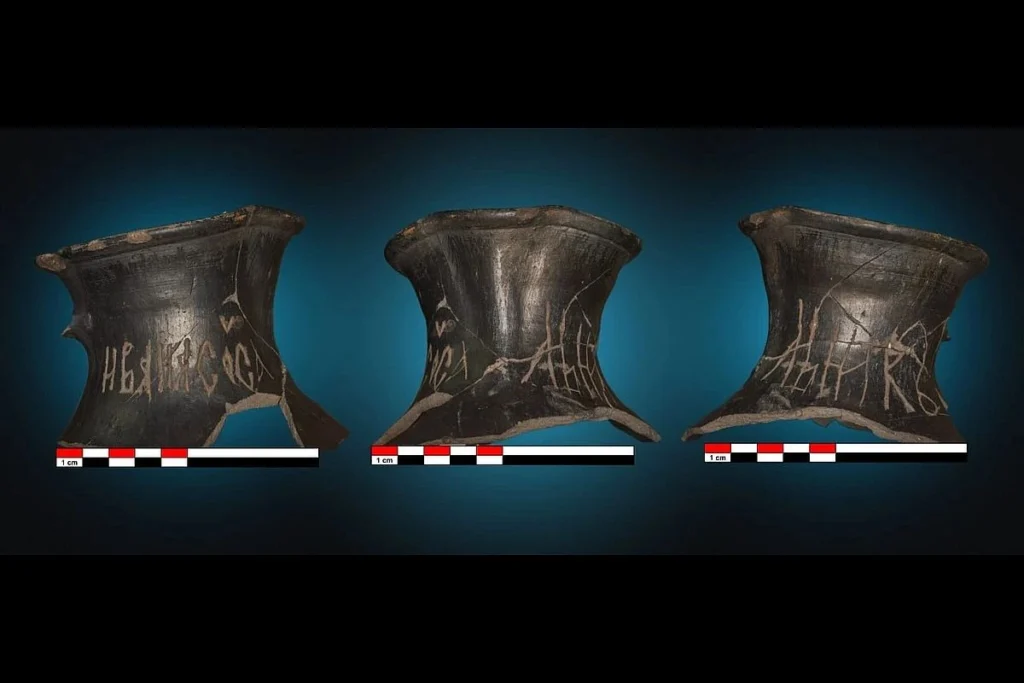
A few scratched words on a broken ceramic vessel have brought archaeologists unusually close to a named person who lived and worked inside one of Russia’s most important monasteries nearly four centuries ago.
Fragments of a black-burnished 17th-century vessel were found during excavations at the Trinity Lavra of St. Sergius in Sergiev Posad, northeast of Moscow. The object carries an almost complete scratched inscription reading “Ivana Sousalnikъ,” a phrase that researchers believe may refer to a gold-leaf craftsman named Ivan.
The discovery was made by the Moscow Region expedition of the Institute of Archaeology of the Russian Academy of Sciences. The vessel fragments came from a cultural layer between the eastern wall of the monastery and the inspector’s building, an area where monastic cells stood in the second half of the 16th century and throughout the 17th century.
A rare inscription from everyday monastery life
The inscription is the most striking part of the find. Such markings often survive only in fragments, but in this case the text is nearly complete. It was scratched onto the vessel rather than formally carved, giving the object the character of a personal or practical possession rather than a ceremonial item.
Specialists noticed that the words are separated by the vessel’s spout and appear to have been written in two different hands. The first part resembles a more formal semi-uncial script close to book tradition, while the second looks looser and more informal, closer to everyday handwriting.
Russian epigrapher Alexander Avdeev also drew attention to the unusual form of the letter Ъ, which resembles the zodiac sign for Leo. A similar form is known from the epitaph of Lavrenty Grigoriev, son of Bulatnikov, who died in 1651 and was buried at the Trinity-Sergius Monastery.
A “mistake” that makes the find more human
The inscription contains a small grammatical mismatch. The name “Ivana” is written in the genitive case, while “sousalnikъ,” meaning a craftsman who worked with gold or silver leaf, appears in the nominative case.
For researchers, this irregularity is not a flaw. It is part of what makes the object valuable. The mistake suggests that the inscription was not produced as a polished official text. It may instead preserve the handwriting of someone using language in an everyday setting.
That detail gives the vessel a rare human quality. Rather than only documenting monastery architecture or religious art, the find points to an individual, possibly a lay craftsman who lived or worked within the Lavra’s community.
Who was Ivan the gold-leaf craftsman?
A sousalnik was a specialist who worked with thin sheets of gold or silver leaf. Such craftsmen were important in Orthodox religious culture, where precious metal leaf was used to decorate icons, icon covers, church vessels and other sacred objects.
Researchers may have a clue to the owner’s identity. According to a 1641–1642 inventory of the Trinity-Sergius Monastery, three lay gold-leaf craftsmen lived there at the time. Two of them were named Ivan: Ivan Eluferyev and Ivan Yuryev.
The vessel may have belonged to one of these men, although archaeologists cannot yet say this with certainty. Still, the inscription narrows the story in an unusual way. It connects a broken household object with a real professional role inside a major religious institution.
A vessel for drinks, not ceremony
Based on its size and the shape of its neck, the vessel likely held about 2.5 to 3 liters. Researchers believe it was used for storing or pouring drinks such as kvass, beer, wine, drinking mead or berry-flavored waters, all known from monastery records of the period.
That makes the find especially revealing. The Trinity Lavra of St. Sergius is usually associated with saints, icons, fortified walls and monumental church architecture. But archaeology also exposes the ordinary routines that supported life inside the monastery: food, drink, workshops, cells and the people who kept the institution functioning.
Founded in the 14th century by Sergius of Radonezh, the Trinity Lavra became one of the spiritual centers of the Russian Orthodox world. Its architectural complex grew over centuries and today stands among Russia’s most significant religious and historical sites.
The newly identified vessel will be transferred by the Institute of Archaeology of the Russian Academy of Sciences to the Sergiev Posad Museum-Reserve. Its importance lies not in luxury, but in intimacy. A scratched inscription, a grammatical slip and a possible name have turned a broken ceramic vessel into a rare trace of personal life inside the 17th-century Trinity Lavra.
Credit: Sergiev Posad City Development Foundation
Cover Image Credit: Sergiev Posad City Development Foundation
