
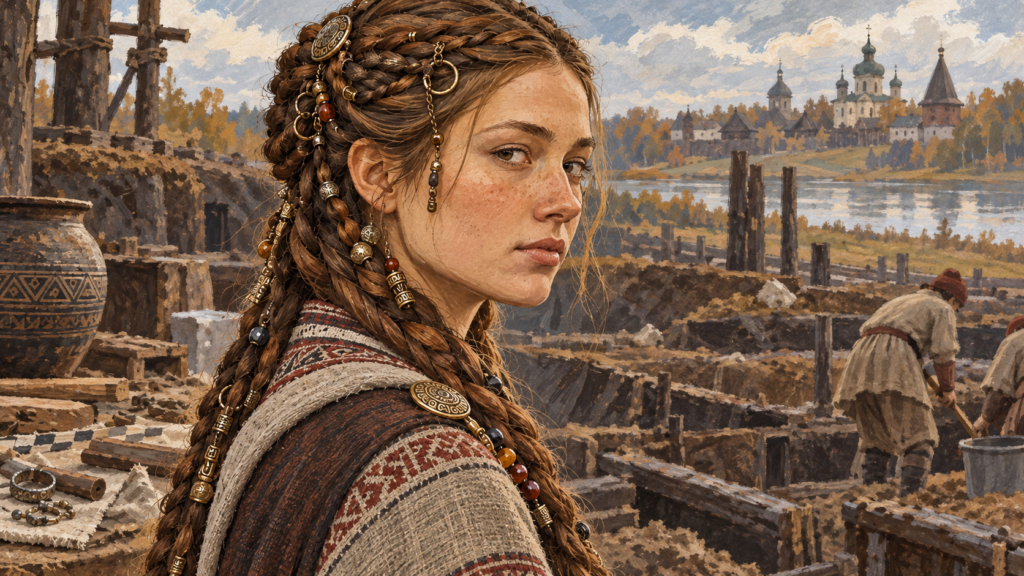
Archaeologists excavating in the historic Russian town of Staraya Russa have uncovered its earliest known urban cemetery, revealing burials dating back roughly 900 years and possibly earlier. Among the graves, one has drawn particular attention: a woman laid to rest with an elaborate hairstyle, rings woven into her hair and a collection of jewelry that may point to cultural ties beyond the local Slavic population.
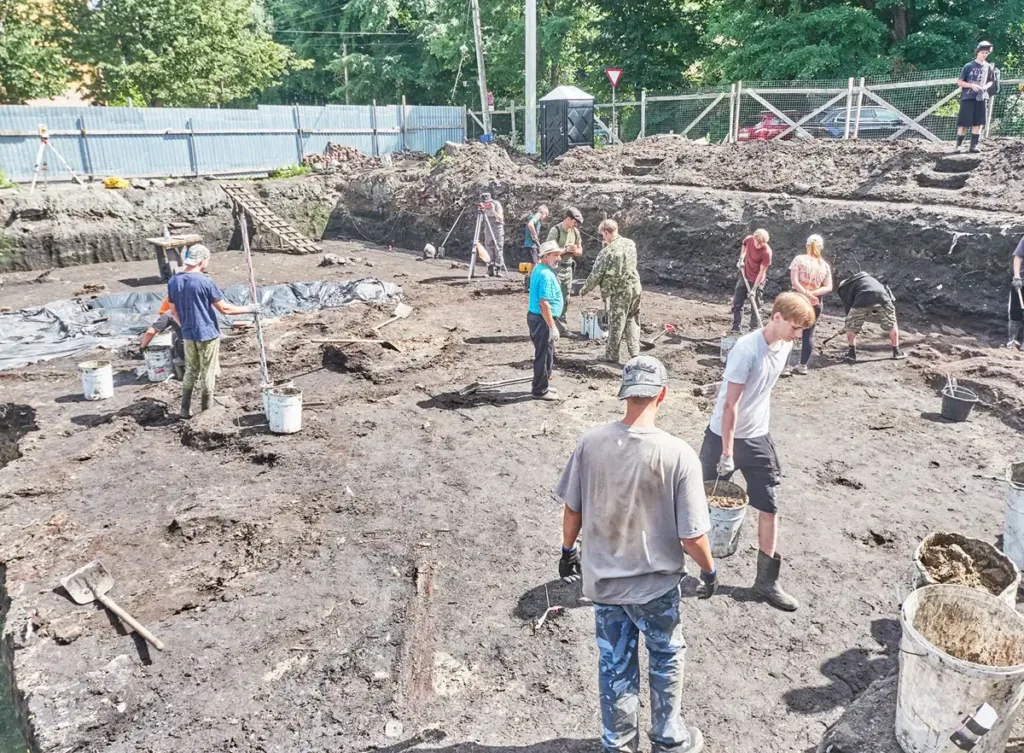
The cemetery was identified during two seasons of rescue excavations at the Ilyinsky II site in the Novgorod region. Archaeologists from Novgorod State University have documented more than a dozen burials, some preserving traces of burial customs that appear to capture a period when Christian practices existed alongside older traditions.
An unexpected cemetery beneath the medieval town
The discovery surprised researchers partly because the graves were not clustered around the known medieval Church of St. Elijah. Christian cemeteries in medieval Rus were commonly associated with churches, yet the known location of the church lies some distance from the newly excavated burials.
That has led archaeologists to consider another possibility. An ancient street known as Ilyina Street passed through this part of Staraya Russa, and comparable early urban cemeteries have previously been found beside roads in Novgorod and Pskov. Researchers now suspect that Staraya Russa may have followed the same pattern, with the cemetery developing along an important route through the early settlement.
The latest university assessment places the earliest phase of the cemetery in the 11th–12th centuries. Archaeologists also identified traces of a circular ditch and surviving ground features that suggest some of the earliest graves may originally have belonged to low burial mounds or semi-mound structures before later construction and ploughing erased their appearance.
A woman buried with her hair still dressed for death
One grave has provided a much more personal glimpse into the people who lived in medieval Staraya Russa. Archaeologists found the remains of a woman whose hair had apparently been arranged in a comparatively elaborate style before burial, with rings incorporated directly into it.
Her grave also contained several pieces of jewelry. Novgorod State University reported four bracelets, crescent-shaped pendants, pins and part of a chain, while one pin was found near the back of the head and appears to have been attached to the hair. Other pins and pendants may originally have been linked by a chain worn across the chest.
Elena Toropova, head of the Department of Russian History and Archaeology at Novgorod State University, provided an even more vivid description in an interview with Novgorodskie Vedomosti. She said the woman had been buried with a complex hairstyle, beads, a particularly fine pin, and rings woven into her hair.
The arrangement matters because archaeologists are not dealing simply with loose jewelry placed beside a body. At least some of the ornaments appear to preserve how the woman presented herself — or how those who buried her chose to present her — at the moment of burial.
Jewelry that may reveal where she came from
The ornaments are especially intriguing because researchers say the assemblage is not typical of the Slavic population that formed the majority in medieval Novgorod and Staraya Russa. Similar objects have nevertheless appeared in archaeological layers across the region, reflecting the movement of people and objects through medieval towns.
Toropova believes the jewelry is more closely connected with Finno-Ugric or Baltic cultural traditions. She has suggested one possible explanation: the woman may have come to Staraya Russa through marriage and continued to wear ornaments associated with her place or community of origin. That remains a hypothesis rather than an established biography, but the grave offers unusually tangible evidence of cultural diversity within the medieval town.
Researchers hope future analysis can reveal more. The remains are expected to undergo genetic study, although their fragile condition means specialists must first carefully clean and stabilize the burial, which was removed together with the surrounding soil as a single block.
Christian graves with echoes of older traditions
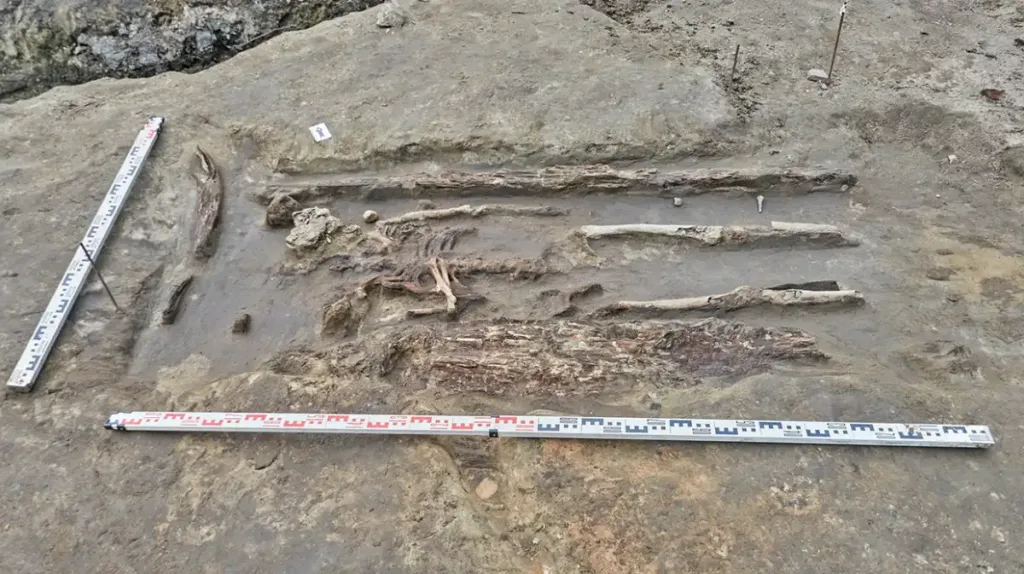
The woman was part of a cemetery that also preserves evidence of changing attitudes toward death. Some individuals were buried in wooden coffins with their heads toward the west and feet toward the east, an orientation consistent with Christian burial practice.
Birch bark was also used extensively. Archaeologists found coffins wrapped in the material, while in some graves the bodies themselves appear to have been additionally wrapped in birch bark before burial. Birch bark was an ordinary material in medieval northern Rus, used for everything from everyday objects to the famous written birch-bark documents.
More revealing is the presence of personal objects inside some of the graves. Archaeologists interpret these burials as Christian in their overall form but retaining elements of older, pre-Christian funerary behavior, since mature Christian practice increasingly discouraged placing possessions with the dead.
By the late 12th century, according to the university team, the burial ritual became noticeably more standardized. Grave goods largely disappeared, and the dead were increasingly placed in orderly rows following conventional Christian practices.
A cemetery that disappeared beneath a living town
The burial ground did not remain sacred forever. By around the transition from the 12th to the 13th century, the cemetery had fallen out of use, and archaeologists found medieval plough furrows cutting directly across graves. The land had effectively changed from a place of burial into agricultural ground.
The city later returned. By the 14th century, expanding Staraya Russa had spread across the area, leaving houses, wooden street surfaces and objects associated with trade and everyday urban life above the forgotten cemetery. Excavators have identified the remains of several estates as well as personal objects, seals, jewelry and a silver grivna from these later occupation layers.
That sequence is what makes the site particularly valuable. Beneath one modern intersection, archaeologists can follow a landscape from cemetery to farmland and eventually back into an urban neighborhood, while the woman with jewelry woven into her hair provides something rarer: the trace of an individual whose appearance may still preserve evidence of migration, identity and cultural exchange nearly nine centuries after she was buried.
