
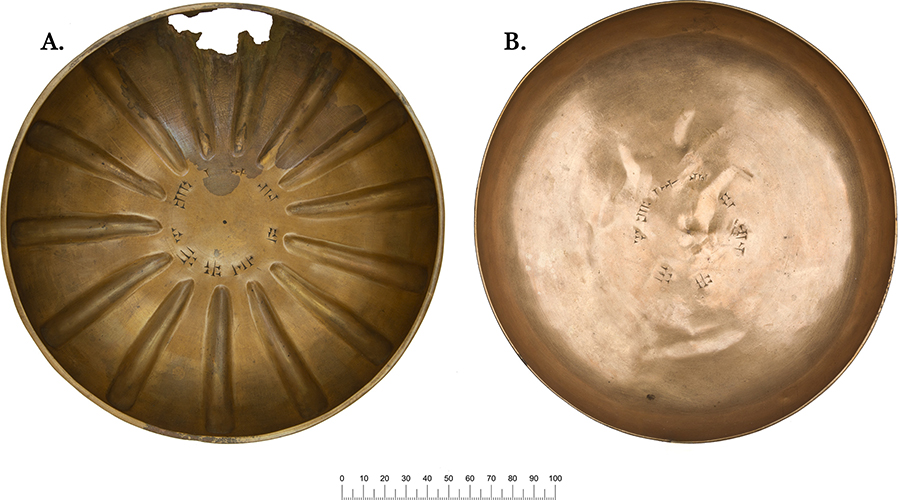
More than 100 bronze bowls inscribed with the names of Urartian kings were not simply elite tableware. A new study suggests that the vessels functioned as portable instruments of royal messaging, carrying carefully constructed claims of political authority, divine legitimacy and dynastic continuity across the kingdom.
Published in the journal Antiquity, the study was conducted by Annarita Stefania Bonfanti, Roberto Dan, Nzhdeh Yeranyan and Astgh Poghosyan. The researchers examined every known inscribed bronze bowl attributed to Urartian rulers from Sarduri I, son of Lutipri, to kings named Rusa. The vessels date broadly from the late ninth to the early seventh centuries BCE, when Urartu was one of the most powerful Iron Age kingdoms in Western Asia.
Using direct examination, macrophotography, digital tracing and comparative palaeography, researchers followed changes in the bowls’ cuneiform signs, engraving methods and royal symbols. The results reveal how Urartian rulers transformed an object influenced by Assyrian court culture into a distinctive medium for expressing their own power.
More than 100 bowls bearing royal names
The largest collection comes from Karmir-blur, the site of the ancient Urartian city and palace-fortress of Teishebaini in present-day Yerevan, Armenia. Located on the left bank of the Hrazdan River in the southwestern part of the city, the site became one of Urartu’s most important centres during the kingdom’s final period.
Excavations in 1949 uncovered at least 97 inscribed bronze bowls inside Storeroom 25. Additional, previously unpublished examples were recovered from Room 23 in 1958, bringing the number examined by the researchers to more than 100.
Each bowl carries a circular cuneiform inscription engraved around the centre of its interior. Although the texts are brief, they identify the ruling monarch and establish a direct connection between the vessel and the royal household.
This made the bowls more than practical containers. They were portable texts designed to be seen in elite settings, where the quality of the bronze, the precision of the inscription and the name of the king reinforced one another.
In modern terms, they functioned much like royal propaganda: objects that placed the ruler’s identity at the centre of courtly, ceremonial and possibly religious activity.
Urartu transformed an Assyrian prestige object
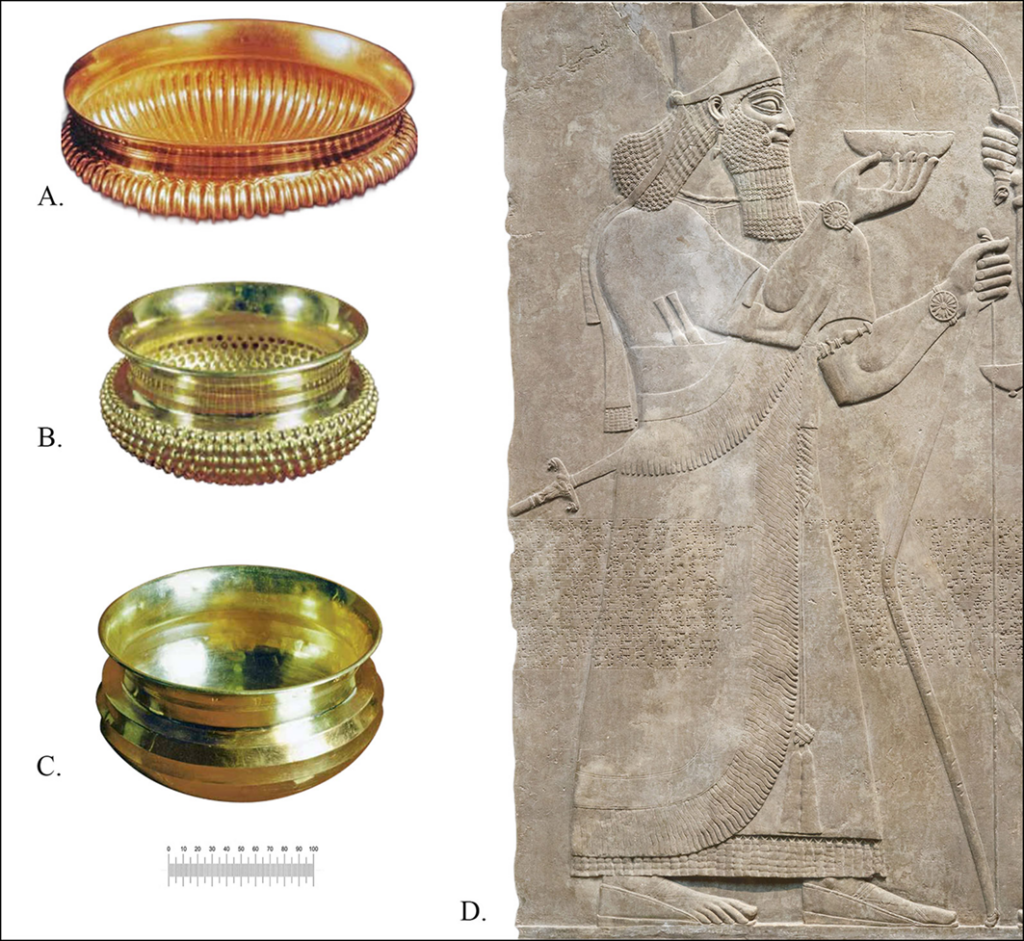
The earliest bowls in the study are associated with Sarduri I, who ruled around 840–830 BCE. Their inscriptions closely resemble Neo-Assyrian cuneiform, particularly in the use of long, narrow wedges.
This similarity reflects the strong influence of Assyria during the formation of the Urartian state. Ribbed vessels appear frequently in ninth-century BCE reliefs from the Assyrian capital of Nimrud, while inscribed gold vessels discovered in the tombs of Assyrian queens demonstrate the practice of marking valuable objects with royal or dedicatory texts.
Urartian rulers adopted this prestigious visual language but did not merely reproduce it.
A ribbed bowl bearing the name of Sarduri I marks the transition from an Assyrian vessel type to the plain bronze bowl that later became characteristic of Urartian royal production. The researchers describe this process as an active cultural transformation rather than straightforward imitation.
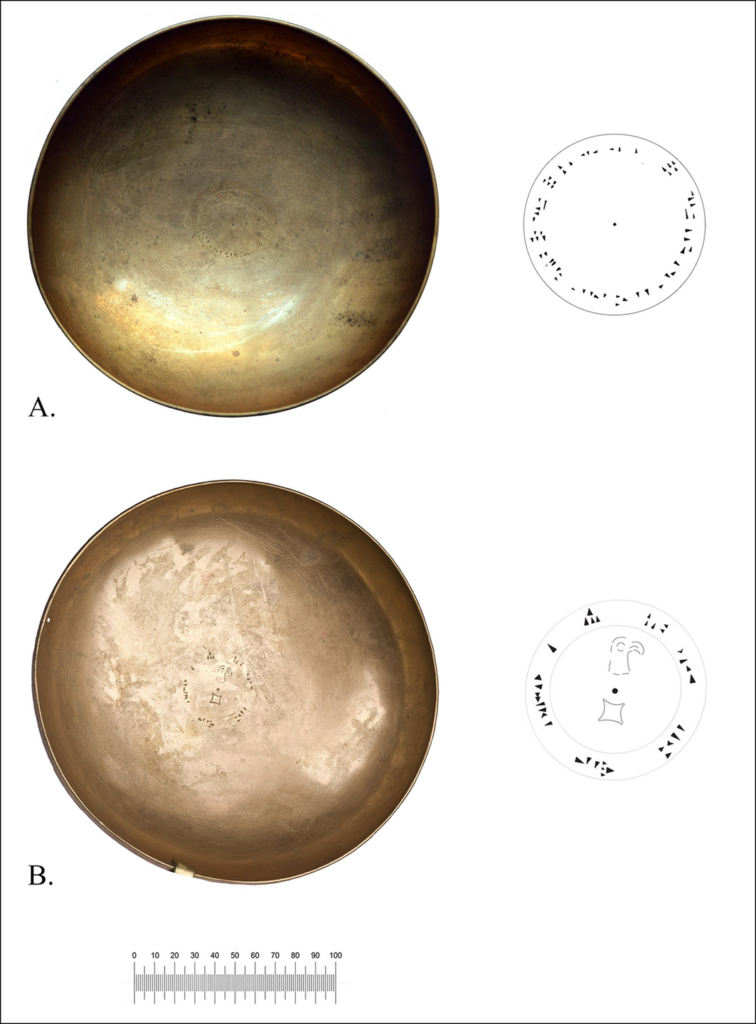
Under King Minua, who ruled approximately between 820 and 785/780 BCE, the cuneiform wedges became shorter, more triangular and more compact. The inscriptions also grew increasingly standardised.
These changes coincided with the emergence of a recognisably Urartian writing tradition. A system initially derived from Assyrian models was gradually reshaped to communicate local authority and serve the requirements of the Urartian court.
Lions, temples and divine authority
The political message of the bowls became increasingly visual during the reign of Argišti I, around 785/780–756 BCE.
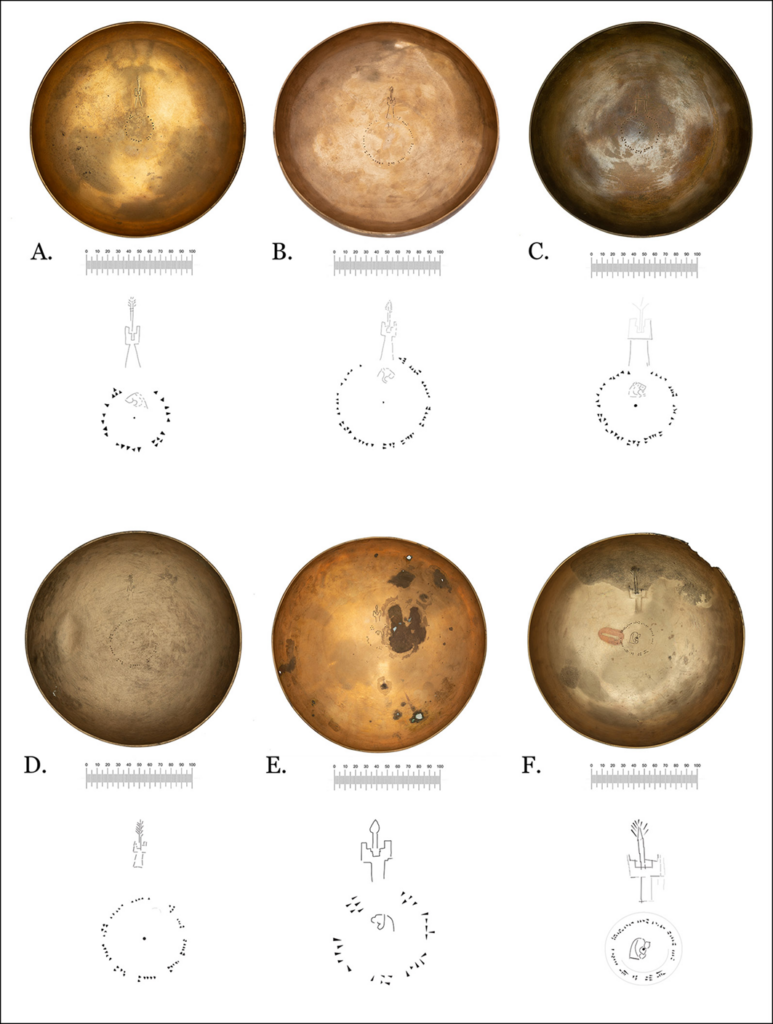
Metalworkers began placing symbols alongside the royal inscriptions. Early designs included a square with concave sides and a bird’s head. These images later developed into more consistent motifs, including a tower crowned with a spear—often interpreted as a susi temple—and the head of a roaring lion.
Both symbols carried meanings that would have been immediately understandable within the royal court.
The lion represented strength and kingship, while the temple image connected the monarch with sacred authority. Combined with the king’s written name, these motifs transformed each bowl into a compact statement about rulership, religion and military power.
Later bowls associated with kings named Sarduri and Rusa repeatedly used this established imagery, indicating that the designs had become part of an official royal visual language.
Writing itself became a display of power
Engraving cuneiform onto bronze required a different technique from cutting signs into stone or pressing them into clay.
Urartian craftspeople had to adjust the proportions, depth and angle of the wedge-shaped signs to suit curved metal surfaces. The bowls therefore preserve evidence not only of scribal practice but also of close cooperation between writers, engravers and metalworkers.
The finished vessel combined three functions. It was a ritual utensil, a high-status possession and a written royal artefact.
Its political force came from this combination. The king’s authority was communicated not only through the words themselves but through the valuable material, skilled workmanship and controlled imagery surrounding them.
The inscriptions show that writing in Urartu was more than a means of recording information. It had become a royal technology capable of turning everyday forms into material declarations of power.
Karmir-blur may have preserved the memory of a dynasty
The concentration of so many royal bowls at Karmir-blur may also provide evidence for the final decades of the Urartian kingdom.
According to the study, archaeological layers suggest that the vessels were deliberately deposited before the fortress was destroyed, rather than scattered during an attack or abandoned in the confusion of conquest.
Comparable collections have not been found at other Urartian sites. The researchers therefore propose that bowls once distributed among different royal fortresses may have been brought together at Karmir-blur when it served as one of the kingdom’s final political centres.
The gathering of vessels carrying the names of earlier rulers may have represented an attempt to preserve dynastic continuity during a period of instability. By assembling the possessions of past kings, Urartu’s final occupants could have created a physical archive of royal memory.
The site was probably destroyed around the middle of the sixth century BCE, ending the long process through which the bowls were produced, circulated and ultimately collected.
What survived was an unusual record of how Urartian kings made their authority portable. Inscribed with royal names and marked by lions, temples and carefully adapted cuneiform, the bronze bowls carried the monarchy’s message far beyond palace walls—and preserved it for nearly three millennia.
Bonfanti, A. S., Dan, R., Yeranyan, N., & Poghosyan, A. (2026). Memory of the kings of Bia/Urartu: inscribed royal bowls from Western Asia. Antiquity, 1–9. doi:10.15184/aqy.2026.10395
Cover Image Credit: Bonfanti, A. S., et al. 2026
