
Archaeologists excavating a Late Iron Age farmstead near Tours in central France have uncovered an intentionally mutilated sword and a weathered limestone statue, two unusual objects that appear to have been deposited during rituals marking major changes in the life of the settlement.
The discoveries were made at Le Désert in Mettray, where a preventive excavation by France’s National Institute for Preventive Archaeological Research (Inrap) exposed an enclosed Gaulish residence dating to between approximately 150 and 80 BC. The settlement covered around 1.2 hectares within a wider 3.5-hectare excavation area north of Tours.
Although the enclosure contained the buildings, workshops and agricultural installations expected at a rural settlement, its ditches produced objects rarely encountered in an ordinary domestic setting. Their locations and stratigraphic positions suggest they were not simply lost or discarded.
A Stone Figure Deposited as the Settlement Changed
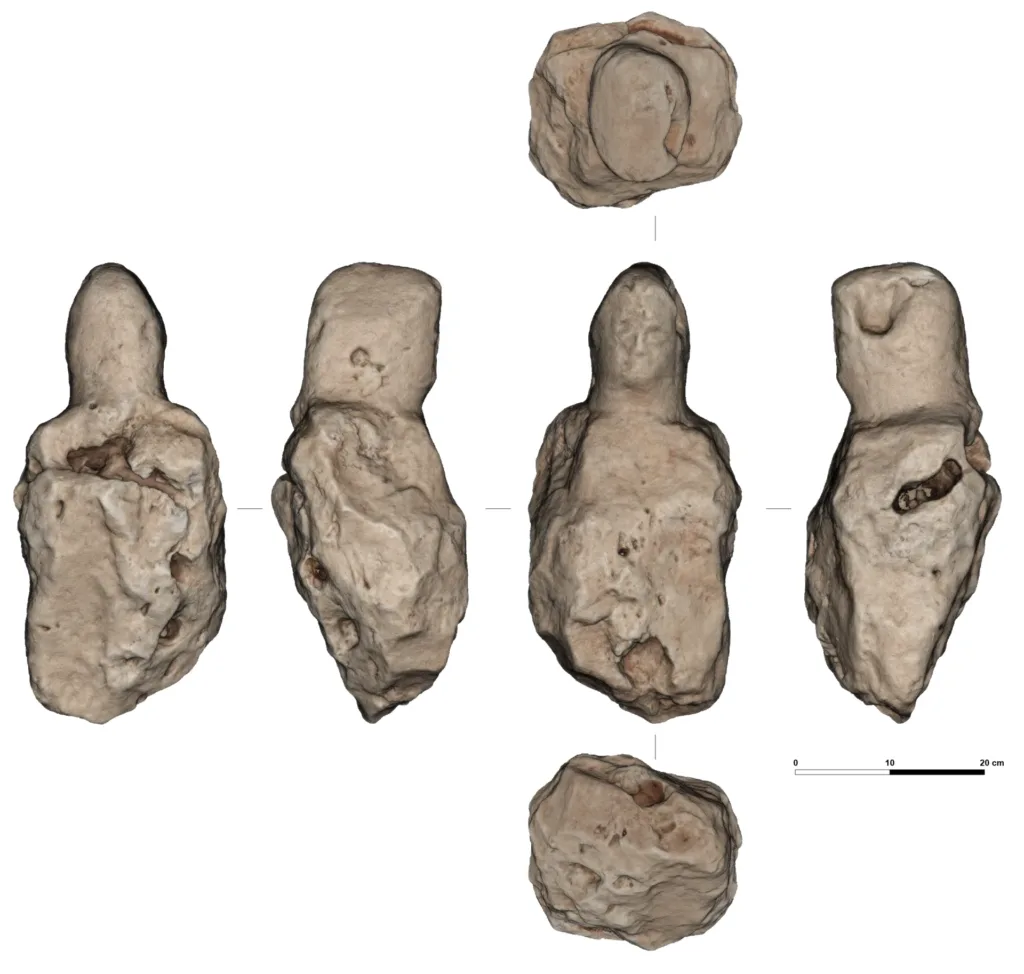
The limestone statue was recovered from the southern enclosure ditch. Measuring 49 centimeters high and weighing more than 18 kilograms, it had been carved from locally available stone containing numerous natural imperfections.
Heavy surface wear has erased much of its original appearance, but the figure’s eyes, nose, mouth, and the beginning of a hairstyle can still be recognized. Its prolonged exposure before deposition may explain the erosion, raising the possibility that it had once stood above ground somewhere within or near the settlement.
The statue entered the ditch during the transition between two distinct phases of occupation. This timing is important: it suggests that the figure may have been removed from use when the enclosure was reorganized rather than discarded as routine household waste.
Anthropomorphic stone sculpture remained relatively uncommon in Iron Age western Gaul. A major survey published in Aquitania documented only a limited corpus of such figures, including carved heads, busts and seated individuals. Their exact identities are often impossible to establish, but they are generally associated with social memory, ancestor representation, elite display or religious practice.
Approximately 90 meters from the statue, archaeologists found fragments of a human cranial vault in the same ditch and within a contemporary layer. Inrap describes the bone as a possible “memorial object” associated with the statue’s deposition.
The evidence does not establish that the fragments belonged to a decapitated enemy or that the statue represented the same individual. Nevertheless, the deliberate treatment and display of human heads is well documented in parts of Iron Age Gaul. At Le Cailar in southern France, for example, weapons placed beyond use were displayed alongside severed heads during the third century BC. Chemical analysis has also indicated that some of those heads were treated with plant resins to preserve them.
Mettray differs significantly from Le Cailar: it was a rural residence rather than a public martial display area, and no evidence of embalming or decapitation has been reported. The comparison instead demonstrates that cranial remains could carry powerful symbolic meanings in Gaulish communities and might remain in circulation after death.
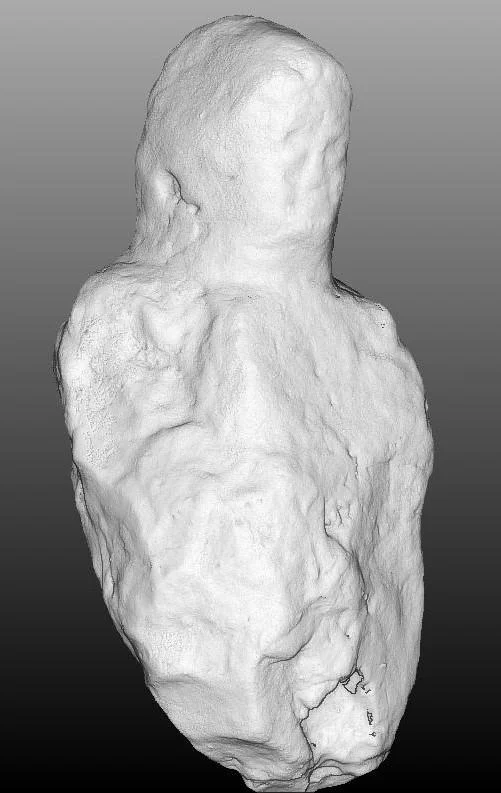
3D scan of the limestone statue. Credit: Sylvain Badey and Agnès Couderc, Inrap.
A Sword Placed Beside an Internal Crossing
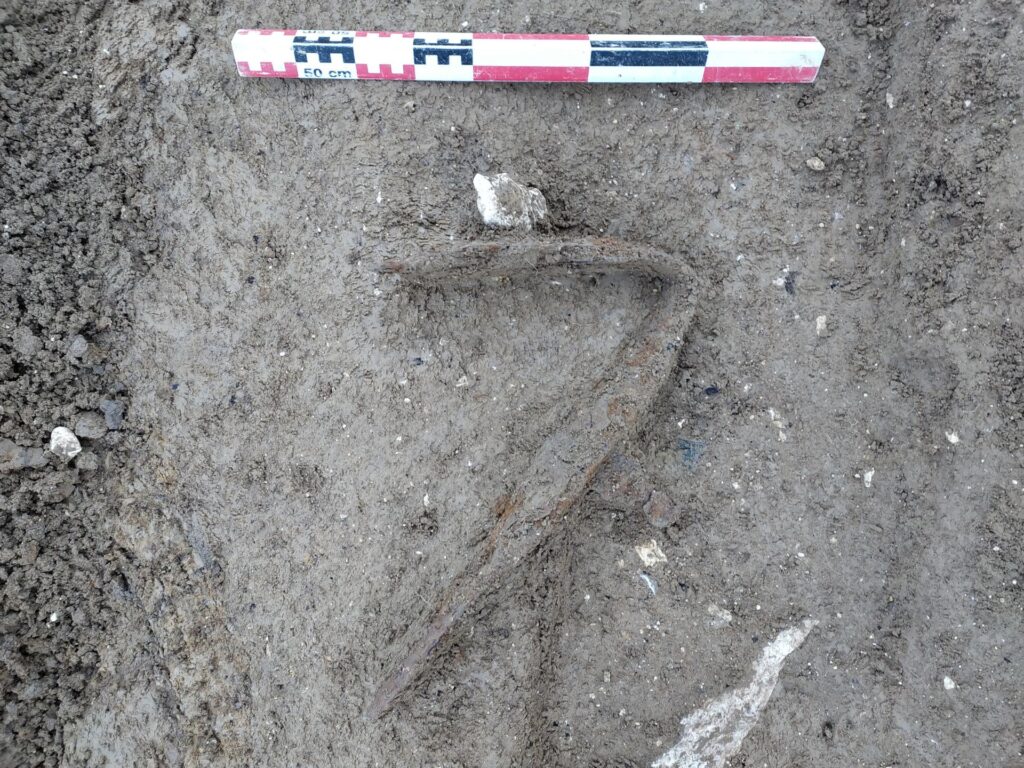
The second major find was an iron sword still accompanied by its scabbard. It lay in the ditch dividing the enclosure into two functional courtyards, close to the crossing used by residents moving between them.
Before being deposited, the weapon had been deliberately damaged so severely that it could never be used again. Archaeologists date this act to the final abandonment of the settlement.
Its position may have been as meaningful as its destruction. Entrances, gateways and internal crossings were liminal spaces—points separating one area from another. Depositing an unusable weapon beside such a passage may therefore have marked the symbolic closure of the route and, by extension, the end of the residence itself.
Comparable practices are known across Iron Age Europe. Swords were sometimes bent, twisted, cut or damaged while still inside their scabbards before being placed in sanctuaries, graves, rivers or other specially selected locations. Museum collections include several La Tène weapons deliberately folded into U or circular shapes, a process often described by archaeologists as “decommissioning” or ritually “killing” the object.
At the Gaulish sanctuary of Gournay-sur-Aronde, excavations revealed swords bent either with or without their scabbards. The repeated destruction of valuable weapons at such sites indicates that deformation was not merely practical disposal. It transformed an object associated with warfare, status and personal identity into something that could no longer return to ordinary circulation.
At Mettray, the association between the mutilated sword, the internal crossing and the settlement’s final abandonment supports a similar interpretation. The weapon may have represented an individual, a household or the authority once exercised within the enclosure. Destroying it could have signaled that this authority—and the place connected to it—had reached its end.
A Well-Organized Rural Estate
The enclosure was rectangular and divided by a broad internal ditch. Four buildings occupied its western courtyard, while a four-post structure stood in the eastern section. Sterile strips beside the surrounding ditches indicate that earthen banks once reinforced the enclosure but were later flattened.
Outside the residential area, a secondary network of ditches managed surface water and organized spaces used for craft production, agriculture and livestock. Evidence recovered from the settlement documents ironworking, grain milling, textile production, food preparation and animal processing, suggesting that the household was largely self-sufficient.
Animal remains add another unusual element. During the first occupation phase, horse butchery reached particularly high levels. Horses held economic, social and symbolic importance in Iron Age communities, but the Mettray evidence indicates that they were also processed for meat at this settlement. Whether the unusually large proportion reflects specialized breeding, periodic communal consumption or a local economic strategy remains under investigation.
Life in the Territory of the Turones
Mettray lies on a limestone plateau overlooking the La Perrée stream valley, north of modern Tours. Archaeological work across this plateau has documented a dense rural landscape during the Late Iron Age, including enclosed farms at nearby Parçay-Meslay and Monnaie.
These settlements formed part of the territory generally attributed to the Turones, the Gaulish people whose name survives in both Tours and the historical region of Touraine. Research indicates that their territory contained several levels of settlement, from isolated farms and enclosed estates to larger centers, including the important fortified settlement at the Châtelliers plateau in Amboise.
The Le Désert excavation was directed by Inrap archaeologist François Cherdo and conducted between November 2023 and March 2024. Inrap has described the site as one of the richest in remarkable objects yet excavated in this part of the Tours plateau.
Its significance lies not simply in the presence of a sword or statue, but in the sequence connecting them to the settlement’s history. The statue and nearby cranial fragments were deposited when the residence was reorganized. The sword was destroyed and placed near a crossing when the enclosure was finally abandoned.
Together, the finds suggest that leaving a Gaulish farmstead was not necessarily a purely practical event. At Mettray, changes to buildings, boundaries and household life appear to have been accompanied by deliberate acts intended to close one phase, preserve selected memories and formally bring the occupation of the site to an end.
Cover Image Credit: Nicolas Holzem, Inrap.
