
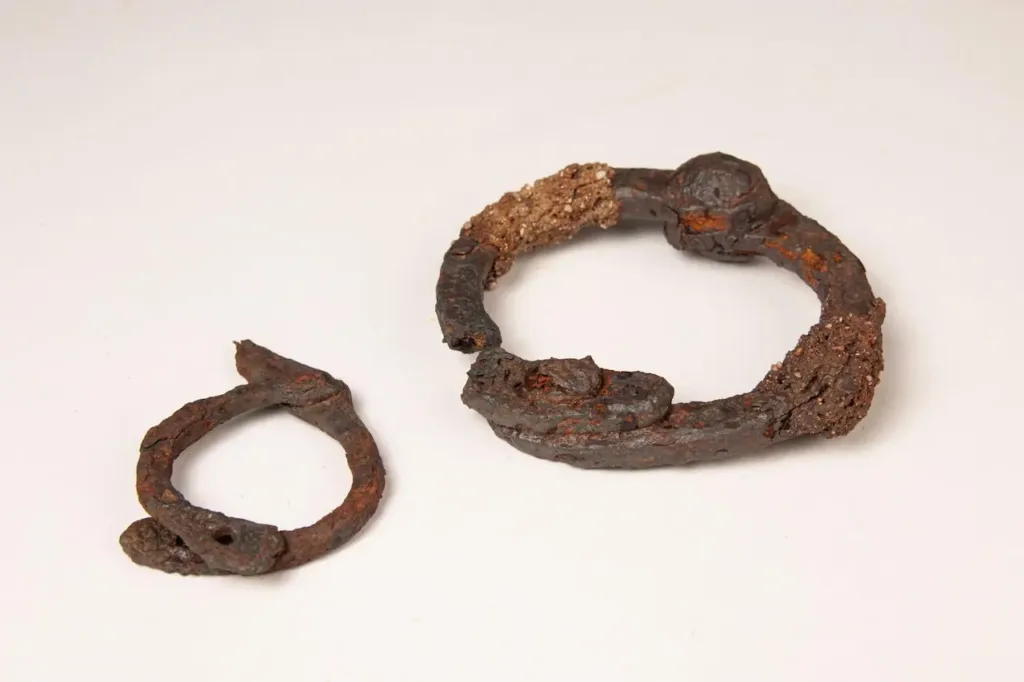
At least five iron restraints discovered at a major Gallic settlement in western France are providing rare archaeological evidence of slavery before the Roman conquest.
The shackles, designed for wrists and ankles, were among hundreds of metal objects recovered at Allonnes in Maine-et-Loire. Archaeologists believe their presence indicates that enslaved people may have been held, transported or traded within the settlement.
Founded during the third century BC, Allonnes developed into a roughly 20-hectare center of craft production, commerce and religious activity. Excavations conducted by France’s National Institute for Preventive Archaeological Research, or Inrap, uncovered part of the settlement and an adjoining sanctuary that remained in use for centuries.
Rare evidence of slavery in pre-Roman Gaul
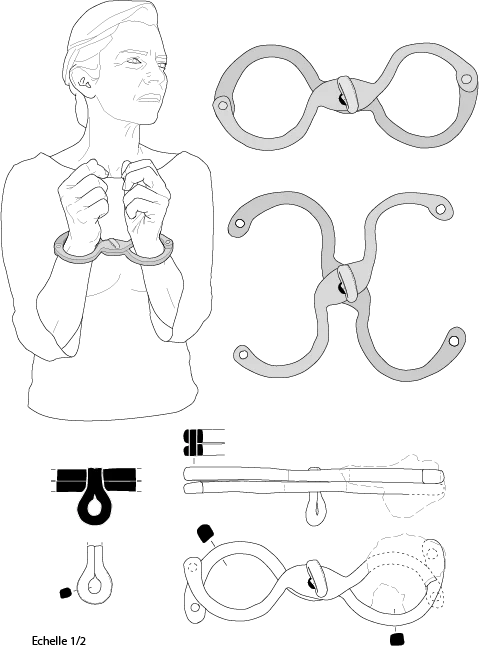
The archaeologists identified at least five well-preserved iron restraints intended for human wrists and ankles. Objects of this kind are exceptionally rare in Iron Age Gaul, where the lives of enslaved and socially marginalized people are often almost invisible in the archaeological record.
One of the wrist restraints has an internal diameter of less than six centimeters, suggesting that it may have been used on a woman or child. The ankle restraints were considerably heavier, with individual rings weighing more than one kilogram.
Inrap researchers say the shackles support the possibility that enslaved people were present and potentially exchanged at Allonnes. They may have included prisoners captured during warfare, people sentenced for crimes or individuals reduced to servitude because of unpaid debts.
Men, women and children subjected to such conditions lost their legal and social autonomy and could be treated as property. Yet physical evidence connected directly with these individuals is difficult to identify, making the Allonnes restraints particularly significant.
The objects do not, by themselves, establish that Allonnes operated as a specialized slave market. Their discovery within an active commercial settlement, however, provides unusually direct evidence that coercion and human captivity formed part of Gallic society before Roman rule.
A metalworking and commercial center
The shackles were found within a busy artisanal quarter occupied by metalworkers and merchants.
Archaeologists recovered tools, iron implements, copper-alloy objects, unfinished metal bars, slag and hammer scale. Together, these finds indicate that blacksmiths, bronze workers, coppersmiths and specialists in sheet-metal production worked within the district.
Small structures supported by four posts may have served as workshops, storage buildings or sales stalls. Open areas between the buildings could have accommodated markets and seasonal fairs where locally manufactured objects, agricultural produce and processed food were exchanged.
The remains reveal a planned settlement rather than an irregular concentration of workshops. Excavations exposed streets, secondary paths, public spaces and buildings likely divided into areas with different commercial, domestic and religious functions. Earlier investigations documented around 2,000 archaeological features within the 1.5-hectare area examined ahead of a housing development.
Fragments of wine amphorae imported from the Roman world show that Allonnes participated in trade networks extending well beyond its immediate agricultural hinterland.
A strategic position between Gallic territories
Allonnes occupied the eastern edge of the territory associated with the Andecavi, the Gallic people whose lands broadly corresponded to the later Anjou region.
The settlement stood close to the territories of the Turones to the east and the Pictones to the south. It was also positioned at the intersection of two important communication corridors.
One route followed the Loire region between Angers and Tours, while another connected the areas around Le Mans and Poitiers. This location would have allowed traders, craftspeople, agricultural goods, and imported products to move through the settlement from several directions.
Inrap describes settlements of this type as emerging centers of production and redistribution that appeared across Celtic Europe during the third and early second centuries BC. Fewer than 100 comparable sites are currently known across the wider Celtic world, and only a limited number have been excavated over substantial areas.
Allonnes therefore offers evidence of an increasingly urbanized Gallic economy before Julius Caesar’s conquest of Gaul in the first century BC.
Weapons and coins offered to the gods
Commercial and industrial activity developed beside a major religious complex.
The sanctuary remained active long after the original Gallic settlement was abandoned, continuing through the Roman period. Its unusually long history allows archaeologists to examine how local religious practices changed—or survived—during the transition from independent Gaul to Roman administration.
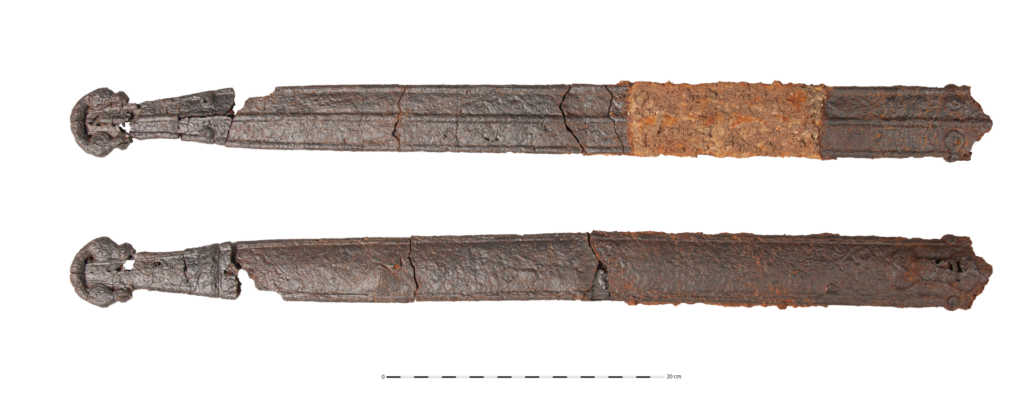
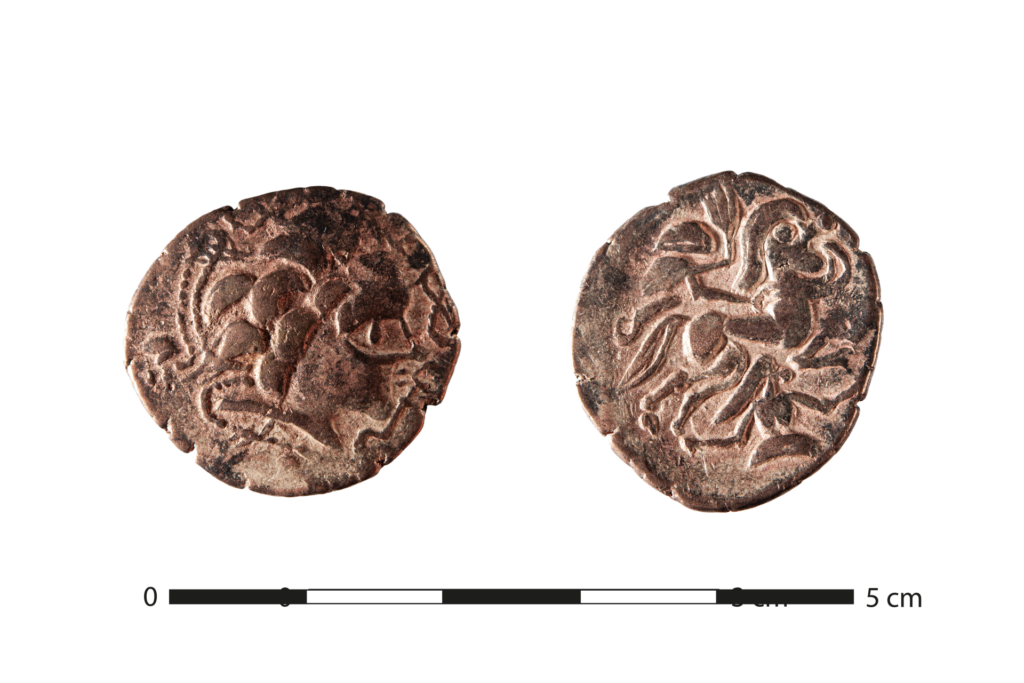
Excavations recovered swords, scabbards, spearheads and other military equipment deposited as offerings. Hundreds of Gallic and Roman coins spanning more than five centuries were also found, together with harness fittings, keys, brooches, rings, amulets and items associated with clothing.
Many had been deliberately damaged before deposition.
Weapons were bent, folded, cut or rendered unusable. Approximately one-third of the coins had been struck with chisels, filed or sheared. These actions were probably intended to remove the objects from normal circulation and transform them into permanent gifts to the gods.
Some ceremonies may have taken place within the enclosed sanctuary under the control of religious specialists. Other deposits were made in a nearby public votive area that appears to have been accessible to the wider community.
The sanctuary was also connected with a natural depression where rainwater collected. Such a setting may have strengthened the religious significance of the location, particularly within belief systems that associated springs, wetlands and flowing water with sacred activity.
Conservation reveals the settlement’s hidden history
The metal objects recovered at Allonnes were transferred to the Arc’Antique conservation laboratory in Nantes.
Because iron and copper alloys can deteriorate rapidly after excavation, conservators used chemical baths, glass-bead microblasting and delicate scalpel work to remove corrosion and stabilize the objects.
Specialist studies are now helping researchers reconstruct how the metal objects were manufactured, used, damaged and deposited. Numismatic analysis of the coins is also providing information about commercial contacts, political influence and the ritual treatment of currency.
More than 90 finds were presented locally during the 2026 European Archaeology Days, several years after the excavation began.
Taken together, the workshops, imported amphorae, ritual deposits and human restraints reveal two very different sides of Allonnes. It was a prosperous center of skilled production and long-distance exchange, but also part of a deeply hierarchical society in which some people could be deprived of their freedom and treated as commodities.
Cover Image Credit: Emmanuelle Collado, Inrap
