
A construction site in the heart of Cologne has turned into one of the most significant archaeological discoveries in northern Europe. During preparatory excavations for the underground visitor route of the MiQua – LVR-Jewish Museum in the Archaeological Quarter Cologne, archaeologists uncovered an exceptionally well-preserved Roman house altar from the 2nd century CE — a find described as unique north of the Alps.
But the altar is only part of a much larger story emerging beneath the Rathausplatz. Excavations have also revealed a monumental late Roman basilica foundation and a rare 1st-century staircase connected to the city’s former Roman governor’s palace. Together, these discoveries are reshaping our understanding of ancient Cologne — once known as Colonia Claudia Ara Agrippinensium.
A Roman Lararium Unlike Any Other in Northern Europe
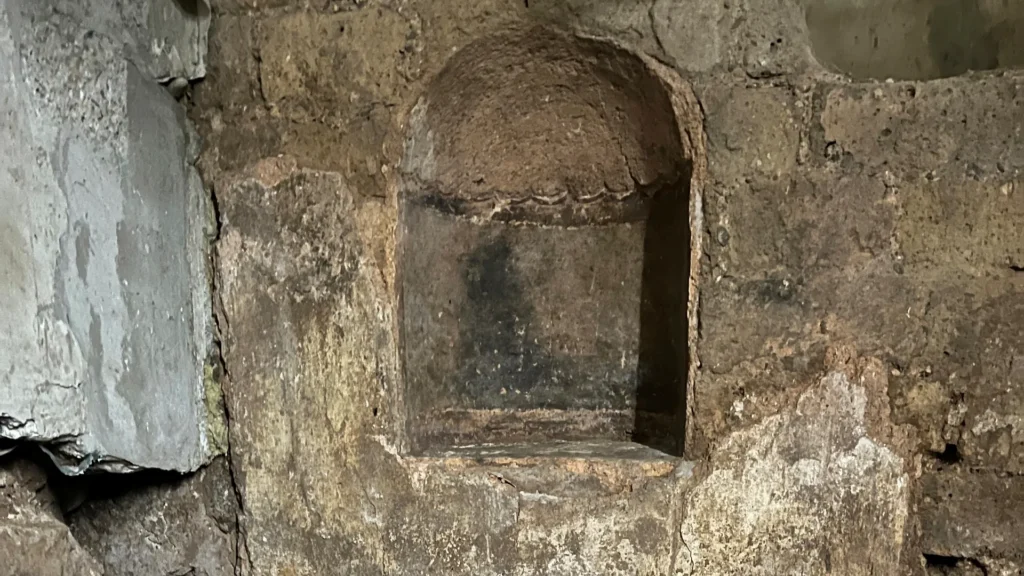
The most remarkable discovery is a lararium, a domestic shrine dedicated to the protective household deities known as the Lares. The altar was found within the area of the former Roman Praetorium — the governor’s palace that once symbolized imperial authority in the province of Germania Inferior.
Lararia were common in Roman homes across the Mediterranean world, yet their survival north of the Alps is extraordinarily rare. In Cologne’s case, the preservation is almost unprecedented. Archaeologists identified the altar niche with visible traces of original wall painting still intact inside.
Small nail holes above and beside the niche suggest that garlands once decorated the shrine. Below the niche, a clear break line marks where the altar table had originally been inserted. That altar slab was also recovered during excavation and is expected to be restored to its original position.
Comparable examples are well known from Vesuvian cities such as Pompeii and Herculaneum, where volcanic ash preserved Roman domestic life in extraordinary detail. In contrast, northern European Roman architecture has generally suffered from poor structural survival due to centuries of rebuilding and urban development.
This makes the Cologne lararium a rare architectural survival rather than just a loose artifact — and that distinction matters. It provides direct evidence of private religious practice within a high-status Roman building in northern Europe.
The Praetorium: Seat of Roman Power on the Rhine
The altar was discovered within the archaeological layers of the Praetorium — the official residence of the Roman provincial governor. Cologne was one of the most important Roman cities north of the Alps, strategically positioned along the Rhine frontier.
Domestic shrines inside such an elite administrative complex reveal the coexistence of imperial authority and personal devotion. Offerings at the lararium would have included food and small objects dedicated to household gods for protection and prosperity.
Excavation director Michael Wiehen emphasized that the structural preservation of this altar is what makes the discovery exceptional. While monumental Roman structures like the Porta Nigra survive in Germany, intact domestic religious installations from this period are virtually unheard of in the region.
A Rare Roman Staircase from the 1st Century
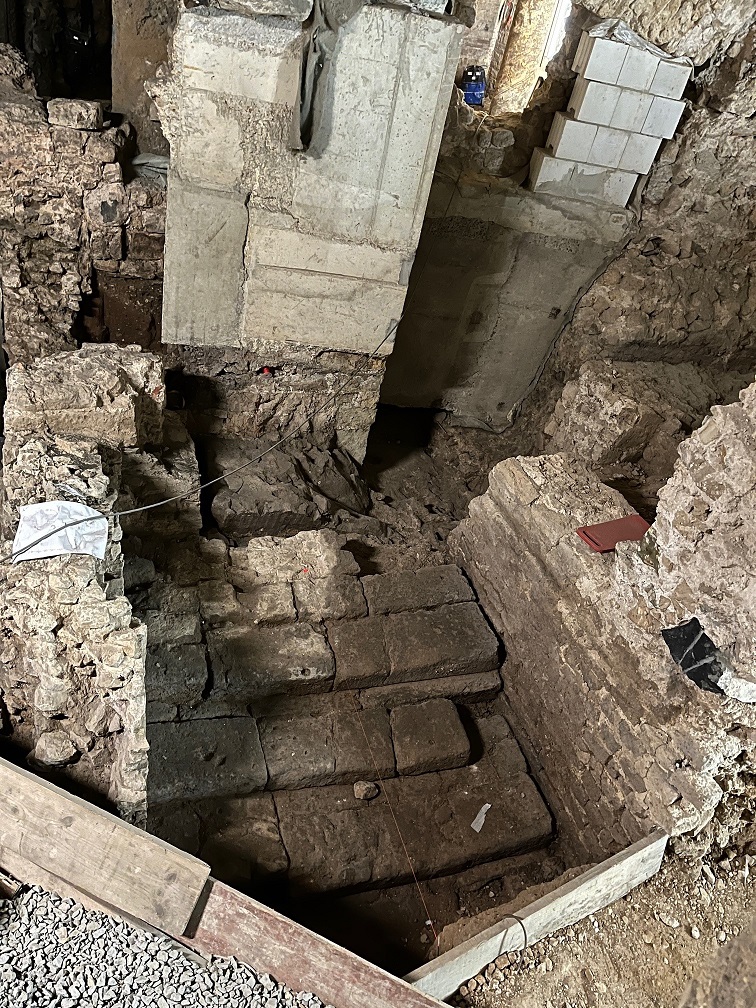
Another significant find is a Roman staircase dating to the late 1st century CE. The staircase connected a lower area closer to the Rhine with a higher section of the early Praetorium complex.
Staircases are seldom preserved in Cologne’s archaeological record because most Roman remains survive only at foundation level. In this case, unique topographical conditions played a decisive role. Early Roman structures had already been buried in antiquity due to artificial infill along the former Rhine slope, protecting them from later destruction.
Where the staircase originally led remains unknown. However, its discovery offers rare insight into the vertical organization of Roman Cologne’s urban architecture.
Breakthrough at the Basilica Apse
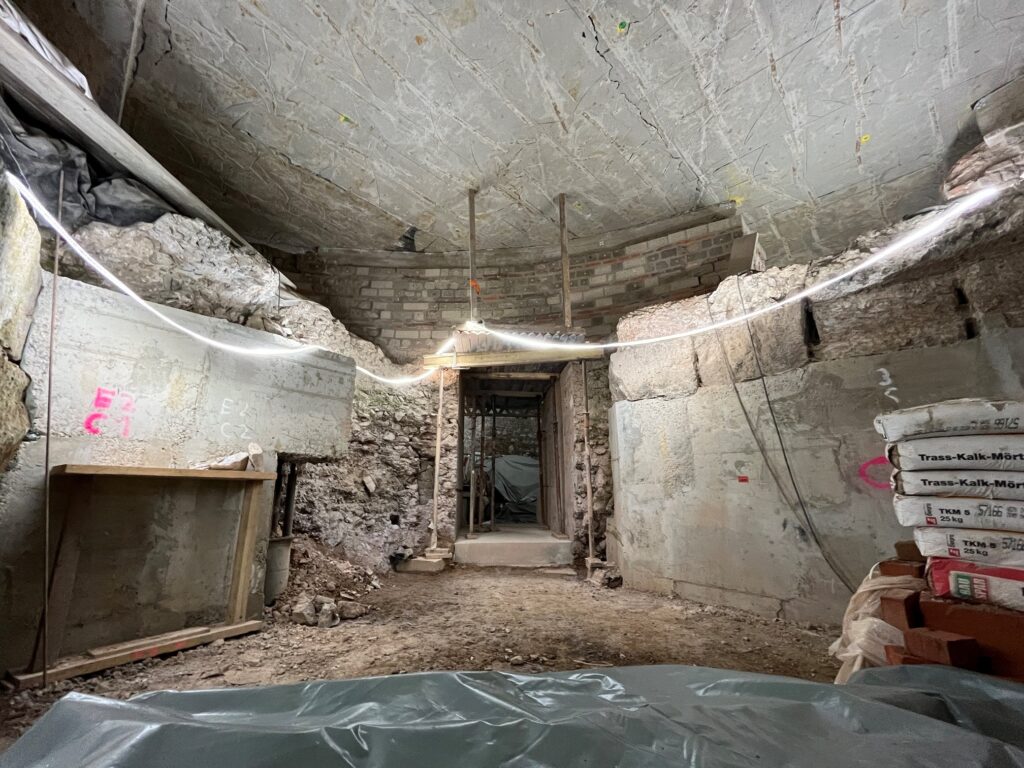
Excavations also exposed the massive foundation of a 4th-century Roman basilica apse — a structural element up to four meters thick. What initially appeared to be typical Roman concrete (opus caementicium) was revealed, upon section analysis, to consist of carefully layered volcanic tuff, basalt, and limestone bonded with an exceptionally durable mortar containing brick and gravel fragments.
Before excavation, this area appeared only as a slight depression on the Rathausplatz surface. Today, it is accessible to visitors for the first time.
The basilica remains highlight Cologne’s transformation in Late Antiquity, when administrative and possibly ecclesiastical architecture reshaped the cityscape.
Why This Discovery Matters for Roman Archaeology
The Cologne lararium is not simply another Roman artifact. It represents:
Architectural preservation rarely seen north of the Alps
Direct evidence of domestic religious life in a provincial capital
A physical link between Roman imperial administration and private devotion
A new benchmark for Roman urban archaeology in Germany
While southern European sites like Pompeii have long dominated discussions of Roman domestic religion, this discovery demonstrates that comparable architectural features once existed along the Rhine frontier — even if they rarely survived.
The combination of the house altar, the staircase, and the basilica foundation paints a layered picture of Cologne’s Roman past spanning from the 1st to the 4th century CE.
MiQua’s Underground Archaeological Walk
All three discoveries were made during construction of the future underground tour route of the MiQua Museum. Once completed, visitors will be able to walk through the archaeological remains beneath modern Cologne and experience Roman, Jewish, and medieval history in situ.
The project represents one of Germany’s most ambitious urban archaeological museum concepts — integrating active excavation with public accessibility.
For Cologne, a city built on Roman foundations, these finds reaffirm its status as one of the most important archaeological centers in northern Europe.
And for scholars, the lararium offers something even rarer: a preserved moment of Roman domestic spirituality frozen beneath centuries of urban life.
Cover Image Credit: Section view of the massive 4th-century Roman apse foundation uncovered during excavations at the MiQua site in Cologne. Stadt Köln/Römisch-Germanisches Museum, Michael Wiehen
