
8 December 2025 The Future is the Product of the Past

Unearthing One of the Earliest Examples of Roman Monumental Architecture: Ancient Basin Discovered in Gabii

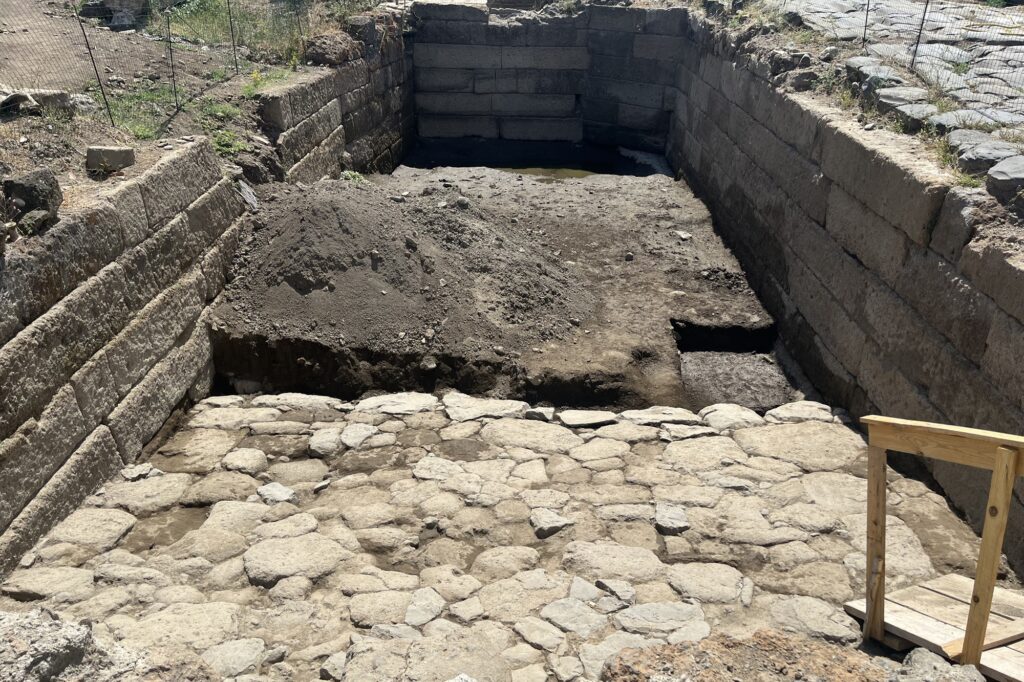
Hidden beneath the soil of an ancient city just east of Rome, archaeologists from the University of Missouri have uncovered what may be one of the earliest examples of Roman monumental architecture — a vast, stone-lined water basin dating back to around 250 B.C.

This extraordinary find sheds new light on how early Romans began to shape their cities not only for function, but also as symbols of power, identity, and civic pride.

A Monument Lost for Centuries

The discovery was made in Gabii, an ancient city located roughly 11 miles east of Rome. A team led by Professor Marcello Mogetta, chair of Mizzou’s Department of Classics, Archaeology and Religion, unearthed the remains of a massive man-made basin, partially carved directly into the volcanic bedrock.

According to Mogetta, this structure predates much of the monumental stone construction typically associated with Imperial Rome. “This discovery gives us a rare look at how the early Romans experimented with city planning,” he explained. “Its position at the center of Gabii, near the city’s main crossroads, suggests it was a monumental pool — possibly part of a public forum, the heart of civic life in Roman towns.”

If confirmed, the Gabii basin could represent a prototype for later Roman forums and water features — monumental spaces that defined the architectural landscape of cities across the empire.


📣 Our WhatsApp channel is now LIVE! Stay up-to-date with the latest news and updates, just click here to follow us on WhatsApp and never miss a thing!!


A Window into Early Roman City Planning

Built centuries before iconic structures like the Colosseum or the Pantheon, the Gabii basin reveals how early Romans began adapting Greek architectural principles for their own urban experiments. Earlier work by the same team, including the excavation of the “Area F Building,” a terraced complex nearby, has shown how Roman architects drew inspiration from Greek civic design — from paved plazas and dramatic terraces to public gathering spaces that conveyed political power.

“The Greeks used architecture to express civic identity,” Mogetta noted. “The Romans took those lessons and made them their own. The Gabii basin shows that even in the third century B.C., they were already thinking about architecture as a tool for influence and authority.”
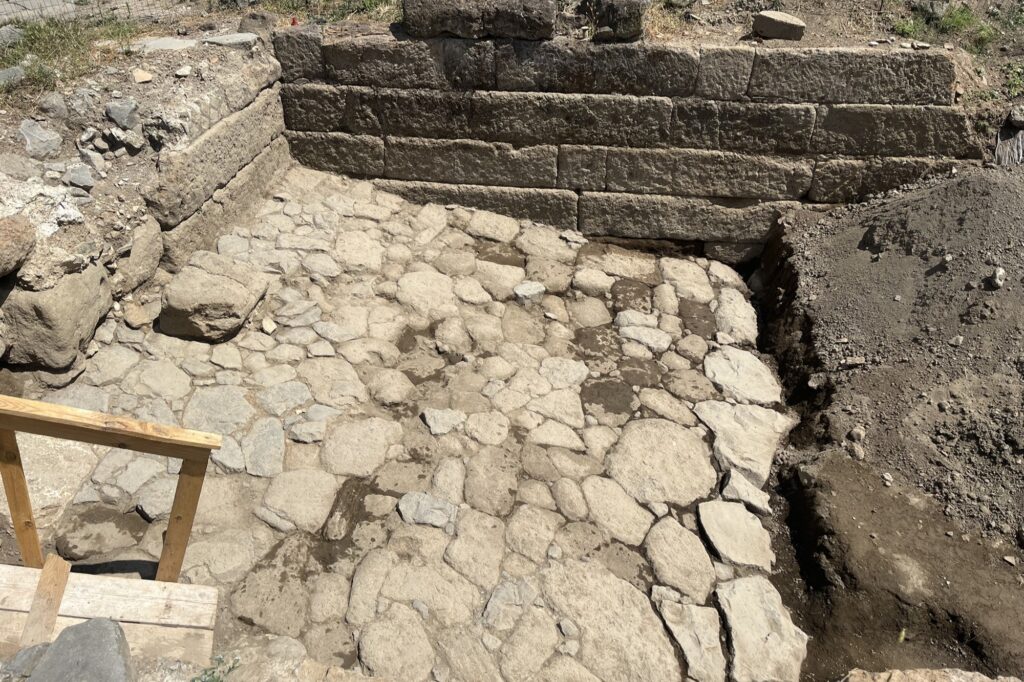
In the heart of the ancient Roman city of Gabii, located just 11 miles east of Rome, archaeologists discovered the remains of a massive stone-lined basin, partly carved directly into the bedrock. Credit: Marcello Mogetta

Preserving an Ancient Rival of Rome

Gabii holds a unique place in early Roman history. Once a powerful rival of Rome, it was largely abandoned by 50 B.C., meaning that its original street grid and building foundations remain remarkably intact. This makes Gabii an archaeological treasure — offering one of the clearest windows into early Roman urban development.

Recognizing its significance, Italy’s Ministry of Culture designated Gabii as an official archaeological park under the Musei e Parchi Archeologici di Praeneste e Gabii. The site is now being studied by an international research collaboration known as the Gabii Project, directed by Mogetta.

Excavating the Past, Uncovering the Future

The team’s next phase of work will focus on what lies within and around the basin. Supported by Italy’s General Directorate of Museums, excavations will continue next summer to examine layers of sediment and artifacts accumulated over centuries. Archaeologists also plan to investigate a nearby “anomaly” detected through thermal imaging — a large underground structure that may turn out to be a temple or civic building.

“If it’s a temple, it could help explain some of the ritual objects we’ve already found,” said Mogetta. Among the discoveries are intact vessels, lamps, perfume containers, and cups inscribed with mysterious markings — possibly offerings left behind when the pool was ritually closed around 50 C.E. These artifacts underscore the spiritual and civic importance of water management in ancient Roman life.

Reconstructing the Origins of Roman Power

As excavation continues, researchers hope to answer one of archaeology’s most enduring questions: Did civic spaces emerge before religious centers — or the other way around? The answer could reshape how historians understand the evolution of Roman cities and the forces that drove their architectural ambitions.

By piecing together the story of Gabii, Mogetta and his team are reconstructing not only the rise and fall of a single city, but the foundations of Roman architectural identity — one that continues to shape the modern world more than two millennia later.

University of Missouri

Cover Image Credit: Marcello Mogetta

Related Articles

19 funerary tombs from Roman times were discovered in Tartus, Syria

27 May 2022

27 May 2022

During search and excavation operations in the archaeological area of Amrit in Tartus, Syria, a joint excavation team from the...

Unique Roman Cavalry Parade Helmet Recreated

6 April 2024

6 April 2024

Two replicas have been created of the gilded silver unique Roman cavalry helmet that amateur archaeologists found in 2001 while...

Samen Underground City Getting Prepared for Public Visits

6 June 2021

6 June 2021

Samen Underground City is a unique structure in Iran and the extent of such a structure has not been observed...

Remains of a 3,700-year-old domed oven were discovered in the ancient city of Troy

10 September 2022

10 September 2022

Remains of a 3,700-year-old domed oven were found in the ancient city of Troy, located in the Tevfikiye district of Çanakkale...

At Göbeklitepe, believed to be the earliest known Mesolithic temple complex, grinding stones were discovered

26 October 2022

26 October 2022

A recent discovery at Göbeklitepe, the oldest known Mesolithic temple complex, has revealed grinding stones, new finds expected to shed...

Japan’s possibly oldest stone molds for bronze casting discovered at Yoshinogari ruins

4 December 2023

4 December 2023

At the Yoshinogari Ruins in the western prefecture of Saga, relics including stone casting molds for bronze artifacts have been...

The Mysterious Origins of the Cerne Abbas Giant Finally Revealed

3 January 2024

3 January 2024

There’s a huge chalk image of a man with a powerful erection and no clothes on his butt located in...

Unique 7,700-year-old figurines were discovered in Ulucak Mound, one of the oldest settlements in Western Anatolia

6 October 2023

6 October 2023

Ulucak Mound (Ulucak Höyük), one of the oldest neolithic settlements dating back to 6800 BC, male and female figurines evaluated...

A pendant with a figure of St. Nicholas found in the Ancient Church Hidden in Turkish Lake

7 October 2022

7 October 2022

Underwater archaeological excavations and research, which were started 8 years ago in the basilica located 20 meters off the lake...

The Gallo-Roman Sanctuary Unearthed in France

30 June 2024

30 June 2024

During a recent archaeological excavation in the old Hôtel Dieu neighborhood of Rennes in north-western France, archaeologists discovered the remains...

Turkey to Present 12 Historic Artifacts to Istanbul Patriarch

10 August 2021

10 August 2021

The government said on Monday that Turkey will deliver stolen icons from ancient local churches to Istanbul’s Fener Greek Patriarch...

Traces of Pozzolan Dust from Phlegraean Fields Found in a 1st-Century Roman Hydraulic Structure Submerged in Venetian Lagoon

29 November 2024

29 November 2024

In the San Felice Canal, in the northern Venetian Lagoon, a material used as an additive in Roman concrete was...

New Museum being Built for the Stolen Goddess Cybele in Western Turkey

12 June 2021

12 June 2021

A marble statue of the Anatolian mother goddess Cybele, which was returned to its native home of Turkey’s Afyonkarahisar will...

Mysterious ruins discovered at the bottom of Lake Van, Türkiye’s largest lake

16 August 2023

16 August 2023

At the bottom of Lake Van, Türkiye’s largest salty soda lake with 3,712 square kilometers, divers discovered a cemetery and...

First Visual Evidence of the Milky Way Found in Ancient Egyptian Cosmological Vignettes

1 May 2025

1 May 2025

Did ancient Egyptians gaze upon the Milky Way and immortalize its form in their artwork? New research suggests this very...