
8 December 2025 The Future is the Product of the Past

Extraordinary Monumental Roman Burial Mound Discovered in Bavaria Stuns Archaeologists

Archaeologists in Bavaria have uncovered what appears to be the foundation of a monumental Roman burial mound, a discovery that has astonished experts and shed new light on the Roman presence in southern Germany’s ancient province of Raetia.

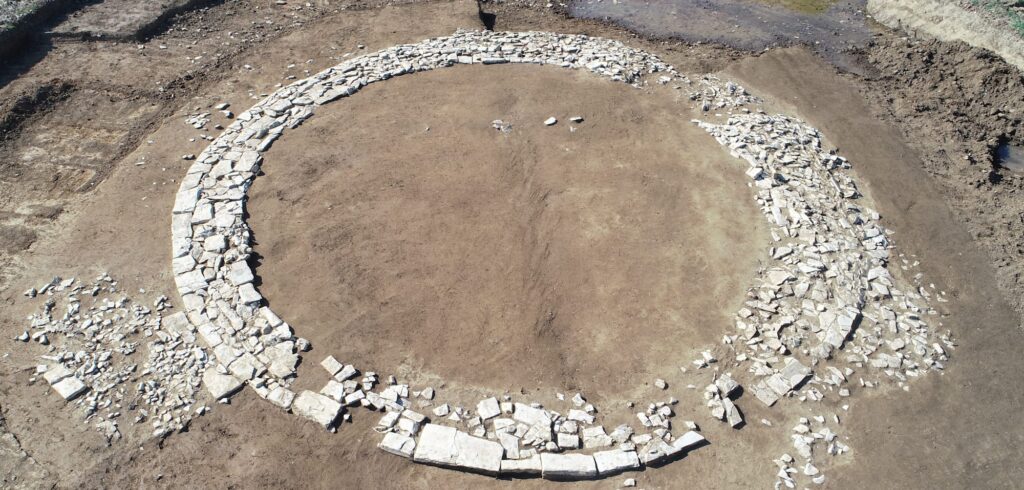
The Bavarian State Office for Monument Preservation (Bayerisches Landesamt für Denkmalpflege, BLfD) announced that the remains, unearthed near Wolkertshofen in the district of Eichstätt, likely represent the base of a Roman tumulus — a large circular stone structure used as a burial monument. What makes this find remarkable is its rarity in Raetia, where such elaborate Roman grave monuments are almost unheard of.

A Remarkable Stone Circle with a Hidden Story

The excavation revealed a meticulously constructed stone ring, about twelve meters in diameter, situated directly beside an ancient Roman road. Attached to the southern side is a square annex, two by two meters in size, which may have served as the foundation for a stele or statue. Despite its monumental appearance, the interior of the structure was completely empty.

“Discovering a burial monument of this scale and period here was entirely unexpected,” said Prof. Mathias Pfeil, General Conservator of the BLfD. “The tumulus stood along an important Roman transport route. The family erected it as a highly visible memorial — both a place of remembrance and a symbol of social status.”
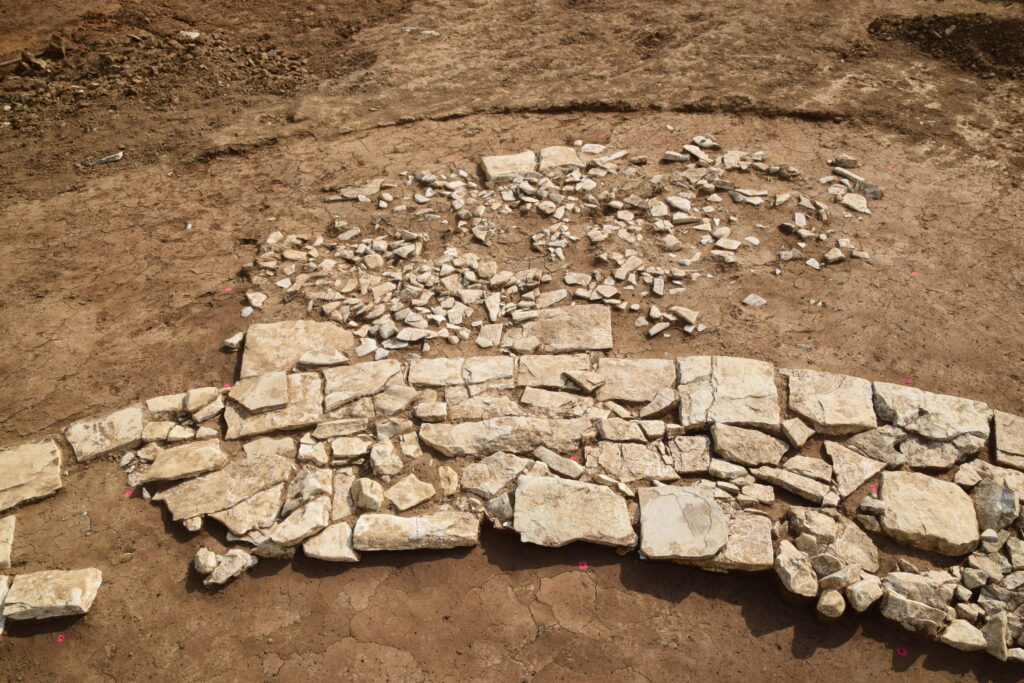
Archaeologists also uncovered a square annex measuring two by two meters. A square annex was likely serving as the base for a Roman stele or statue. Credit: Archäologiebüro Dr. Woidich GmbH

A Symbolic Tomb: The Kenotaph of Wolkertshofen

Surprisingly, archaeologists found no human remains or grave goods inside the structure. This absence led researchers to conclude that the site is not a traditional burial, but rather a kenotaph — a symbolic grave built in honor of someone buried elsewhere. Such monuments served as memorials for distinguished individuals, often emphasizing family prestige and social hierarchy.


📣 Our WhatsApp channel is now LIVE! Stay up-to-date with the latest news and updates, just click here to follow us on WhatsApp and never miss a thing!!


The location of the tumulus reinforces this interpretation. It lies near a Roman road that once connected Nassenfels to the Altmühltal valley, and close to the remains of a villa rustica — a Roman country estate. Together, these suggest that the person commemorated was likely a member of the local elite.

Rediscovering Raetia’s Roman Heritage

The find was made during construction work for a rainwater retention basin in autumn 2024. Archaeologists accompanied the project after discovering that the area was classified as an archaeological heritage site. Earlier layers revealed prehistoric settlement traces and ceramic fragments, but the appearance of the circular stone foundation came as a surprise.

In the Roman world, tumuli were already a well-established burial form across central Europe and Italy. In the northwestern provinces of the empire, such as Raetia, they appeared from the first century AD onward. Some Roman tumuli reused older Bronze Age or Iron Age burial mounds, reflecting both continuity and adaptation of local traditions. Archaeologists believe the Wolkertshofen monument may similarly reflect a fusion of Mediterranean architectural influence and Celtic burial customs.

“While the stone foundations clearly follow Roman models,” the BLfD notes, “burial mounds in this region mostly date back to pre-Roman times. This makes the Wolkertshofen tumulus an exceptional and important find for understanding cultural exchange in the province of Raetia.”
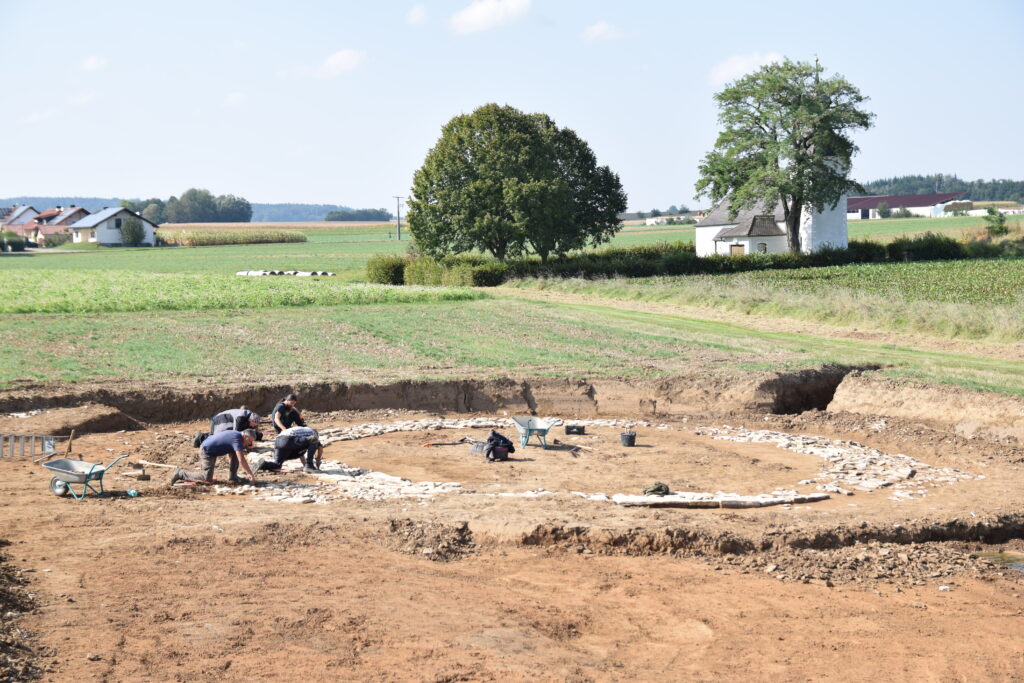
The stone circle was uncovered in the northeast of the village of Wolkertshofen. Credit: Archäologiebüro Dr. Woidich GmbH

A Unique Discovery in Southern Germany

Although several Roman graves are known from the Augsburg region, tumuli with stone ring walls of this scale and quality remain extremely rare in Bavaria. The Roman burial monument of Wolkertshofen therefore represents an invaluable addition to the archaeological record, offering insights into the funerary and commemorative practices of Roman settlers in ancient Raetia.

Experts from the BLfD emphasize the importance of the discovery for future research: it demonstrates how Roman architecture and symbolic traditions were adapted to local landscapes — creating monuments that were not only functional but also political and social statements.

Wolkertshofen’s Long Settlement History

The village of Wolkertshofen has long been an archaeological hotspot. Excavations in and around the area have revealed settlements and burial sites spanning thousands of years — from the Neolithic, through the Bronze and Iron Ages, into the Roman imperial period and the early Middle Ages. The new find continues this long history, reinforcing Wolkertshofen’s role as a key site for understanding Bavaria’s deep past.

Bavarian State Office for Monument Preservation

Cover Image Credit: The stone circle of Wolkertshofen was discovered by chance. Archäologiebüro Dr. Woidich GmbH

Related Articles

Human Relief Found at Million Stone Excavation Site in İstanbul

18 July 2021

18 July 2021

The Milion Stone (also known as the Million Stone) from the Eastern Roman period is one of important the historical...

A 4,500-year-old rope remains were discovered at Turkey’s Seyitömer mound

26 December 2021

26 December 2021

In the rescue excavation carried out in the mound, which is located within the license border of Çelikler Seyitömer Electricity...

Archaeologists Discover 8600-year-old Bread at Çatalhöyük May be the Oldest Bread in the World

5 March 2024

5 March 2024

Archaeologists have discovered about 8,600-year-old bread at Çatalhöyük, a Neolithic settlement in central Turkey. Çatalhöyük is noteworthy because it is...

Rock tombs dating back 1,800 years have been discovered in Turkey’s ancient city of Blaundus

1 October 2021

1 October 2021

In the ancient city of Blaundus, located in the Ulubey neighborhood of the western Anatolian city of Uşak, 400 rock-cut...

Remains of Norman Stone Tower Defending Chichester Castle Discovered

5 June 2025

5 June 2025

A remarkable archaeological excavation in Chichester’s historic Priory Park has uncovered the remains of a Norman-era stone tower, known as...

Iran wants UNESCO recognition for 56 of its historic caravansaries

10 October 2021

10 October 2021

Iran wants 56 Caravanserais from various periods, from the Sassanids (224 CE-651) to the Qajar period (1789-1925), to be included...

Metal Detectorist Finds on 4,000-year-old Dagger in Poland Forests

24 February 2024

24 February 2024

A copper dagger more than 4,000 years old was found in a forest near the town of Jarosław on the...

Remains of 2 houses belonging to the founding period of the city were unearthed in the ancient city of Hierapolis

5 November 2021

5 November 2021

During this year’s excavations in the ancient city of Hierapolis-Pamukkale in Turkey’s Aegean province Denizli, the remains of two houses...

Extraordinary 27,000-Year-Old Gravettian Female Figurine Head Discovered at Amiens-Renancourt, Northern France

9 July 2025

9 July 2025

Recent archaeological excavations at the Amiens-Renancourt 1 site in northern France have unveiled an extraordinary Gravettian-era female figurine head, dating...

New Discovery Challenges Origins of Iconic Sutton Hoo Helmet: It Could Radically Alter Our Understanding of 7th Century Northern European Power Dynamics

28 March 2025

28 March 2025

A recent find on the Danish island of Tåsinge has sparked a significant reevaluation of the origins of the renowned...

Massive New Kingdom Fortress Unearthed on the Horus Military Road in North Sinai

12 October 2025

12 October 2025

An Egyptian archaeological mission has uncovered a massive military fortress dating back to Egypt’s New Kingdom period along the ancient...

A 12.000 -year-old temple was found during excavations in Boncuklu Tarla in southeastern Turkey

21 October 2021

21 October 2021

A temple thought to be 12 thousand years old was unearthed in Boncuklu Tarla in the Ilısu Neighborhood of Dargeçit...

Experts to uncover the secret of the monumental and three-dimensional Urartian statue found on Garibin Tepe

2 November 2024

2 November 2024

In an area where rescue excavations were conducted last year, archaeologists discovered a basalt stone statue from the Urartian period...

10,000-year-old Settlement Discovered in Turkey’s Şanlıurfa

25 June 2021

25 June 2021

A Neolithic settlement was discovered in the garden of a house in the Sayburç Neighborhood of Şanlıurfa’s Karaköprü district. News...

Archaeologists Discover Old Bulgarian Inscription and Rich Finds at Nikopol Fortress Excavations

2 September 2025

2 September 2025

This summer’s archaeological season at the Nikopol Fortress has yielded one of the most remarkable discoveries in recent years: an...