
Ancient life can seem almost storybook from a distance: kings and queens, princes and princesses, monumental tombs, pyramids, glittering treasures and beautifully decorated halls. Archaeology often brings these spectacular remains to the surface, but they represent only one part of the past.
For many people, life was far less secure. Violence did not belong only to battlefields, and even childhood offered no guarantee of safety. A new study of human remains from Iron and Viking Age Scandinavia is bringing some of those less visible lives into focus, including people who never reached a formal cemetery.
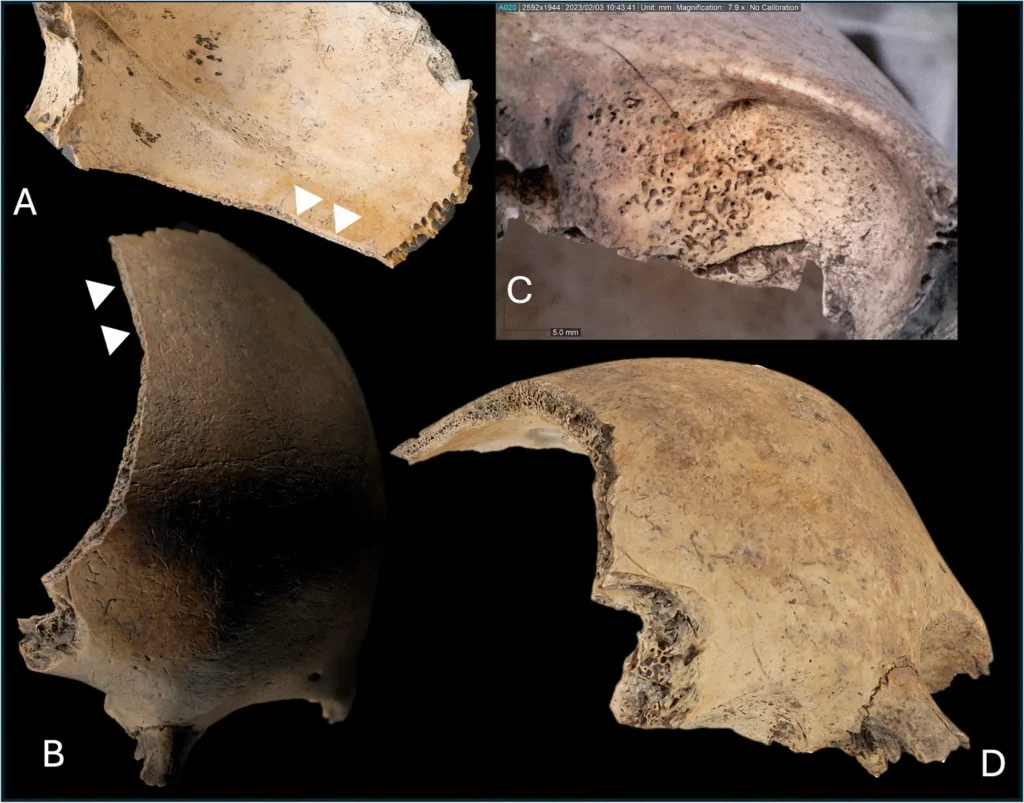
One of them was a boy only two to four years old. Researchers know him from part of his skull, which carries trauma that may have resulted from a heavy bladed weapon or a similar force around the time of death. Instead of receiving a conventional burial, the child’s cranial fragment eventually ended up beneath the floor of a longhouse, where later inhabitants may have walked above it.
His story lies at the heart of a larger question: how much violence have archaeologists missed because they have looked for its victims primarily in cemeteries?
The people who never reached the cemetery
The study, led by Marianne Hem Eriksen and colleagues through the BODY-POLITICS project, examined an unusual dataset from Denmark, Sweden and other parts of southern and central Scandinavia. Rather than focusing on burial grounds, the researchers turned to human remains found inside settlements, including houses, yards, wells, pits, postholes and floors.
The wider dataset contains unburnt remains representing an estimated 192 individuals from 197 depositional contexts, spanning roughly 1,500 years. Most do not survive as complete skeletons. Archaeologists often have only a skull fragment, a femur, a shoulder blade, or another isolated part of a body.
Cemetery studies usually work with much more complete skeletons, while these fragments preserve only a fraction of the places where an injury could leave a mark. Soft-tissue injuries such as strangulation, throat cutting, or stabbing may leave no skeletal evidence at all.
Among the 192 individuals, researchers identified 12 with evidence of trauma before or around the time of death. Together, those people carried 19 traumatic injuries, including sharp-force wounds, blunt-force impacts, fractures, and possible defensive injuries. At least eight, and possibly nine, appear to have experienced deliberate violence.
A spear from behind, injured skulls and a body beneath a house
Some cases offer unusually direct glimpses of violent encounters.
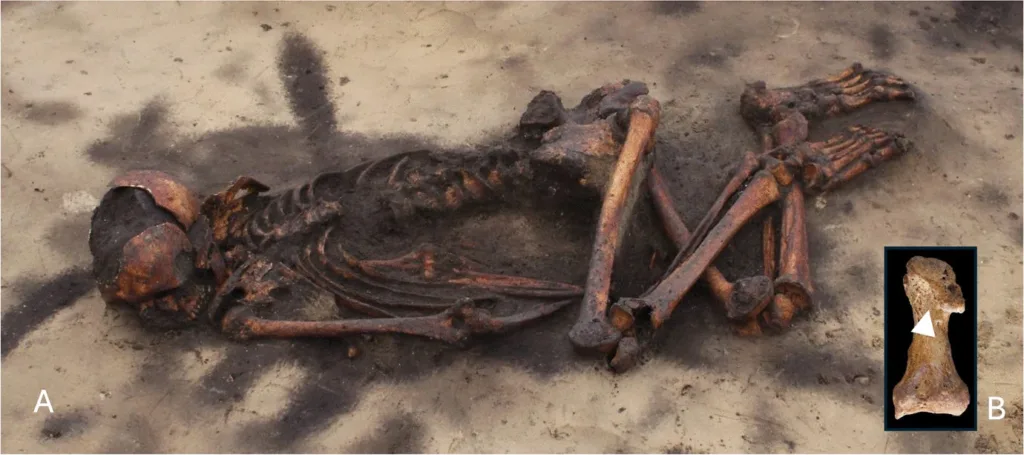
At Uppåkra in southern Sweden, an adult’s shoulder blade carried a penetrating wound that researchers believe came from a spear or lance entering from behind. Someone later placed that single bone into the posthole of a hall at the major pre-Christian ritual and political centre. The rest of the person’s body remains unknown.
Elsewhere, a man aged about 25 to 35 had sharp-force injuries to a rib consistent with a sword, long dagger or spear. Excavators found his wrists crossed beneath his ribcage and suggested that someone may have tied them together. His remains also showed weathering and animal gnawing before a three-aisled house eventually rose above the place where his body lay.
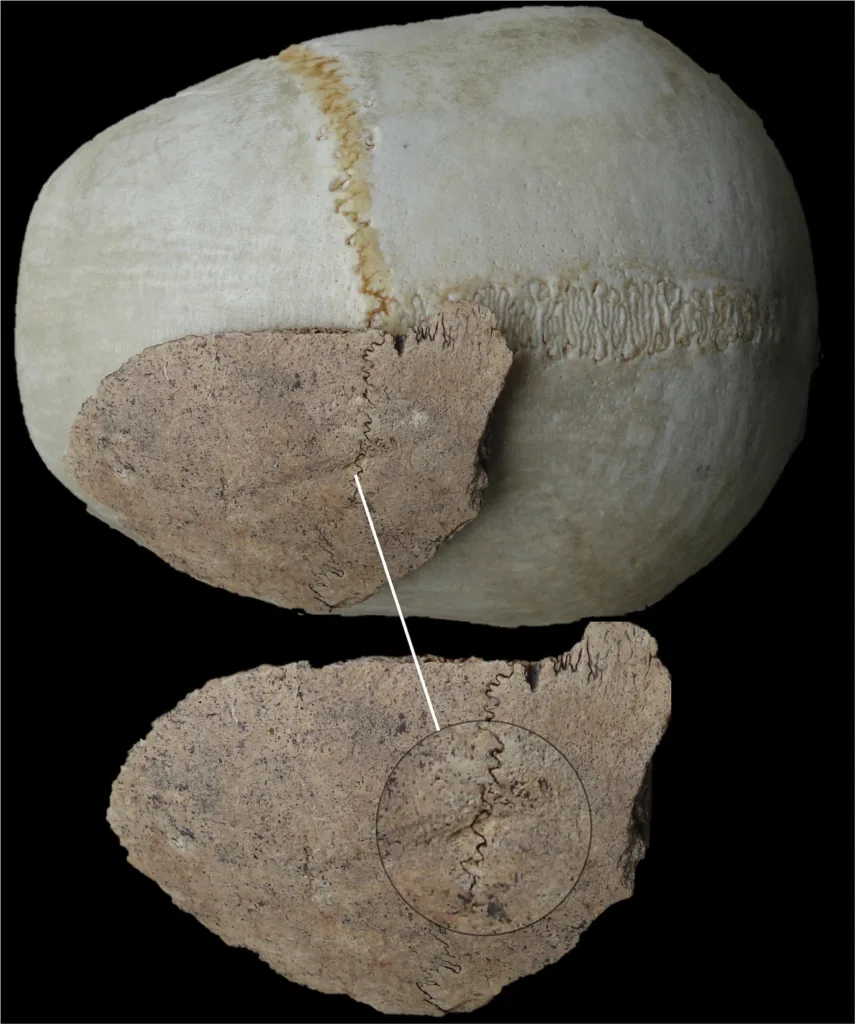
Another case involves the skull of a genetically female individual aged between 18 and 25. She had suffered dental disease and other signs of physiological stress, while damage near the left eye may represent a sharp-force injury from a sword or axe. By the time her cranium entered a well, the skull had already lost the lower jaw and may have remained exposed for some time.
The evidence does not allow every injury to become a murder story. The authors repeatedly caution that fragmented and weathered bones can make diagnosis difficult, and falls, hazardous work or other accidents could explain some fractures.
Some people survived violence again and again
One of the most revealing individuals came from Gammel Lejre in Denmark, a major Viking Age royal and feasting centre. The 30- to 35-year-old man carried evidence of five separate episodes of trauma during his life.
He had healed fractures of the clavicle and forearm, the latter compatible with a possible defensive fracture caused when someone raises an arm to shield the head. His skull also carried three blunt-force injuries at different stages of healing. At least one blow had struck only weeks or months before his death, while two others occurred earlier.
The researchers see cases like this as more than isolated wounds. Several individuals combine repeated trauma with dental disease, poorly healed fractures, degenerative joint changes, and other signs of physiological or mechanical stress. Such patterns raise the possibility that some people lived under persistent social or physical vulnerability long before death.
The authors describe this broader process as structural or “slow” violence. Their argument does not require every injury to result from an attack; hard labour, inadequate care, nutritional stress, social inequality and repeated exposure to dangerous situations could combine over a lifetime.
The violence may be more common than the bones suggest
The team calculated a trauma rate of 6.25 percent among the settlement remains, a figure broadly comparable with rates reported from Viking Age cemetery populations. Yet that comparison may hide an important difference.
Most cemetery skeletons preserve much of the body. Many of the settlement remains consist of a single bone. Finding a similar trauma rate in a dataset where most of the skeleton is missing suggests that the surviving evidence probably underestimates the true level of injury.
The geographical pattern reinforces that possibility. The 12 injured individuals came from about 23 percent of the identified sites where communities deposited human remains within settlements. In other words, nearly one in four communities represented in this unusual dataset contained remains carrying skeletal evidence of serious trauma.
Most identifiable victims were adult males, although the sample also includes genetically female individuals and the two- to four-year-old boy. The researchers therefore resist reducing the evidence to a single group or a single explanation.
Why put human remains beneath a floor?
Warfare provides one possibility. Spears, swords, axes and other weapons belonged to the martial world of Iron and Viking Age Scandinavia, and some injuries could certainly have occurred during conflict.
But warfare alone cannot explain what happened afterward. Why would communities bring back only part of one person’s body, expose it for months, break it apart, or place it beneath a building rather than perform the customary funerary rites?
Domestic or interpersonal violence offers another possibility, as do punishment and efforts to assert social dominance. Yet those explanations also struggle to account for the deliberate treatment of the dead.
The researchers therefore see a ritual dimension running through at least some of these cases. The wider BODY-POLITICS dataset includes drilled skull fragments that may have served as amulets, a human femur found among comb-making materials, and human bones deliberately incorporated into architectural practices. In some circumstances, a dead body or body part seems to have acquired a function beyond burial.
The authors stop short of calling every case human sacrifice. They suggest a wider range of possibilities, from socially sanctioned killings and executions to ritual responses that transformed people who had already died through warfare or interpersonal violence.
What emerges is a group almost invisible in conventional archaeological narratives. These people did not receive the funerary treatment usually associated with their communities. Some lived with repeated injury and physical stress; some appear to have died violently, and afterward their bodies could remain in the places where daily life continued.
People repaired houses, held gatherings and carried out ordinary work while human remains lay in wells, yard pits, postholes and beneath their floors. By looking beyond graves, the study reveals a side of Iron and Viking Age Scandinavia that monumental burials, weapons and treasures alone could never show.
Eriksen, M.H., Tamorri, V., Louka, V. et al. Broken bodies in Domestic Spaces: Direct and Structural Violence in an Atypical Mortuary Dataset from Iron and Viking Age Scandinavia. J Archaeol Method Theory 34, 26 (2027). https://doi.org/10.1007/s10816-026-09817-w
