
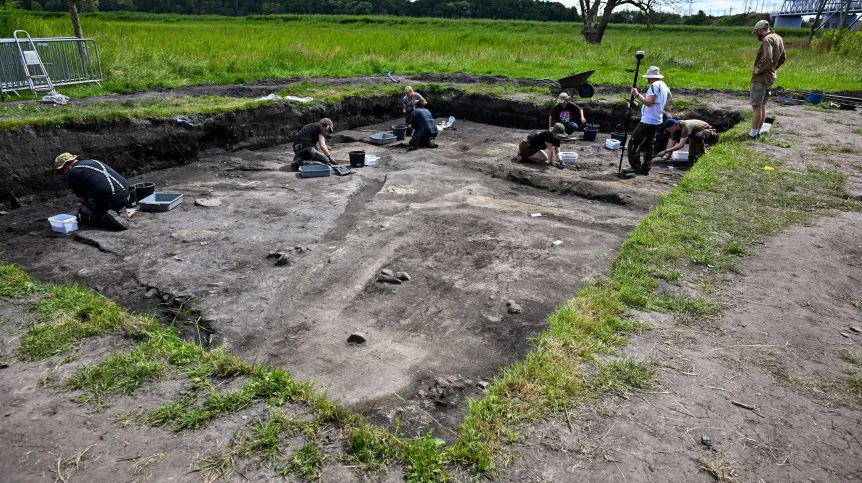
Archaeologists excavating the early medieval town of Wolin in northwestern Poland have uncovered four 1,000-year-old houses whose unusual construction closely resembles buildings found in Scandinavian Viking Age trading settlements around the Baltic Sea.
The structures were discovered at Srebrne Wzgórze, or Silver Hill, a northern district of medieval Wolin believed to have contained workshops, markets and buildings connected with the town’s waterfront. Researchers say the houses probably date to the 11th or early 12th century, although their precise relationship with Wolin’s Scandinavian population has yet to be established.
The excavation is part of a three-year Polish-Danish research project led by the Institute of Archaeology and Ethnology of the Polish Academy of Sciences and Aarhus University. Its central goals are to locate Wolin’s early medieval harbour and determine how Scandinavian merchants, craftspeople and settlers contributed to the town’s development.
Houses unlike anything previously found in Wolin
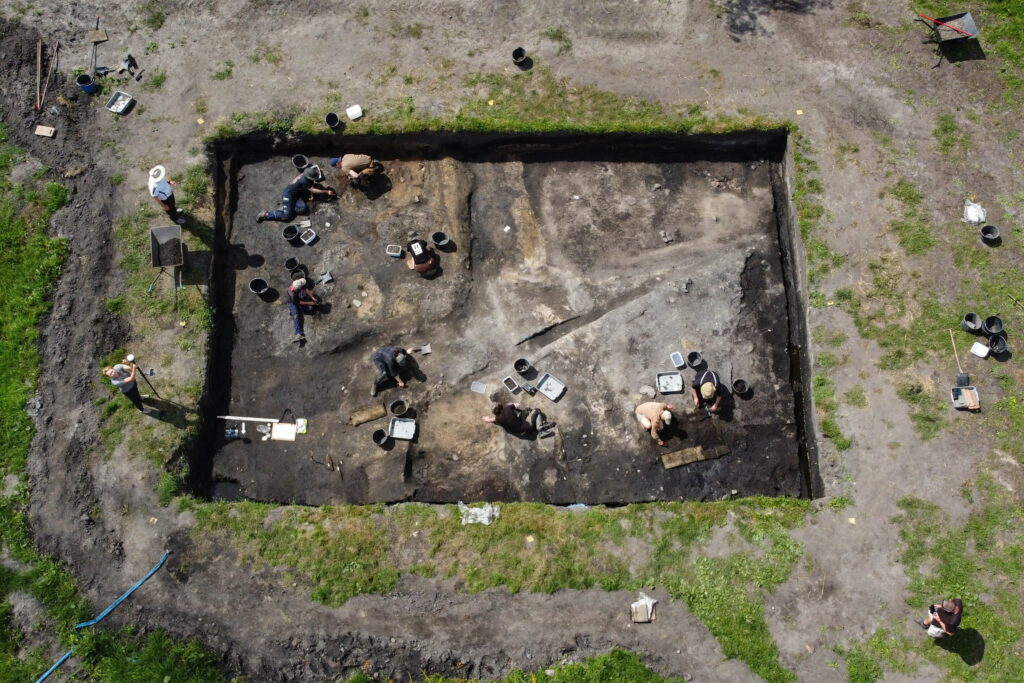
The archaeologists identified four well-preserved house remains, along with traces of three more damaged structures. Each building stood on a platform made from clay and sand, measuring approximately five by five metres.
Some contained hearths, while others had ovens. The houses were packed closely together and separated by drainage channels only about 50 centimetres wide.
According to excavation leader Dr Wojciech Filipowiak of the Polish Academy of Sciences, this method of construction had not previously been documented in Wolin. Comparable buildings, however, are known from craft and commercial settlements established by Scandinavians along the Baltic coast.
“The construction closely resembles those known from Scandinavian craft and trading centres founded by Vikings around the Baltic Sea,” Filipowiak told the Polish Press Agency. He cautioned that the similarity does not yet prove that Scandinavians built or occupied the houses, but it may indicate that Silver Hill held particular importance for Wolin’s Norse-connected communities.
Norwegian whetstones and evidence of long-distance trade
The buildings were surrounded by material from everyday urban life. Finds included amber and glass beads, metal ornaments, clay spindle whorls, pottery, animal bones and whetstones made from stone quarried in Norway.
The Norwegian whetstones provide particularly clear evidence of the maritime networks that connected Wolin with Scandinavia. Such tools were widely transported from Norwegian quarries and used to sharpen knives, axes and other iron implements.
Archaeologists also recovered vessels carrying enigmatic marks. Some may have been potters’ symbols passed between generations, while others have been interpreted as signs with ritual or magical meanings. Their actual purpose remains uncertain.
Earlier work at Silver Hill produced tens of thousands of pottery fragments and animal bones, as well as more than 500 registered objects, including ornaments, beads and imported whetstones. Together, the finds portray a densely occupied district where craft production and international exchange formed part of daily life.
A major Baltic trading town
Wolin developed near the mouth of the Oder River, where waterways connected the Baltic Sea with the interior of Central Europe. By the middle of the ninth century, it had grown into one of the largest trading ports on the southern Baltic coast.
Merchants and travellers passing through the town could exchange raw materials, crafted goods and imported objects moving between Scandinavia, the Slavic territories, Western Europe and regions farther east. Wolin remained an important port and urban centre between approximately the ninth and 12th centuries.
Its population was probably culturally mixed. Archaeological research suggests that Wolin retained a predominantly Slavic core but also attracted Scandinavians, possibly including merchants, craftspeople and members of a short-lived Norse elite.
This makes Wolin different from several other Baltic trading settlements that appear to have supported more permanent Scandinavian family communities. The town may instead have contained neighbouring Slavic and Scandinavian districts connected by trade and political alliances.
Was Wolin the legendary Viking stronghold of Jomsborg?
Wolin has long been associated with Jomsborg, a fortified Viking stronghold described in medieval Scandinavian sagas. The stories portray Jomsborg as the home of an elite warrior brotherhood known as the Jomsvikings.
Some researchers have proposed that the legendary fortress stood in or near Wolin. Danish King Harald Bluetooth is also said in later traditions to have died there around AD 987. Yet no archaeological discovery has conclusively proved that Wolin and Jomsborg were the same place.
The new excavations are therefore important not because they confirm the legends, but because they may reveal how Scandinavian groups actually lived and worked alongside the town’s Slavic population.
Archaeologists search for Wolin’s lost harbour
The excavation team is now moving beneath the house remains into tenth-century deposits. Deeper layers from the ninth and possibly late eighth centuries could reach the period when Wolin first emerged as a major settlement.
Researchers believe the remains of an early harbour quay may lie below the Scandinavian-style houses. Finding it would allow them to reconstruct the organisation of the waterfront and examine how ships, goods and people entered the city.
The waterlogged, oxygen-poor soil at Silver Hill offers exceptional preservation. Wood, streets and other organic structures that normally disappear can survive for centuries in these conditions. Since early medieval towns in this part of Europe were constructed largely from timber, the deeper deposits may contain some of Wolin’s most revealing archaeological evidence.
The discovery does not yet prove that Silver Hill was a separate Viking quarter. It does, however, strengthen the possibility that Scandinavian building traditions and commercial networks influenced at least part of the district.
As excavations descend toward Wolin’s earliest levels, archaeologists may finally determine whether the town developed from a single Slavic centre or grew from several communities living around one of the Baltic’s busiest medieval ports.
Cover Image Credit: Marcin Bielecki/PAP
