
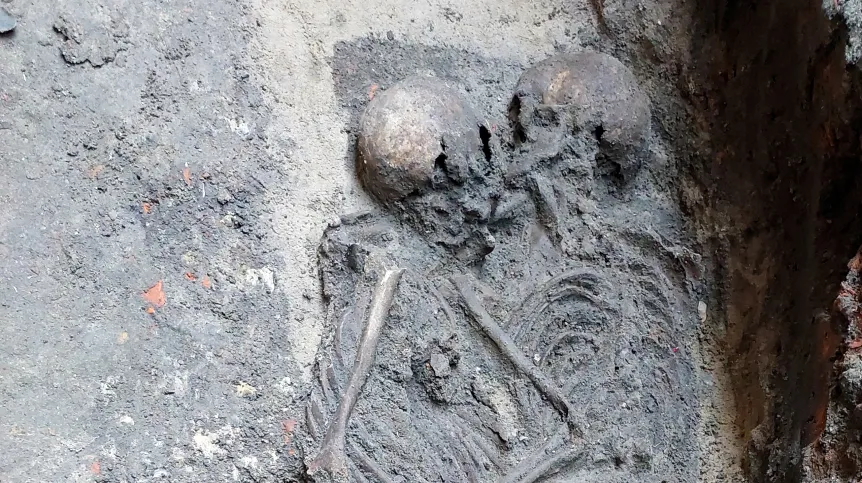
A medieval grave discovered beside the Cathedral of the Exaltation of the Holy Cross in Opole, Poland, has revealed one of the most unusual burial stories yet documented from the region. Two adults, laid to rest close together in what appeared to be an embrace, have now been identified through ancient DNA analysis as two women who were not closely related.
The discovery is significant because it marks the first genetically confirmed medieval burial in Poland involving two individuals of the same sex. It does not provide a simple answer about who the women were to each other. Instead, it opens a more difficult and more interesting question: what kind of relationship was strong enough for a medieval community to bury two unrelated women together?
A grave that stood out beside Opole’s cathedral
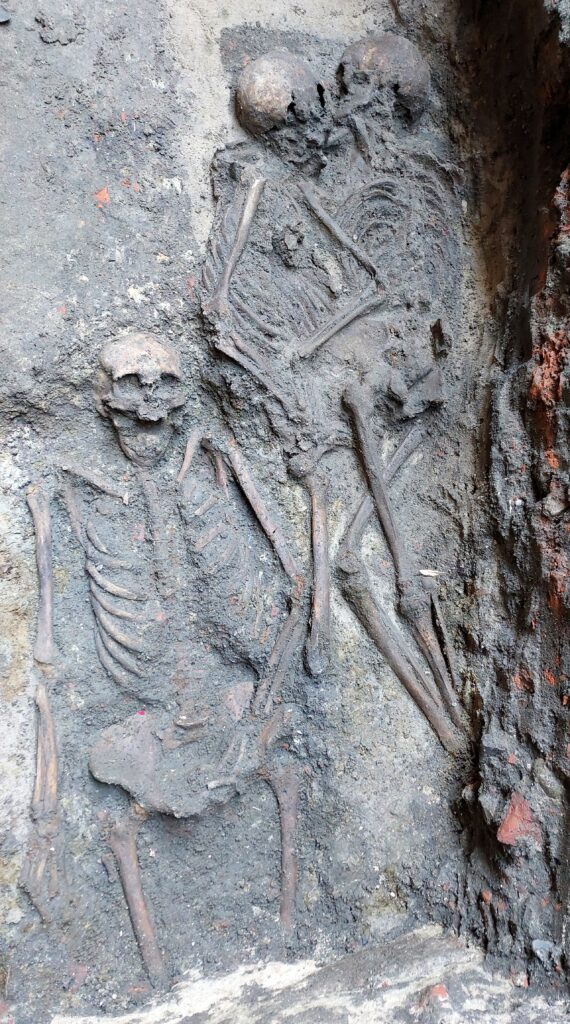
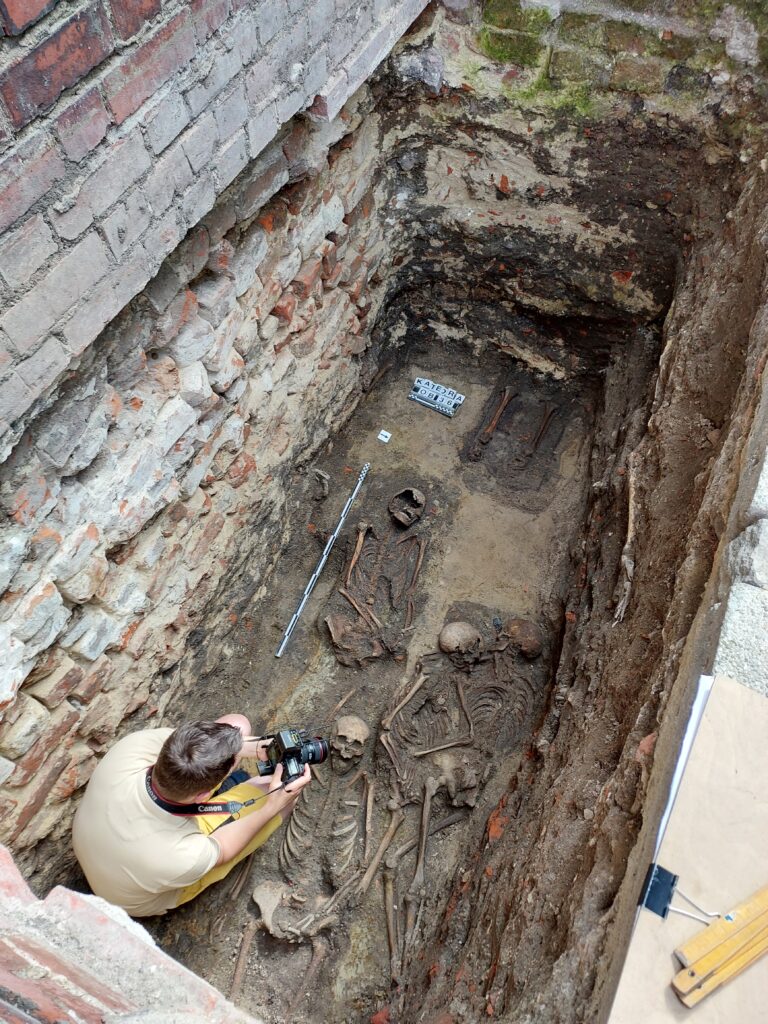
The burial was found during archaeological work near the walls of Opole’s medieval cathedral. From the beginning, the grave drew attention because of the position of the bodies. One individual had been placed in a more conventional burial posture, while the other lay in an unusual position, close enough to create the impression of physical closeness.
Researchers found no evidence of violence, no sign of a rushed burial, and no indication that the grave had been filled carelessly. This matters. In medieval Christian burial practice, adults were usually buried individually, especially in formal cemetery contexts. A shared grave therefore demands explanation, particularly when the arrangement appears deliberate rather than accidental.
The location also adds weight to the find. Burial near a cathedral was not an ordinary choice. Such places were often associated with status, religious importance, or strong ties to the local community. These two women were not treated as outcasts. Their grave suggests that someone made a conscious decision to place them together in a meaningful setting.
DNA changed the interpretation of the burial
Because the bones were poorly preserved, determining biological sex through anatomy alone was uncertain. Researchers from the Ludwik Hirszfeld Institute of Immunology and Experimental Therapy of the Polish Academy of Sciences in Wrocław, Christian-Albrechts University in Kiel, and the University of Opole therefore turned to ancient DNA.
The genetic results showed that both individuals were female. The same analysis also ruled out close biological kinship up to the third degree. In other words, the women were not sisters, mother and daughter, or close cousins.
That finding challenges one of the most common assumptions in burial archaeology. Double graves are often interpreted as family burials, especially when the individuals are placed close together. In this case, genetics forced researchers to move beyond the usual explanation.
Dr. Agata Cieślik, the first author of the study, noted that adult double burials have been recorded at several archaeological sites in Poland, but they have rarely been tested with archaeogenetic methods. This grave, she explained, is the first medieval Polish case in which a same-sex double burial has been confirmed genetically.
Not sisters, but not strangers either
The most tempting interpretation would be to describe the grave as that of two lovers. The burial position may invite that reading, especially for modern audiences. But the researchers remain cautious, and that caution is important.
Archaeology can identify bodies, burial positions, genetic kinship, and cultural setting. It cannot easily recover private emotions. The women may have shared a religious role, belonged to the same household, served a similar social function, or been connected through a local crisis such as illness. The absence of mass burial features, however, suggests this was not simply an emergency disposal of bodies.
Medieval communities were built on more than bloodlines. Guilds, neighborhoods, religious brotherhoods, charitable networks, and household ties could create bonds that shaped daily life and death. In a town such as medieval Opole, where civic, religious, and social communities overlapped, closeness could have been defined in ways that are difficult to translate into modern categories.
This is what makes the grave so valuable. It does not only tell us that two women died. It shows that their community considered their relationship important enough to preserve in death.
A rare window into medieval social bonds
Other medieval double burials in Poland have often involved spouses, mothers and children, or other relatives. In some cases, hands were placed toward each other or bodies arranged in ways that suggested emotional closeness. But same-sex, non-kin adult burials are much harder to interpret because they fall outside the most familiar archaeological patterns.
The Opole burial therefore widens the discussion. It suggests that medieval ideas of belonging may have been broader than modern reconstructions sometimes allow. Family mattered deeply, but so did religious affiliation, shared work, neighborhood loyalty, and emotional companionship.
The study also shows why DNA analysis has become essential in modern archaeology. Without genetic testing, the two individuals might have been described as a male-female pair, close relatives, or simply an unusual grave. Instead, the evidence points to something more complex: two unrelated women, buried together with care, in a place of significance.
For now, the precise nature of their relationship remains unknown. That uncertainty is not a weakness of the discovery. It is the reason the grave matters. Eight centuries after their burial, the two women from Opole are forcing scholars to ask better questions about intimacy, identity, and community in the medieval world.
Cover ımage Credit: Dr. Magdalena Przysiężna-Pizarska/ Uniwersytet Opolski
