
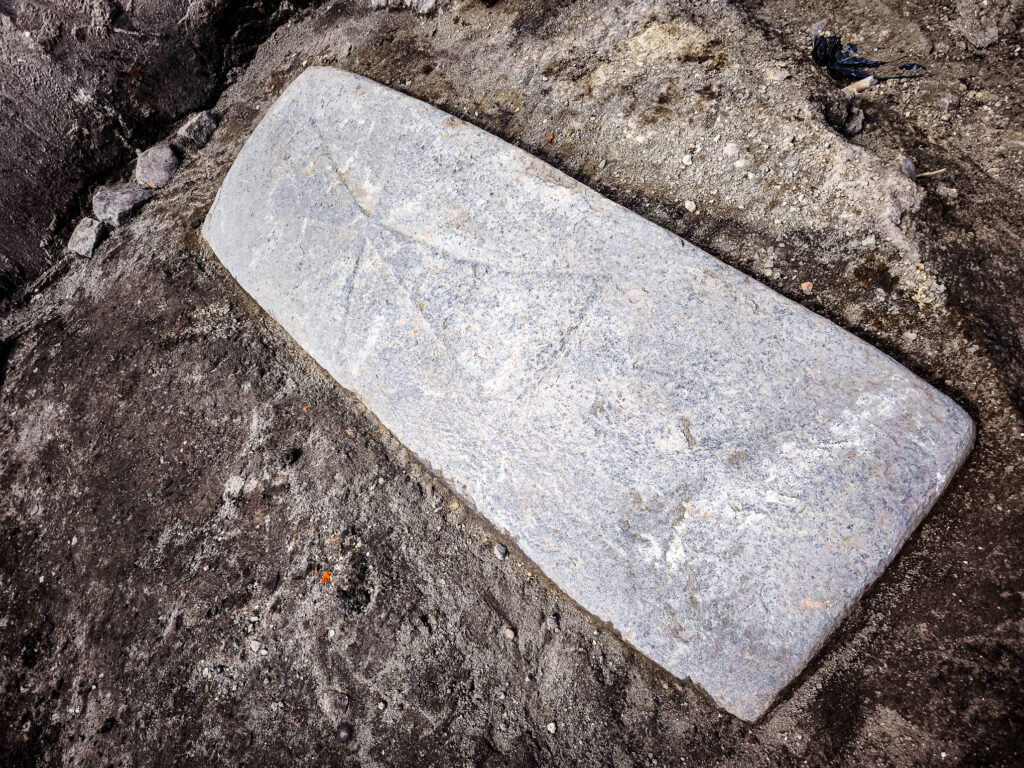
A granite tombstone carved with a Latin cross has been uncovered beneath the former Miś ice cream parlor in central Gdańsk, adding another remarkable chapter to one of Poland’s most closely watched medieval excavations.
The slab, dated to the 13th century, was found at the site between Grodzka and Sukiennicza streets, an area once associated with the medieval stronghold of Gdańsk. Archaeologists believe a burial may still lie beneath the stone, though the grave has not yet been fully explored. The discovery is the first major find reported from the site this season and follows last year’s sensational uncovering of a knight’s tombstone and the remains of what may be the oldest wooden church yet identified in the Polish lands.
A Cross-Carved Stone in the Heart of Medieval Gdańsk
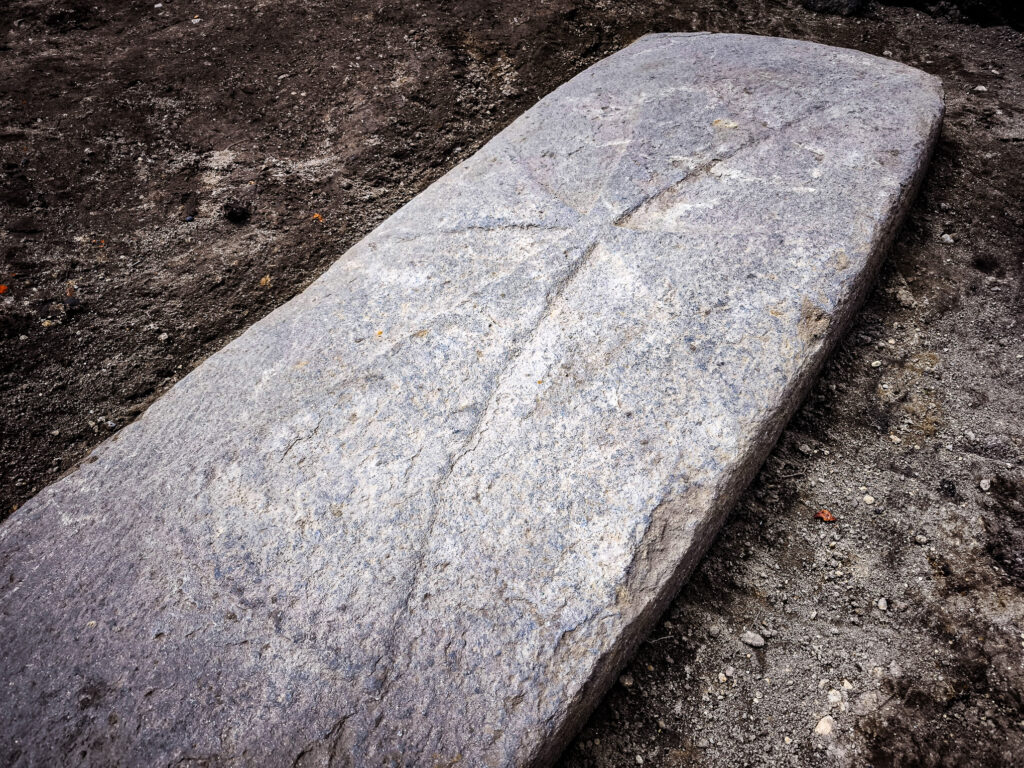
The newly discovered tombstone is made of granite and bears a relief of a Latin cross. According to heritage officials, it is one of seven medieval tombstones found so far at the site, including three decorated with crosses.
Such slabs are not ordinary grave markers. In 13th-century Gdańsk, stone tombstones were costly objects, usually reserved for people of elevated social rank. The person buried beneath this latest slab may therefore have belonged to the local elite, possibly a cleric or another prominent member of the settlement around the church.
The location gives the find additional weight. Before the Teutonic Knights seized Gdańsk in 1308, the area was part of the power center of the Pomeranian dukes. That means the cross-carved slab most likely belongs to the earlier ducal phase of the city’s history, not to the later Teutonic period.
Not Necessarily a Teutonic Knight
Large granite tombstones with carved crosses are often linked in the public imagination with the Teutonic Knights. Two similar slabs previously found in the Gdańsk stronghold area were transferred years ago to the Malbork Castle Museum, where they can easily be mistaken by visitors for Teutonic grave markers.
The chronology, however, points in another direction. The newly found slab dates to the 13th century, while the Teutonic takeover of Gdańsk came only after 1308. For that reason, researchers consider it far more likely that the tomb belonged to someone from the community that lived under the authority of the Pomeranian dukes.
That distinction matters. It places the burial in a formative period before Gdańsk became a major contested city between Polish, Pomeranian, and Teutonic interests. The grave may help illuminate the social hierarchy of the early town, when Christianity, ducal authority, and Baltic trade networks were already reshaping the settlement.
The Church Beneath the Ice Cream Parlor
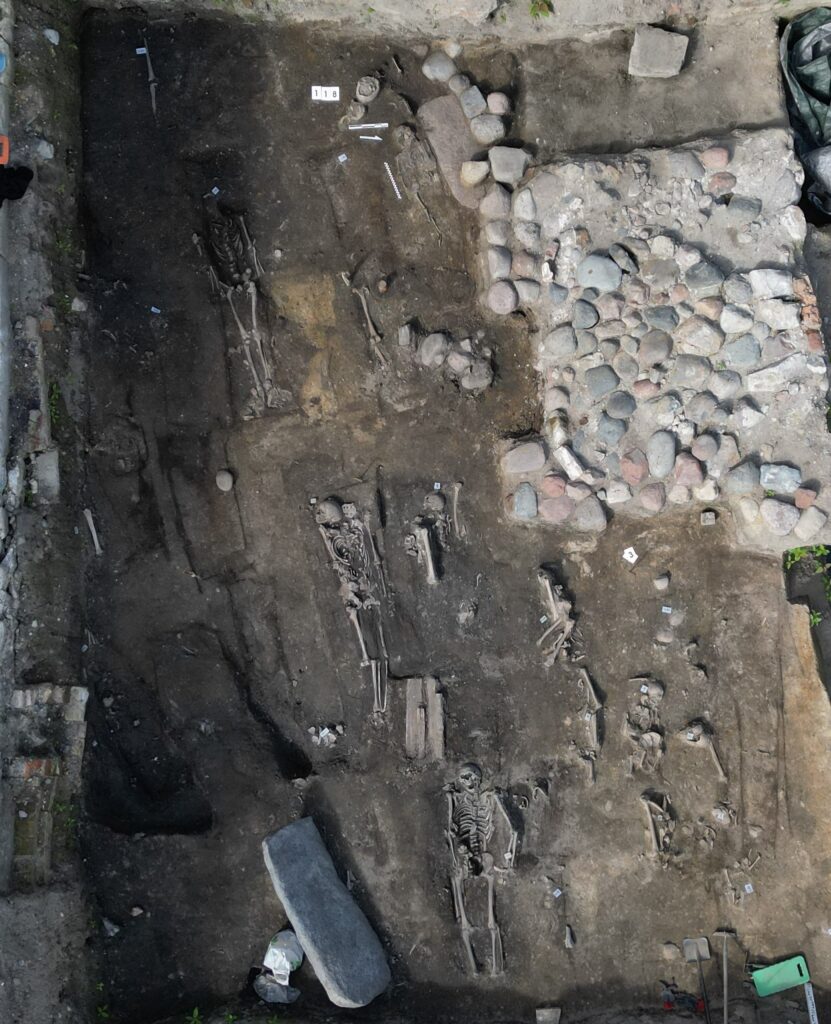
The former Miś ice cream parlor was once a familiar local landmark. Beneath it, archaeologists have revealed a much older and far more important landscape: a medieval cemetery, elite burials, wooden buildings, and the remains of an early church.
The church, discovered during earlier excavation work, was built from oak beams dated to around 1140. It appears to have been constructed on a Greek-cross plan, an unusual and symbolically charged layout. Researchers believe it may have been the first church in Gdańsk dedicated to the Virgin Mary.
Some Polish reports have described the structure as the oldest wooden church discovered in the Polish lands. This does not mean it was the oldest Christian church in Poland overall, but it does make the Gdańsk find exceptional. Wooden architecture rarely survives so clearly from this period, and dendrochronological dating gives the discovery unusual precision.
Around the church, archaeologists have identified more than 200 graves. Most were modest burials, but a small number were marked by stone slabs. These marked graves suggest that the cemetery served not only ordinary residents but also people of authority, wealth, or religious importance.
The Knight’s Grave That Drew Global Attention
The same excavation gained international attention last year when archaeologists uncovered a limestone tombstone showing a knight in chainmail, holding a sword and shield. The slab was made from imported Gotland limestone, a material that points to long-distance trade and high status.
Beneath it lay the complete skeleton of a tall man by medieval standards. Although his identity remains unknown, the burial suggested a person of considerable importance, perhaps connected to the ducal elite or the military world of 13th-century Gdańsk.
The newly found cross-carved slab now broadens that story. Instead of a single spectacular grave, the site is beginning to look like a privileged burial zone attached to one of the earliest Christian monuments in the city.
A Rare Window into Gdańsk Before the Teutonic Era
The excavation at Grodzka and Sukiennicza is changing how scholars view medieval Gdańsk. It shows that before the famous brick architecture of the later city, there was already a complex wooden settlement with religious, political, and social significance.
The latest tombstone does not solve the mystery of who was buried there. It sharpens the question. Under a place once known for ice cream, archaeologists are uncovering the earliest layers of Gdańsk’s Christian and urban identity, one grave at a time.
Pomorski Wojewódzki Konserwator Zabytków
Cover Image credit: Pomorski Wojewódzki Konserwator Zabytków via Facebook
